Brass life

NigelM

Well-Known Member
Another day another lesson and a whole load more questions.

Working up a load for the 6.5 Lapua using R15 and 129 ABLR's.

Did a ladder test, found what looked like a lower and higher node, chose the high node as I am trying to extract maximum energy for Stags and shot some groups.

At 38 grains I tried 3 seating depths and none of them delivered better than 0.8". Tried 3 depths at 38.3 grains, still no better than 0.8".

I had been wondering about neck tension as the bullets were easier than usual to seat, very little pressure required. I have recently neck turned all the brass to get a consistent 13 thou wall thickness. New brass runs 13 thou to 14 thou so I just made it all consistent. This brass is 6 times fired. Never annealed.

So I took 5 brand new cases and loaded them up at 38.3 grains and the seating depth I had a feeling was probably right, and shot a 0.4" 5 shot group.
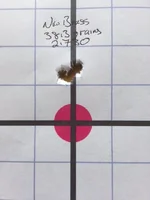
IMG_0861.webp

How do you get pictures up the right way???

So now I'm wondering

1. Is the brass past it's best and I need to buy a new box?
2. Is the brass fine but I need a new .287 bushing to allow for the neck turning?

What is the collective wisdom?
 
Another day another lesson and a whole load more questions.

Working up a load for the 6.5 Lapua using R15 and 129 ABLR's.

Did a ladder test, found what looked like a lower and higher node, chose the high node as I am trying to extract maximum energy for Stags and shot some groups.

At 38 grains I tried 3 seating depths and none of them delivered better than 0.8". Tried 3 depths at 38.3 grains, still no better than 0.8".

I had been wondering about neck tension as the bullets were easier than usual to seat, very little pressure required. I have recently neck turned all the brass to get a consistent 13 thou wall thickness. New brass runs 13 thou to 14 thou so I just made it all consistent. This brass is 6 times fired. Never annealed.

So I took 5 brand new cases and loaded them up at 38.3 grains and the seating depth I had a feeling was probably right, and shot a 0.4" 5 shot group.

View attachment 86956

How do you get pictures up the right way???

So now I'm wondering

1. Is the brass past it's best and I need to buy a new box?
2. Is the brass fine but I need a new .287 bushing to allow for the neck turning?

What is the collective wisdom?
I would anneal the brass to start. Skipping neck turning to remove .001" of run out would be the next.~Muir
 
Don't know about collectives or wisdom, but annealing the old brass is surely worth a try, it's bound to be work hardened after six firings.

Ian
 
No wisdom or font of knowledge, but I get my brass annealed after about five loadings. What is your loaded round neck size ? I originally went by the Redding guideline of buying a bush .001 smaller, but after advice from more experienced folks and a certain local celebrity gun plumber I moved to the .287 bush, and it definitely helped.
Could need a slightly slower powder for the heavier bullet ?
 
Thanks for all the replies guys.

I will take myself to a darkened room and anneal tomorrow morning. The turning means I need to get a .287 bushing to achieve the same neck tension as the new brass. I will then shoot a group and see if I can match the performance of the new brass.

Maxwal, I think I have proven to myself that as long as the brass is right the powder, load and seating depth work very well, I'm really just trying to work out whether my brass is shot or not.
 
Why a darkened room? please don't say it's so you can see the case start to glow a dull red, that's too hot.

Buy/steal/borrow some Tempilaq, 650c just below the shoulder or 750c inside the neck.
 
Why a darkened room? please don't say it's so you can see the case start to glow a dull red, that's too hot.

Buy/steal/borrow some Tempilaq, 650c just below the shoulder or 750c inside the neck.

I have heard more opinions on what temperature you should anneal at than you can jump over.

Muir, do you agree with this advice?
 
You don't need a dark room N, you will see the colour change quite easily (blue'ish just below the shoulder)
I just rotate cases with my fingers & the blowtorch flame played onto case neck/shoulder.
I don't know how long the timing is with a 6.5x47L case, but my .25-06 cases take around 14 secs.
No quenching, just drop them onto a cloth (not on your jorries)
Your cases are much shorter, so a glove to hold the case might be an idea??

When done and cases cool, give the inside of the case neck a going over with a bronze brush prior to sizing.
If they make one for your cartridge, a Lee Factory Crimp die may well go a long way to evening up neck tension. It's inexpensive & well worth a try.
Certainly works for me.
 
Last edited:
I've found that on heating, colour differs widely between batches & manufacturers of the brass & it also depends on the surface condition before annealing (how it was cleaned & how long ago too) - so much so that it isn't an acceptable measure of brass temperature IMHO.
Tempilaq works, but can give false results if applied to the outside of a case that is heated in a gas flame. Applied inside the case neck is better in this respect, but difficult in practice.
These days I set my annealer up using scrap brass (cleaned) & find a setting that just starts the flame showing yellow, (zinc burning off) I then shorten the time a bit so the flame remains constant (almost) & run the good cases through at that setting.

Ian
 
I've found that on heating, colour differs widely between batches & manufacturers of the brass & it also depends on the surface condition before annealing (how it was cleaned & how long ago too) - so much so that it isn't an acceptable measure of brass temperature IMH
This may well be true. I know if you anneal when brass is dirty, it turns 'a horrible hard to remove black' where heat is applied, so, I always clean my brass thoroughly first.
You'll definitely see a colour change in any event, just two or three seconds after the change & it's done.

Tempilaq works, but can give false results if applied to the outside of a case that is heated in a gas flame. Applied inside the case neck is better in this respect, but difficult in practice.
I've never used Tempilaq, but have always anneald by eye sight and 'feel'. As far as I know, my results have always been good enough. My case life is extended many fold. And the round to round POI extremely consistent.

These days I set my annealer up using scrap brass (cleaned) & find a setting that just starts the flame showing yellow, (zinc burning off) I then shorten the time a bit so the flame remains constant (almost) & run the good cases through at that setting.
I don't have one of these, - don't shoot anywhere near enough now to invest in one. If you do, then I'd guess it's worthwhile.

Ian

Give it a go on just a few cases, say ten maybe, to begin with & see how you get on. For the cheapness of the process and the not small benefit you gain, it has to be worth a try.
It really is easy peasy .. don't be daunted by the process or all the techno speak, you have nothing to lose other than a few cases you are considering binning & a little time.

Yorric probably anneals many more cases than I do, and so, is more experienced.
However, I've done it my simple easy way for many years and it works.
You soon get to know what's right and what's not.
 
Last edited:
Thanks for your help guys. This will be the mission for the morning. Although I will not be able to test the results until I get hold of a .287 bushing, so next weekend.
 
How do you get pictures up the right way???

Before uploading the picture make sure the original image is the right way up.

If I need to rotate the image I right click it in the folder where it is held on my pc and select open with..
Then choose Microsoft office, paint or a program of your choice (office is the better program to use for editing, or photo gallery for just rotating).
Once it is open you can rotate the image then save it without any loss of picture quality
 
Before uploading the picture make sure the original image is the right way up.

If I need to rotate the image I right click it in the folder where it is held on my pc and select open with..
Then choose Microsoft office, paint or a program of your choice (office is the better program to use for editing, or photo gallery for just rotating).
Once it is open you can rotate the image then save it without any loss of picture quality


My original images are the right way up. But when they upload to SD they end up on their side more often than not. It's all very odd.
 
Another day another lesson and a whole load more questions.

Working up a load for the 6.5 Lapua using R15 and 129 ABLR's.

Did a ladder test, found what looked like a lower and higher node, chose the high node as I am trying to extract maximum energy for Stags and shot some groups.

At 38 grains I tried 3 seating depths and none of them delivered better than 0.8". Tried 3 depths at 38.3 grains, still no better than 0.8".

I had been wondering about neck tension as the bullets were easier than usual to seat, very little pressure required. I have recently neck turned all the brass to get a consistent 13 thou wall thickness. New brass runs 13 thou to 14 thou so I just made it all consistent. This brass is 6 times fired. Never annealed.

So I took 5 brand new cases and loaded them up at 38.3 grains and the seating depth I had a feeling was probably right, and shot a 0.4" 5 shot group.

View attachment 86956

How do you get pictures up the right way???

So now I'm wondering

1. Is the brass past it's best and I need to buy a new box?
2. Is the brass fine but I need a new .287 bushing to allow for the neck turning?

What is the collective wisdom?
I would just go out and shoot the deer, the old brass is plenty accurate for the job
 
I'd not worry too much about neck turning at this stage unless shooting competition. Annealing is worth it as it can lengthen brass life and improve consistency between shots, often considerably judging by the tightening up of measured SD and ES I've seen from annealing. I used to anneal every 4 or 5 firings. I now anneal every firing to help consistency of neck tension. I don't worry so much for my stalking rounds, but for my LR work, everything is annealed every firing. Life-span...for my .308, I would expect 15 firings at least if annealing. I don't use especially hot loads, but as with many things reloading, brass life can depend on factors such as powder and charge used, plus things like attention to setting dies correctly to minimise headspace. The hotter the loads, the more I'd expect brass life to suffer due to the higher pressures and hammering that the brass gets.
 
I'd not worry too much about neck turning at this stage unless shooting competition.
I found setting the F/L sizing die absolutely correctly so the case neck & expander rod were exactly centralised (there is a way to do this) more beneficial than neck turning IMO.
I use a Lee universal de-capping die to remove primers as one operation, then resize with the decap/expander backed right off so it just clears through the case neck.

Annealing is worth it as it can lengthen brass life and improve consistency between shots, often considerably judging by the tightening up of measured SD and ES I've seen from annealing. I used to anneal every 4 or 5 firings. I now anneal every firing to help consistency of neck tension.
Definitely annealing increases brass life significantly.
I don't know it in itself reduces ES & SD, but do know the use of the Lee FC dies does aid neck tension considerably, giving more consistent ES/SD.

I don't worry so much for my stalking rounds, but for my LR work, everything is annealed every firing. Life-span...for my .308, I would expect 15 firings at least if annealing. I don't use especially hot loads, but as with many things reloading, brass life can depend on factors such as powder and charge used, plus things like attention to setting dies correctly to minimise headspace..
Setting your F/L sizing die to 'fired case headspace' dimensions is a must. Definitely works the brass much, much less. Hardly works it more than neck sizing and Aids case life along with annealing.

The hotter the loads, the more I'd expect brass life to suffer due to the higher pressures and hammering that the brass gets.
I fully accept this, but am still using brass loaded many times and thirteen years old while still delivering excellent results, - this with 'hot' loads. So, spending time looking after your brass is certainly worthwhile and delivers great performance.

I hope the comments based on my experience help.
Cheers. d.
 
Back
Top
