Can we talk Roe scouring please?

wytonpjs

Well-Known Member
So, I have only been a regular deer stalker for the last 10 years and every day remains a school day stalking-wise in some way or another. Over the years, I have associated scouring in roe to be a seasonal/dietary issue, with our recent cold snap and wet conditions contributing to the current flush of observations. I however have a significantly more experienced stalking colleague who sees this very differently, associating it with internal parasites/infection and avidly promotes culling. I am more relaxed about this and always factor in the overall condition, size, age of the animal, the prevailing weather conditions and the time of year, invariably leaving nature to take its course on most occasions. Winter invariably seems to bring on some instances but usually its more a Spring occurrence which I associate with the change in nutrient content of the grass upsetting their stomachs.

Having been advised of a buck kid in poor condition by rough shooters earlier this week, I caught up with it yesterday, dead. It was indeed in very poor condition, probably weighed less than 5 kg and had I believe only succumbed the previous night when temperatures were below zero. Had I caught up with this animal earlier, his overall condition was such that I would not have hesitated to take a welfare cull out of season. This provoked the usual diatribe of shoot them followed by "adults normally get over it but kids normally don't especially buck kids".

Now, my question to experienced roe stalkers, and particularly our very helpful veterinarians on here from a scientific perspective (@Buchan et al), what is your experience of roe scouring please? In our cull forecasting we take account of fecundity so my view is that this is nothing new just sadly part of the natural cycle, or am I missing something here?
 
I suppose you are refering to what we call roe sickness/illness in Denmark.

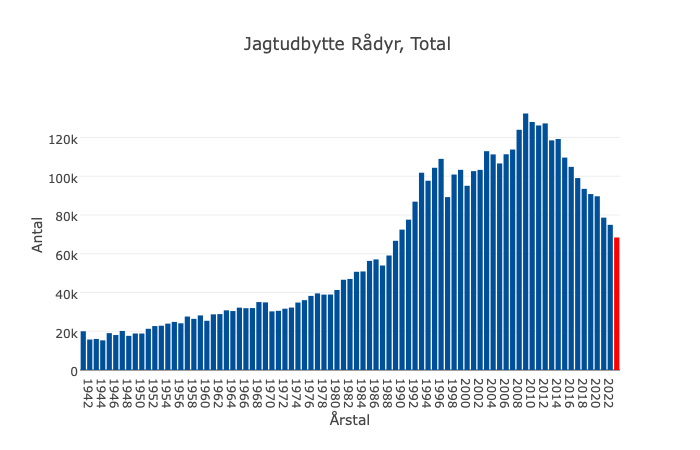
On Funen the entire population collapsed in 2004-2008 due to this, and it has since spread to all parts of Denmark.
The population on Funen is still only about a third of what it was at peak before 2004.
Probably for the best, it was wild!

One research after another have found no definitive answer to what it is.

Bacteria, virus, parasites, poor management and bad feeding feeding practice is the official explanation.
There is a lot of speculation on zinc and copper from pig manure, also the rape has been mentioned.

Below is statistics on total reported roe deer shot.
The outtake is still in decline.
newplot-2-1.png


In my area there is not a lot of roe, and they are not managed per se.
We occasionally see a roe with diarrhea, usually in the spring as described above, they seem to get over it though.
 
Last edited:
I have often wondered whether the sheer volume of cattle sharing the same downland habitat may have anything to do with this?
 
I had this in some deer a few years ago. They tested positive for yersinionis.
I think I may have posted it back then.
 
I had this in some deer a few years ago. They tested positive for yersinionis.
I think I may have posted it back then.
Had to look that one up :thumb:

To save others:

Yersiniosis is a bacterial infection of the intestines, usually caused by Yersinia enterocolitica, contracted by eating contaminated food (especially undercooked pork) or unpasteurized milk, or through contact with infected animals or people.Symptoms include fever, abdominal pain (often lower right, mimicking appendicitis), and diarrhea (bloody in kids), lasting 1-3 weeks. Management focuses on hydration, but severe cases might need antibiotics; prevention involves good hygiene, especially handwashing after handling pork and raw foods,
 
Round here there were a lot of roe scouring and in poor condition a year or two ago. IIRC the post mortems came back with a high worm burden. Certain sheep and cow worms can also infect deer.

Flush of spring grass could do it but that's more common in livestock being turned out to grass in spring having been housed indoors, and suddenly getting a richer diet. Deer which have been out year round don't get the same sudden exposure.

Many of the worm species will increase in spring, plus with pregnancy there is a degree of immunosuppression so there is often an uptick in shedding of worm eggs ready to infect the young.

Simplest answer would be to get a sample of the scouring analysed for worm eggs and maybe inspect the intestinal contents for worms.
 
Round here there were a lot of roe scouring and in poor condition a year or two ago. IIRC the post mortems came back with a high worm burden. Certain sheep and cow worms can also infect deer.

Flush of spring grass could do it but that's more common in livestock being turned out to grass in spring having been housed indoors, and suddenly getting a richer diet. Deer which have been out year round don't get the same sudden exposure.

Many of the worm species will increase in spring, plus with pregnancy there is a degree of immunosuppression so there is often an uptick in shedding of worm eggs ready to infect the young.

Simplest answer would be to get a sample of the scouring analysed for worm eggs and maybe inspect the intestinal contents for worms.
Thank you :tiphat:
 
Depending on the condition of the deer could easily be johnes too so maybe bear that in mind
As @308rws points out, the area where I’m seeing this primarily is heavily grazed using a rolling penning system and the possibility of some transmission from cattle has always been a thought in the back of my mind. However, in the 10 years that I have stalked that ground I have never seen any ill cattle, indeed they always look in the best of condition as they are fattened up on the ground.

For others:

Johne's disease (also called paratuberculosis) is a chronic, contagious bacterial infection in ruminants (like cattle) causing severe weight loss, diarrhea, and reduced milk production, ultimately leading to death; it's caused by Mycobacterium avium subspecies paratuberculosis (MAP) and usually infects young animals, but signs appear years later, spreading via feces and contaminated milk/colostrum.
 
I suppose you are refering to what we call roe sickness/illness in Denmark.

On Funen the entire population collapsed in 2004-2008 due to this, and it has since spread to all parts of Denmark.
The population on Funen is still only about a third of what it was at peak before 2004.
Probably for the best, it was wild!

One research after another have found no definitive answer to what it is.

Bacteria, virus, parasites, poor management and bad feeding feeding practice is the official explanation.
There is a lot of speculation on zinc and copper from pig manure, also the rape has been mentioned.

Below is statistics on total reported roe deer shot.
The outtake is still in decline.
newplot-2-1.png


In my area there is not a lot of roe, and they are not managed per se.
We occasionally see a roe with diarrhea, usually in the spring as described above, they seem to get over it though.
Copper has only been allowed as a trace element for sometime at very low levels.
Zinc Oxide for prevention of post weaning scour has more recently been banned.
So the uptake theoretically in grazing should diminish to very low levels if it were a contributing factor.

All because of the export market and REACH compliance.
 
I’ve not seen scoured roe, but I only shoot a few deer a year. Parasites are possible, but they only cause scour in farm animals when in large quantities on grazing. Light burdens of parasites are well tolerated. Rape/brassicas and new pasture should be a short lived scour. That leaves some of the bacterial causes, Johne’s is usually older animals but Salmonella, Campylobacter or Yersenia can hit younger ones. There’s a new deer disease book out, which I may need to buy!
 
I’ve not seen scoured roe, but I only shoot a few deer a year. Parasites are possible, but they only cause scour in farm animals when in large quantities on grazing. Light burdens of parasites are well tolerated. Rape/brassicas and new pasture should be a short lived scour. That leaves some of the bacterial causes, Johne’s is usually older animals but Salmonella, Campylobacter or Yersenia can hit younger ones. There’s a new deer disease book out, which I may need to buy!
Pictures of the dead roe buck kid showing the extent of the scouring:

IMG_1627.webpE12181AF-2A74-46C1-9B4F-B89539DABCF2.webp
 
Last edited:
Oddly the only one l have shot recently with severe green scour,was different symptons,bloated,but very poor body condition.
March '25.
On clover/grass ley.
Very non aware of me,the two with it scarpered.
 
Oddly the only one l have shot recently with severe green scour,was different symptoms, bloated, but very poor body condition.
March '25.
On clover/grass ley.
Very non aware of me,the two with it scarpered.
This sounds like the Spring scour I associate with new grass, often with fertiliser added, affecting their stomachs after a winter on poor grass.
 
This sounds like the Spring scour I associate with new grass, often with fertiliser added, affecting their stomachs after a winter on poor grass.
Winter 24/25 was wet and minging so correct.
The first growth was hit hard in the grass fields by the groups of roe,and the oat crops left from harvest for the wild birds.
The mature deer did better on it.
Had not been fertilized at that point,was a few weeks later.
 
Back
Top