Cast bullet success!

'm curious. What kind of comps are you talking of?

I believe in the contemporary comps at the time of the issue of the 577/450 Martini Henry - so the 1880s - but also today's comps using "arms in the spirit of the original" run by the likes of the British HBSA, the (British) NRA Historic Arms Register at the annual Trafalgar Meeting, and etc., using arms from the 19th Century.
 
Sorry! I didn't finish the thought on the bore rider! Yes, the bullet dimensions are more critical in that the nose of the bullet must ride on the tops of the rifling lands to be effective. If unsupported, the nose is free to woggle about instead of being guided by the bore. Undersized noses work fine at low velocity loadings but seldom produce good results at high velocity. My "quick test" of a bore-riding bullet's suitability is to drop it into the muzzle, nose first. If it drops to the driving bands with a clank, it's too small. If it's a push fit, ok.

When buying a mold for a new rifle, it's best to measure the bore diameter directly. You can tap in a pure lead slug and find a way to accurately measure the areas between the lands, or borrow a small hole gage from a machinist. (engineer) Most bore riding 30 cals will have a nose diameter of .301" if done correctly. If your bore is larger than nominal and you still want to use a bore rider, you simply switch to a mold designed for the .303 British. Sized to .310 or .311 inches these bullets will take up the nose slack. Part of the beauty of cast bullets is the ability to custom fit the bullet to your throat.:cool:~Muir
OK I've got to double check my terminology here. By 'tops of the rifling lands' do you mean major diameter of the bore - as in groove diameter, or what measures 0.243" on my rifle?
Then when you say 'bore diameter', is that the daimeter between the rifling - the minor diameter, or what meaures roughly 0.237 in my rifle?
Use my measurements as an example - what would I want a bore riding bullet for my 243 to measure?

Sorry for asking you to repeat yourself, but I don't feel I've got a good grasp on barrel diameter nomenclature
 
Harry,
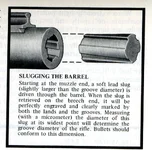
This would be the smaller of the two dimensions. I took this from an old Lyman catalog.
Barrel slugging.webp

The smaller diameter of the slug pictured represents the distance from the top of one rifling land, to the top of the opposite land; or the "bore" diameter. (It gets rough when measuring a 5 groove Enfield barrel!)
~Muir
 
I believe in the contemporary comps at the time of the issue of the 577/450 Martini Henry - so the 1880s - but also today's comps using "arms in the spirit of the original" run by the likes of the British HBSA, the (British) NRA Historic Arms Register at the annual Trafalgar Meeting, and etc., using arms from the 19th Century.

Gottcha. I owned a 577/450 Martini but only had some collector-grade ancient foil cased rounds and a badly rusted bore. I still own a Snider 577 that I shoot every once in a while. It's a 2 band with an excellent barrel. Remarkably accurate, actually. I never entertained the thought of breech-seating for it.... especially after spending $250 for the FL reloading dies!! Nowadays Lee makes them for $50!! :banghead:~Muir
 
Right, so using my 243 as an example - I would want a nose diameter of .237 and a driving band diameter of .243? I thnk I've got it...
 
You actually want a .238 x .244 as a minimum. Larger can be dealt with but undersized is worthless.~Muir
 
used to cast for my 444 marlin with great results using 300 grain hollow points and 420 grainers was amazed at accuracy over 100 yds using reloader 7
 
I built a couple of 1-18" twist 444's and RL-7 was a top choice. I think 4895 was in the running, too. What rifle, if I may ask?~Muir
 
Back
Top