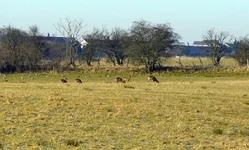
Deer eating young trees

All I will say is if you use tubes get the right bloody size whenever I see new planting done in my area which is full of fallow they put 4 foot tubes on and wonder why the get browsed off.


Lots shoot the buck that, if left to live, keeps all others away. Once he is shot, new pretenders to the kingdom come along, and start thrashing, albeit never the old departed’s former fraying stocks, thus multiplying the damage. 🤔

But for sure there’s also an absolute world of poor sylviculture out there, and most foresters fail to understand the tree preferential league according to deer, with oak at the top and Sitka spruce and birch at the bottom. This leads to problems, mostly caused by (their) failure to consider these aspects, whilst the deer and stalker get the blame; the more they shoot, the more damage is created, unless you more or less wipe them out - even though leaving the boss buck would let the overwhelming majority of the trees get away without excessive damage...

Another trend is deer fencing which is grant compliant, but not deer proof.
In the Netherlands they take the sensible approach as advocated by @sillbeam s land manager, it’s certainly the most cost effective way to get them going, as @Greenmist suggests.

But I’ve seen 30% damage done by hares, and the response from the local conservancy was to try to shoot the deer harder, because the hares were out of season! The oaks there are little higher than when they were first planted, the birch are 6- 7metres tall. Fencing keeps as many deer in as out, birch don’t need fencing IME.
IMG_4363.jpeg
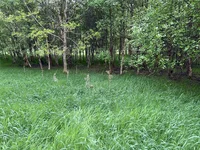
Oaks among birch - lack of thought or indifference ( the ‘forester’ directs but it’s not their money they squander) is the underlying cause, wholly avoidable.

Deer are naturally a woodland creature, and their habits are predictable and known. Whiles the best is to leave one to do the protection of the plantation for you, but to the man with the hammer, every problem looks like a nail.
 
Last edited:
All I will say is if you use tubes get the right bloody size whenever I see new planting done in my area which is full of fallow they put 4 foot tubes on and wonder why the get browsed off.
I’ve watched roe stand in mounded ground and eat the ‘lettuce’ coming out of the 1,2m tubes, so what about the NFE planting using 1,2 tubes where red deer frequent the forests? - Clown world, yet it goes on, the taxpayer funds the ‘effort’…
 
The prolific use of tree shelters and guards is a joke. What’s worse is lazy foresters and landowners failing to recover them.

They were never meant to be used on large sites over 1ha but they go on as default.

Trico is an inert lanolin based deer repellent that works, needs to be applied twice a year. Another tool at our disposal.
 
I have watch Roe many time eat trees i have seen does hammer them when the snow is on the ground Mainly Roe here. I do worry about the tubes and there negative effect on woodlands and the environment. I also wounder if we should be applying the same % to amenity woods as we do commercial woodland. I good bit of deer damage will open up the woods and let light in and the woods will be more natural. I also wounder about the claims for Grants of producing natural regeneration. With absolutely no deer management. Yes trees will grow but only the ones deer dont like to me that's not natural at all.peri ENDOFDOESEASON031.webp
 
Looks like a well established tree.
Looks like an already dead tree. Note the fungus growth. I will agree with above comments that deer certainly do eat young trees/saplings and cause permanent growth. Especially to commercial plantations where leading shoot is eaten causing multiple stems to form. Consistent browsing leads to permanent stunting of growth rendering plants to bushes rather than trees. I would be interested in the species of trees planted as deer seem to avoid certain trees.
 
All quite interesting,
The specifications for the grant schemes mean that the FC or whoever need to sign off on the planting specs stating tree type and percentage as well as the type of protection being used (birch is used as a nurse for oak, but it needs to be managed)
The Nat regen grants also specify numbers and species to be achieved.
You also need to put in your open space and can claim for high seats.
Landowners will also be asked to collect their non bio tree shelters as part of the UKForestry Standard.
A very interesting comment that I heard the other day was that AI is being used to look at planting and felling schemes across the UK and the wider Countryside to detect changes in land use and management.
 
Right enough, I saw a bit of planting that was done on an estate as an experiment with a lot of roe kicking around.

Sitka Spruce planted outside a fence no protection at all and they grew pretty well, barely any browsing damage (but Sitka is pretty resistant to browsing, it’s the other trees in the scheme that tend to get hammered)
That's interesting, of course the species of trees will be a factor.
 
I have watch Roe many time eat trees i have seen does hammer them when the snow is on the ground Mainly Roe here. I do worry about the tubes and there negative effect on woodlands and the environment. I also wounder if we should be applying the same % to amenity woods as we do commercial woodland. I good bit of deer damage will open up the woods and let light in and the woods will be more natural. I also wounder about the claims for Grants of producing natural regeneration. With absolutely no deer management. Yes trees will grow but only the ones deer dont like to me that's not natural at all.View attachment 424371

Several factors are at play which might be considered. I've seen and shot deer in plantations where the only thing above the hard frozen snowscape was sitka spruce tips, yet tracking the deers footprint trail back through the plantation, I saw the deer didn't touch a single one of them, preferring to starve rather than eat the sitka tips (I found several that had perished due to lack of food at that time - the early part of 2011), or pick at very frost bitten heather at the young sitka tree base where the weak winter sun had burned enough of the snow back to expose a fragment of what lies below.

Don't forget soil types either. The better soil types grow more attractive forage, which in turn attract deer. Scots pine regenerated is typically less attractive as compared to transplants from the better soils of the nursery plug transplants, and they likely smell more attractive as a result. The Scots pine are often quoted as a heavily browsed (native) species, by native species deer, which is natural, of course, but there's a world of difference between the relative attraction of regenerating existing Scots pine and alternatively planted plug seedlings, or according to the deer here, anyhow.

The moral? Regional variations obviate absolutes.

It's instructive too, to take time to identify what is inside the rumen of a recently culled deer, that of course being what it has eaten most recently. Seasonal variations also apply, eg the deer will ignore some plants until just at the point when they are most attractive, then feed a lot on them. This is usually when the plant in question has its natural sugar content at its highest. This can apply to non-tree foodstuffs too, like roses or lupins, wild raspberries, chanterelles and other fungi. Somewhat akin to studying which species of fly the trout are selecting during a hatch or hatches of multiple species of insect, this can be educational for the careful observer.

1750018158549.jpeg
 
Several factors are at play which might be considered. I've seen and shot deer in plantations where the only thing above the hard frozen snowscape was sitka spruce tips, yet tracking the deers footprint trail back through the plantation, I saw the deer didn't touch a single one of them, preferring to starve rather than eat the sitka tips (I found several that had perished due to lack of food at that time - the early part of 2011), or pick at very frost bitten heather at the young sitka tree base where the weak winter sun had burned enough of the snow back to expose a fragment of what lies below.

Don't forget soil types either. The better soil types grow more attractive forage, which in turn attract deer. Scots pine regenerated is typically less attractive as compared to transplants from the better soils of the nursery plug transplants, and they likely smell more attractive as a result. The Scots pine are often quoted as a heavily browsed (native) species, by native species deer, which is natural, of course, but there's a world of difference between the relative attraction of regenerating existing Scots pine and alternatively planted plug seedlings, or according to the deer here, anyhow.

The moral? Regional variations obviate absolutes.

It's instructive too, to take time to identify what is inside the rumen of a recently culled deer, that of course being what it has eaten most recently. Seasonal variations also apply, eg the deer will ignore some plants until just at the point when they are most attractive, then feed a lot on them. This is usually when the plant in question has its natural sugar content at its highest. This can apply to non-tree foodstuffs too, like roses or lupins, wild raspberries, chanterelles and other fungi. Somewhat akin to studying which species of fly the trout are selecting during a hatch or hatches of multiple species of insect, this can be educational for the careful observer.

View attachment 424400
This is the first hand, observational,experience based opinion I was trying to glean 👍🏻
 
I have watch Roe many time eat trees i have seen does hammer them when the snow is on the ground Mainly Roe here. I do worry about the tubes and there negative effect on woodlands and the environment. I also wounder if we should be applying the same % to amenity woods as we do commercial woodland. I good bit of deer damage will open up the woods and let light in and the woods will be more natural. I also wounder about the claims for Grants of producing natural regeneration. With absolutely no deer management. Yes trees will grow but only the ones deer dont like to me that's not natural at all.View attachment 424371
You need to buy one of those houses DB, and shoot them out of the bedroom window!
 
1750024613292.webp
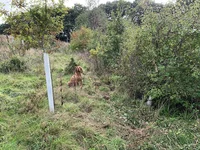
The area to the right of the lovely dog was protected with a 2m high plastic fence and the area on the left had every 5th tree tubed. This was done as it was not felt that deer where having a detrimental impact on the trees …. Nothing else to say really
 
I had a walk around a decent sized farm last week where they have an almost zero tolerance of deer, the difference in their hedgerows and woodland undergrowth was incredible to see.
It opened my eyes somewhat.
 
A recent conversation with a very experienced land manager got me thinking about deer and young trees.
Does anyone have evidence, or personally witnessed deer damaging newly planted trees, hardwood or softwood ?
The general consensus is to protect young trees with tubes and fence off the entire area but he has a very different approach....plant trees with stakes for support but nothing else, no tubes, no fence etc.
After five years + the planted trees are thriving, even though deer are prolific in the area.
I can't help wondering if the "norm" is borne out of opinion rather than fact.
I have watched roe and sika eating the tops off young trees many times.

I have done deer habitat impact assessments many, many times and have seen acres of young trees lost to deer, and have seen whole woodlands with no natural regen because of deer.

It really isn’t a myth. If deer density is high, the trees get hammered.
 
Like all things Deer matters it really depends. Deer have fine mouths so are naturally browsers - some species more so than others. Like any ruminant they will naturally select the most nutrient rich leaf matter available to them. If they are restricted into one area, and the best available food is young trees, these will be eaten, but some species of trees much more so than others.

On the bits of ground I manage there have several acres of trees planted. They have not done so well in the tops of the hills - but that’s much more due to weather and in particular lack of water when trees were still young. But ten years on we now have nice dense plantations of broadleaves and conifers. There were losses due to deer and hares, but overall where the growing conditions are good we have well established woodlands that will need thinning in the next few years to allow decent timber to grow.

We have made a point of leaving the dominant bucks which has kept rubbing damage to a minimum from all the youngsters coming and strutting their stuff.
 
Back
Top