Sheprador1973
Well-Known Member
Hi all. Hope you and your families are all safe and well through this horrible time.
Like some of you I'm guessing, I've been finding new and increasingly unusual ways to pass the time in between family duties, working from home and painting the house. Some have been posted briefly on the Things to do in lockdown thread and its great to see all the creative ways that others have been occupying their time with.
Anyway, following on from one particular project, I thought Id do a brief thread on knife sharpeners for the few of you who may be interested. I know there's 1000 ways to sharpen a knife and each to their own with it, but I think I've created something that works for me...
So a couple of years back I was looking at getting a 'sharpening system' as I wasn't getting on with Japanese whetstones for anything other than scandi grind bushcraft knives. My problem was holding the knife at a consistent angle. As such I looked at the options, eventually settling for (100% down to very low budget) an Amazon knockoff 'Edge Pro' sharpener with stones. Now they are very cheaply made and the supplied Ruixin stones are awful but it did for a time and I was able to sharpen knives much more consistently. I instantly disliked the rubber suckers for holding the unit down so, in my wisdom, epoxied it to the ugliest piece of timber I could find. Anyway, I've been meaning to do something about it so started looking at what I don't get on with regarding the design:
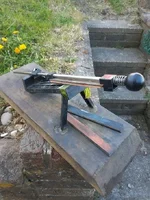
1) The rubber suckers are a pain and don't work well at all, and not at all on anything but a very smooth worktop.
2) The whole unit is plastic so flexes and shifts across a work surface too easily.
3) The supplies stones are rubbish.
4) The plastic swivel bracket that holds the sliding arm is weak and snapped on mine within a year.
5) You have to hold the knife steady with one hand while operating the sliding arm with the other. As such the knife blade often moves.
6) There is no built in compensator for stones of different thicknesses (causing slight differences in grinding angle).
7) The plastic frame for some reason doesn't hold protective tape well (to stop the blade's underside getting scratched.
8) The sliding arm has no stops so I often found myself running off each end of the stones, damaging both the bevel and the stones.
9) The vertical bar that is used to adjust the angle (height of sliding arm bracket) is not fixed, moves and is inconsistent.
Long story, I decided to build my own rather than buying one based on the EP design but hopefully addressing some of the above issues. (I also liked the look of the Hapstone knife clamp systems that allow you to rotate the knife 180 degrees for each side of the knife but that idea will have to wait for another time).
So the frame is built from 4mm, 6mm & 10mm mild steel which was measured and then cut up using and angle grinder. Edges were smoothed on the belt sander and then welded together (badly) by me. I was so ashamed of the look of the welding (its strong, just ugly) that I used car body filler to smooth the joins. Being all metal the frame is heavy, so this is not very portable, but rock solid in use at home where I do 99% of my sharpening.
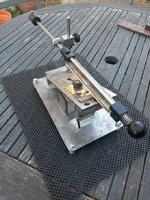
The adjustable legs are made from 8mm threaded bar that I drilled and tapped (on a drill press as sadly I don't have a lathe) for 5mm hex nuts to allow for very small adjustments in level. The rubber feet work well alone but sat on a kitchen anti-slip mat the whole thing doesn't budge at all.
To hold the blade in place 3x rare earth (12mm diameter) are sunk into the blade rest. These are set 1mm below the blade level to avoid wear and scratching of the blade.
The bracket that holds the sliding arm is made from 20mm square steel bar with an 8mm PTFE lined rod end bearing to make the action as friction free as possible.
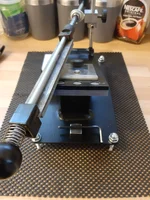
The sliding arm itself is modified from the original to provide stone stops to prevent over running the blade. This length is adjustable depending on blade depth.
Different thicknesses of stone can be compensated for using the 'drill stop' method. I made my own heavy duty version and tapped it to secure using a 5mm hex head bolt.
The stones were replaced with genuine EP stones in grits 120, 220, 400, 600 and 1000. These are much better but still a slight compromise, especially the 120. I'm looking at the Russian Gritomatic stones which have a good rep or the US Moldmaster stones if I can get them imported for the future.
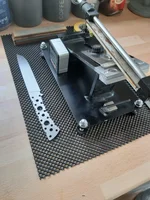
Overall it seems to work great. Can be operated one handed, which is good for me as I seem more consistent using just my right hand. It is almost silent in use which is nice too. Its very easy to adjust for bevel angle, blade width and thickness of stone too. Only tested so far on a knackered old sea fishing fillet knife but its done a good job I reckon. Next step is to modify the sliding arm to allow for different lengths of stones to allow for those from other manufacturers that might be easier to find or better value for money.
Like I say just passing the time...but maybe someone might find it interesting. ATB, Shep
Like some of you I'm guessing, I've been finding new and increasingly unusual ways to pass the time in between family duties, working from home and painting the house. Some have been posted briefly on the Things to do in lockdown thread and its great to see all the creative ways that others have been occupying their time with.
Anyway, following on from one particular project, I thought Id do a brief thread on knife sharpeners for the few of you who may be interested. I know there's 1000 ways to sharpen a knife and each to their own with it, but I think I've created something that works for me...
So a couple of years back I was looking at getting a 'sharpening system' as I wasn't getting on with Japanese whetstones for anything other than scandi grind bushcraft knives. My problem was holding the knife at a consistent angle. As such I looked at the options, eventually settling for (100% down to very low budget) an Amazon knockoff 'Edge Pro' sharpener with stones. Now they are very cheaply made and the supplied Ruixin stones are awful but it did for a time and I was able to sharpen knives much more consistently. I instantly disliked the rubber suckers for holding the unit down so, in my wisdom, epoxied it to the ugliest piece of timber I could find. Anyway, I've been meaning to do something about it so started looking at what I don't get on with regarding the design:
1) The rubber suckers are a pain and don't work well at all, and not at all on anything but a very smooth worktop.
2) The whole unit is plastic so flexes and shifts across a work surface too easily.
3) The supplies stones are rubbish.
4) The plastic swivel bracket that holds the sliding arm is weak and snapped on mine within a year.
5) You have to hold the knife steady with one hand while operating the sliding arm with the other. As such the knife blade often moves.
6) There is no built in compensator for stones of different thicknesses (causing slight differences in grinding angle).
7) The plastic frame for some reason doesn't hold protective tape well (to stop the blade's underside getting scratched.
8) The sliding arm has no stops so I often found myself running off each end of the stones, damaging both the bevel and the stones.
9) The vertical bar that is used to adjust the angle (height of sliding arm bracket) is not fixed, moves and is inconsistent.
Long story, I decided to build my own rather than buying one based on the EP design but hopefully addressing some of the above issues. (I also liked the look of the Hapstone knife clamp systems that allow you to rotate the knife 180 degrees for each side of the knife but that idea will have to wait for another time).
So the frame is built from 4mm, 6mm & 10mm mild steel which was measured and then cut up using and angle grinder. Edges were smoothed on the belt sander and then welded together (badly) by me. I was so ashamed of the look of the welding (its strong, just ugly) that I used car body filler to smooth the joins. Being all metal the frame is heavy, so this is not very portable, but rock solid in use at home where I do 99% of my sharpening.
The adjustable legs are made from 8mm threaded bar that I drilled and tapped (on a drill press as sadly I don't have a lathe) for 5mm hex nuts to allow for very small adjustments in level. The rubber feet work well alone but sat on a kitchen anti-slip mat the whole thing doesn't budge at all.
To hold the blade in place 3x rare earth (12mm diameter) are sunk into the blade rest. These are set 1mm below the blade level to avoid wear and scratching of the blade.
The bracket that holds the sliding arm is made from 20mm square steel bar with an 8mm PTFE lined rod end bearing to make the action as friction free as possible.
The sliding arm itself is modified from the original to provide stone stops to prevent over running the blade. This length is adjustable depending on blade depth.
Different thicknesses of stone can be compensated for using the 'drill stop' method. I made my own heavy duty version and tapped it to secure using a 5mm hex head bolt.
The stones were replaced with genuine EP stones in grits 120, 220, 400, 600 and 1000. These are much better but still a slight compromise, especially the 120. I'm looking at the Russian Gritomatic stones which have a good rep or the US Moldmaster stones if I can get them imported for the future.
Overall it seems to work great. Can be operated one handed, which is good for me as I seem more consistent using just my right hand. It is almost silent in use which is nice too. Its very easy to adjust for bevel angle, blade width and thickness of stone too. Only tested so far on a knackered old sea fishing fillet knife but its done a good job I reckon. Next step is to modify the sliding arm to allow for different lengths of stones to allow for those from other manufacturers that might be easier to find or better value for money.
Like I say just passing the time...but maybe someone might find it interesting. ATB, Shep