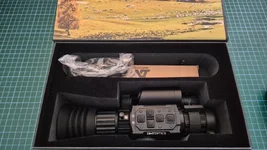
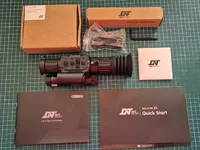
Advice from users please. I’m looking at buying a DNT Zulus V2 to go on my .260, it will mainly be used for morning and evening deer stalking taking advantage of the hour before sunrise and after sunset but occasionally sitting out until mid morning. Also I want it to be able to step in for my nighttime foxing rig if necessary. On the ground I stalk daytime shots would be an absolute max. of 300 metres (infrequent) and nighttime 150 m maximum, most shots are usually around 100 m or less.
My question is do I go for the ZHD520R with it’s greater magnification or the ZHD312R with the wider field of view? As far as I can see there are no differences between the two models apart from magnification.
Advice from users please. I’m looking at buying a DNT Zulus V2 to go on my .260, it will mainly be used for morning and evening deer stalking taking advantage of the hour before sunrise and after sunset but occasionally sitting out until mid morning. Also I want it to be able to step in for my nighttime foxing rig if necessary. On the ground I stalk daytime shots would be an absolute max. of 300 metres (infrequent) and nighttime 150 m maximum, most shots are usually around 100 m or less.
My question is do I go for the ZHD520R with it’s greater magnification or the ZHD312R with the wider field of view? As far as I can see there are no differences between the two models apart from magnification.
Hi Brian, I'm sure you've made a choice now and are putting it to good use. I read part way through the thread and saw it had become a debate on Zulus Vs Alpex or pulsar with some getting quite defensive.
As having owned various Zulus and Alpex 4k and currently owning 2 Zulus V2 (520lrf) and one Alpex 4k, I feel I know them quite well.
One Zulus lives on the 22lr and is so perfectly suited, I think it's welded to the action

The other has been on a foxing rifle but is now about to be moved to the stalking rifle. The Alpex I've used on a stalking rifle and foxing rifle but is now going to be the foxing scope.
Why....many may ask ....
It's not so much about what the scopes are good at, but what they're not so good at (when compared to the other)
The Alpex 4k despite being king of low light, sometimes I've found difficult in morning situations, as the sun is rising and causing lots of shadows etc. It doesn't even have to be sunny, on a grey morning when theres dingy hedgerows with the sky in picture above it can be quite dark and difficult to get a decent image on the scope and that's after playing with the aperture, brightness and contrast etc.
In this same situation I've found the Zulus to just present a bright vibrant image that's not affected by the brighter sky above at all. Simply have the screen brightness up between 3 and 5.
The Zulus doesn't do so well in very last light or moonlight, for me I'm not fussed to go black and white to get the sharper image, as I often did with the Alpex anyway. And when it gets beyond it, the IR is already built in like you mention for that opportunity fox while heading back to the car etc.
The Alpex 4k despite loosing to the Zulus in daytime for me, wins at night, in darkness with IR light, I can sometimes find it takes longer to pick up the target after spotting it. Especially if it's a fox 250-300 yds out. The Alpex has the wider fov, better ambient light gathering and makes better use of IR too so is better imo. Its does better on nights with a bit of moisture in the air, giving a usable image to greater distance. Sometimes I've found the Zulus a struggle to focus (even on base mag at greater distance, if there's a bit of moisture/ humidity). The Alpex also doesn't get so bothered about objects closer (say a tree at 100yds) killing off the IR at a hill behind (say 300yds).The Zulus is quite sensitive to things like that and it can destroy that image your trying to see.
So pros and cons..... I like both, and have always thought of the Alpex as the staking scope due to its low light abilities but I'm now thinking it more the dedicated night scope, and the Zulus for stalking / occasional foxing.