


IntoWind
Active Member
I've had my eye on the DPT muzzle brake for a wee while now and finally took the plunge.
There were a couple of reasons I fancied giving it a go. From a stalking perspective, I was keen to see whether it would make it easier to observe bullet strikes. I've also started dipping a toe into the world of longer-range target shooting, so I was interested in whether it would make it easier to stay on target and spot impacts at distance.
One thing I was conscious of when swapping the end cap for the muzzle brake was the potential increase in noise. My plan was to try and negate some of that by adding an extra baffle at the same time. When the parts arrived, I thought it might be interesting to do some testing and gather some quantifiable data rather than relying purely on my subjective impressions.
For a bit of background, a previous career of mine was in audio engineering, so I have a reasonable understanding of decibel measurements and frequency analysis. That said, this was very much a rough-and-ready test rather than anything approaching a scientific study. I was simply curious to see what differences there might be in measured sound level, perceived loudness, tonality and overall feel between the various DPT configurations.
The rifle was a factory-configured Tikka T3x CTR in 6.5 Creedmoor with a 20" barrel.
For ammunition, I used factory Hornady Outfitter 130gr. It's not a round I've ever been particularly impressed with in this rifle. It generally produces acceptable groups, but often seems to throw a flyer. I've heard similar reports from others shooting heavier copper bullets, whereas my usual 120gr copper round shoots noticeably better. As a result, I was quite happy to sacrifice my remaining rounds in the name of science.
I carried out the testing prone at 100 metres, with my iPhone positioned on a small tripod just to the right of my shoulders to record the sound measurements. The aim was to measure noise from the shooter's position rather than at the muzzle, and compare the relative differences between configurations.
Prior to starting the test, I fired three rounds to warm both the barrel and myself up a little, then allowed the rifle to cool to ambient temperature before beginning the first recorded group.
I also allowed ten minutes between each configuration to let the rifle cool back down to ambient temperature.
For each configuration I fired five rounds. The only exception was the "standard + extra baffle" test, where I fired six rounds because the app failed to record one of the shots.
My standard moderator configuration is a DPT MKII Over-Barrel Non-Magnum consisting of:
1. Standard Configuration
I used a dB meter app on my iPhone and recorded dBC Peak readings. dBC is commonly used when assessing high-level impulse noise such as firearms and provides a measurement that is generally more representative of the overall sound energy present in the report than some other weighting methods. Whilst no single dB measurement perfectly reflects perceived loudness, it felt like the most useful choice for the purposes of this test.
The obvious caveat is that a phone microphone is not calibrated test equipment, and peak dB measurements only tell part of the story. Human hearing is not equally sensitive across all frequencies, meaning perceived loudness is influenced by tonal character as well as sound pressure level. As such, I was interested in perceived sound and feel just as much as the numbers themselves.
It is also worth noting that I was wearing ear defenders throughout the testing. Any comments around perceived loudness or tonal character should therefore be taken in that context, as my impressions were inevitably influenced by the hearing protection as well as the moderator configuration itself.

As can be seen from the table, the left-hand side shows the dBC Peak reading for each shot in each configuration. These were then averaged to give an average peak reading for that configuration.
The next column shows the difference relative to the standard moderator configuration, which averaged 130.6 dBC Peak.
We then have the elevation offset in centimetres, followed by group size in centimetres and MOA. I'll come back to those later.
The move from the standard configuration to the muzzle brake probably provided the clearest A/B comparison of the entire test. As the testing went on, I naturally became more accustomed to the sound and feel of the muzzle brake, but this first transition made the differences particularly apparent.
There was an obvious increase in volume, but perhaps more significantly a change in tonal character. It took on that characteristic muzzle brake "thump", which felt quite different from the more contained report of the standard suppressor configuration.
I could also feel a difference through the rifle itself. Not necessarily better or worse, just different.
At that stage I hadn't looked at any of the recorded measurements, but my immediate impression was that the change was more significant than I had expected. The data ultimately supported that impression, with the muzzle brake configuration producing an average increase of 4.5 dBC Peak over the standard setup.
Moving to the standard configuration plus an additional baffle produced what I thought was one of the more interesting results. Despite adding an extra baffle, the average measured level was actually 0.1 dB higher than the standard configuration. Given the limitations of the test and the relatively small difference, I don't think that tells us the additional baffle is louder. A change that small could easily be explained by slight variations in rifle or phone position between groups. If anything, it serves as a reminder that a single peak dB figure doesn't necessarily capture the whole shooting experience.
Subjectively, the additional baffle did seem to soften the report slightly compared to the standard configuration, despite what the peak dB measurements suggested. Whether that was a genuine reduction in perceived loudness, a change in tonal balance, or simply expectation bias on my part is difficult to say.
Finally, moving to the muzzle brake plus the additional baffle produced a similar tonal shift to the muzzle brake on its own, although not quite as pronounced. Measured peak level was reduced by around 0.6 dB compared to the muzzle brake without the additional baffle.
As a point of interest, I also fired a single unmoderated round. This produced a peak reading of 135 dBC, which is perhaps closer to the muzzle brake configurations than some might expect.
However, this neatly highlights one of the limitations of relying solely on peak dB measurements. Despite the relatively modest difference in measured level, the unmoderated shot was subjectively in a completely different league. It was considerably harsher and less pleasant to shoot than any of the moderated configurations.
There was also a very noticeable increase in muzzle rise and movement off target compared to any of the moderated setups. I didn't attempt to measure this in any way, but the difference was immediately apparent from behind the rifle and reinforced just how much both the moderator and muzzle brake contribute to recoil management.
To me, that illustrates why peak dB figures only tell part of the story. Tonal character clearly plays a significant role in perceived loudness and how comfortable a rifle feels to shoot.
Elevation offset refers to the vertical distance between the point of aim and the centre of the group, rather than the vertical spread of the group itself.
One thing worth noting is that the rifle was not zeroed for this ammunition. It's currently zeroed for my usual stalking round. As such, the absolute elevation offsets aren't particularly meaningful in isolation. Much like the dB readings, I was more interested in the relative differences between configurations and whether changing the moderator configuration resulted in any meaningful shift in point of impact.
One thing that surprised me was how little difference there appeared to be between the various configurations. I had expected to see a more noticeable point of impact shift, particularly with the muzzle brake, having seen others report significant changes when changing configurations.
There did appear to be a slight trend towards the muzzle brake configurations producing a lower elevation offset than their non-brake counterparts. However, the differences were small enough that I'm reluctant to draw any firm conclusions from them. At less than a centimetre at 100 metres, it's entirely possible that we're simply seeing normal group-to-group variation rather than a genuine shift.
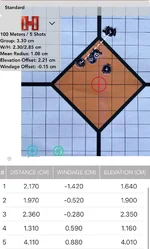
Looking at the groups themselves, the standard configuration produced a result that is fairly typical of what I tend to see from this ammunition. It's an acceptable group and would probably have been hovering around the 1 MOA mark were it not for the flyer in the top right. This is one of the reasons I've never completely fallen in love with this ammunition. It often shoots reasonably well, but there always seems to be the occasional round that wants to go exploring.
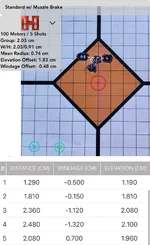
Moving to the muzzle brake, the group tightened up noticeably to around 0.7 MOA. It was a fairly windy day, which may explain some of the horizontal dispersion, but it was still a clear improvement over the standard configuration.
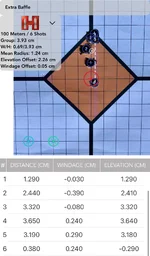
The standard configuration plus the additional baffle produced a result that was again quite typical of what I would expect from this ammunition. It's worth remembering that this was actually a six-shot group rather than five shots due to the missing dB reading. Again, there were one or two shots that opened the group up, whether through shooter error, ammunition variation or a combination of both.
The muzzle brake plus additional baffle configuration produced the best group of the test. Four of the five rounds formed a very tight cluster, with a lone flyer opening the group up to the top right.
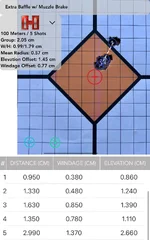
Out of curiosity, I re-ran the analysis excluding the flyer. That produced a 0.76cm group, equivalent to roughly 0.26 MOA at 100 metres. The flyer still counts, of course, but I thought it was an interesting data point and gives some indication of just how tightly those four rounds were clustered.
Of course, we're talking about relatively small sample sizes here and I don't think anyone would claim that a handful of five-shot groups definitively proves one configuration is more accurate than another. However, it was still an interesting result and certainly wasn't what I expected going into the test.
One thing that isn't really captured by the numbers is the overall feel of the rifle. Unlike the dB measurements and group sizes, I didn't have any way of quantifying recoil or return to target, so these observations are entirely subjective. It's also worth remembering that all of this testing was conducted prone at 100 metres, which is a very stable shooting position.
That said, I did notice a consistent difference between the configurations. With the standard moderator setup, both with and without the additional baffle, the rifle tended to recoil slightly upwards and to the left. With the muzzle brake fitted, the recoil impulse felt noticeably straighter and more vertical, with less apparent muzzle movement overall.
It is worth noting that the two best groups of the test were both shot with the muzzle brake fitted. That's certainly not enough data to conclude that the muzzle brake is inherently more accurate, but it's an interesting observation nonetheless.
It's possible that the improved recoil management and more settled shooting characteristics simply made it easier for me to shoot consistently. Equally, by the time I reached the final configuration, I was becoming more accustomed to the increased volume and altered feel of the muzzle brake setup. Either way, both muzzle brake configurations produced the two best groups of the test.
For me, the muzzle brake plus additional baffle configuration was by far the most enjoyable setup to shoot.
I'm keen to repeat this testing at longer distances and from less stable shooting positions. I suspect any differences in recoil, return to target and spotting impacts will become more apparent there than they are from a prone position at 100 metres.
Most importantly, the muzzle brake delivered the sort of improvements I was hoping for. It was louder, as expected, but the improvement in recoil management was immediately noticeable.
Given that the muzzle brake plus additional baffle only adds 43.4 grams over the standard end cap, I'm more than happy with that trade-off. It'll definitely be my default setup going forward.
I appreciate this has turned into quite a long read, so if you've made it this far, thank you for sticking with it! Hopefully some of the data and observations are useful to anyone else considering making the same upgrade.
A quick thank you to Grampian Guns (@remmy700) for supplying the parts and for the excellent customer service throughout. I'd highly recommend them if you're looking for DPT components or any other shooting-related items.
I'll report back once I've had the chance to test it a bit further!
There were a couple of reasons I fancied giving it a go. From a stalking perspective, I was keen to see whether it would make it easier to observe bullet strikes. I've also started dipping a toe into the world of longer-range target shooting, so I was interested in whether it would make it easier to stay on target and spot impacts at distance.
One thing I was conscious of when swapping the end cap for the muzzle brake was the potential increase in noise. My plan was to try and negate some of that by adding an extra baffle at the same time. When the parts arrived, I thought it might be interesting to do some testing and gather some quantifiable data rather than relying purely on my subjective impressions.
For a bit of background, a previous career of mine was in audio engineering, so I have a reasonable understanding of decibel measurements and frequency analysis. That said, this was very much a rough-and-ready test rather than anything approaching a scientific study. I was simply curious to see what differences there might be in measured sound level, perceived loudness, tonality and overall feel between the various DPT configurations.
The rifle was a factory-configured Tikka T3x CTR in 6.5 Creedmoor with a 20" barrel.
For ammunition, I used factory Hornady Outfitter 130gr. It's not a round I've ever been particularly impressed with in this rifle. It generally produces acceptable groups, but often seems to throw a flyer. I've heard similar reports from others shooting heavier copper bullets, whereas my usual 120gr copper round shoots noticeably better. As a result, I was quite happy to sacrifice my remaining rounds in the name of science.
I carried out the testing prone at 100 metres, with my iPhone positioned on a small tripod just to the right of my shoulders to record the sound measurements. The aim was to measure noise from the shooter's position rather than at the muzzle, and compare the relative differences between configurations.
Prior to starting the test, I fired three rounds to warm both the barrel and myself up a little, then allowed the rifle to cool to ambient temperature before beginning the first recorded group.
I also allowed ten minutes between each configuration to let the rifle cool back down to ambient temperature.
For each configuration I fired five rounds. The only exception was the "standard + extra baffle" test, where I fired six rounds because the app failed to record one of the shots.
My standard moderator configuration is a DPT MKII Over-Barrel Non-Magnum consisting of:
- 1 stainless steel blast baffle
- 3 aluminium baffles
- Standard end cap (effectively another baffle)
1. Standard Configuration
- 1 stainless baffle
- 3 aluminium baffles
- End cap
- 1 stainless baffle
- 3 aluminium baffles
- Muzzle brake
- 1 stainless baffle
- 4 aluminium baffles
- End cap
- 1 stainless baffle
- 4 aluminium baffles
- Muzzle brake
Sound & dB Results
Before diving into the results, it's probably worth a quick explanation of the measurement method and why I chose it.I used a dB meter app on my iPhone and recorded dBC Peak readings. dBC is commonly used when assessing high-level impulse noise such as firearms and provides a measurement that is generally more representative of the overall sound energy present in the report than some other weighting methods. Whilst no single dB measurement perfectly reflects perceived loudness, it felt like the most useful choice for the purposes of this test.
The obvious caveat is that a phone microphone is not calibrated test equipment, and peak dB measurements only tell part of the story. Human hearing is not equally sensitive across all frequencies, meaning perceived loudness is influenced by tonal character as well as sound pressure level. As such, I was interested in perceived sound and feel just as much as the numbers themselves.
It is also worth noting that I was wearing ear defenders throughout the testing. Any comments around perceived loudness or tonal character should therefore be taken in that context, as my impressions were inevitably influenced by the hearing protection as well as the moderator configuration itself.
As can be seen from the table, the left-hand side shows the dBC Peak reading for each shot in each configuration. These were then averaged to give an average peak reading for that configuration.
The next column shows the difference relative to the standard moderator configuration, which averaged 130.6 dBC Peak.
We then have the elevation offset in centimetres, followed by group size in centimetres and MOA. I'll come back to those later.
The move from the standard configuration to the muzzle brake probably provided the clearest A/B comparison of the entire test. As the testing went on, I naturally became more accustomed to the sound and feel of the muzzle brake, but this first transition made the differences particularly apparent.
There was an obvious increase in volume, but perhaps more significantly a change in tonal character. It took on that characteristic muzzle brake "thump", which felt quite different from the more contained report of the standard suppressor configuration.
I could also feel a difference through the rifle itself. Not necessarily better or worse, just different.
At that stage I hadn't looked at any of the recorded measurements, but my immediate impression was that the change was more significant than I had expected. The data ultimately supported that impression, with the muzzle brake configuration producing an average increase of 4.5 dBC Peak over the standard setup.
Moving to the standard configuration plus an additional baffle produced what I thought was one of the more interesting results. Despite adding an extra baffle, the average measured level was actually 0.1 dB higher than the standard configuration. Given the limitations of the test and the relatively small difference, I don't think that tells us the additional baffle is louder. A change that small could easily be explained by slight variations in rifle or phone position between groups. If anything, it serves as a reminder that a single peak dB figure doesn't necessarily capture the whole shooting experience.
Subjectively, the additional baffle did seem to soften the report slightly compared to the standard configuration, despite what the peak dB measurements suggested. Whether that was a genuine reduction in perceived loudness, a change in tonal balance, or simply expectation bias on my part is difficult to say.
Finally, moving to the muzzle brake plus the additional baffle produced a similar tonal shift to the muzzle brake on its own, although not quite as pronounced. Measured peak level was reduced by around 0.6 dB compared to the muzzle brake without the additional baffle.
As a point of interest, I also fired a single unmoderated round. This produced a peak reading of 135 dBC, which is perhaps closer to the muzzle brake configurations than some might expect.
However, this neatly highlights one of the limitations of relying solely on peak dB measurements. Despite the relatively modest difference in measured level, the unmoderated shot was subjectively in a completely different league. It was considerably harsher and less pleasant to shoot than any of the moderated configurations.
There was also a very noticeable increase in muzzle rise and movement off target compared to any of the moderated setups. I didn't attempt to measure this in any way, but the difference was immediately apparent from behind the rifle and reinforced just how much both the moderator and muzzle brake contribute to recoil management.
To me, that illustrates why peak dB figures only tell part of the story. Tonal character clearly plays a significant role in perceived loudness and how comfortable a rifle feels to shoot.
Grouping & Shooting Characteristics
Before looking at the groups themselves, it's worth briefly touching on the elevation offset figures shown in the table.Elevation offset refers to the vertical distance between the point of aim and the centre of the group, rather than the vertical spread of the group itself.
One thing worth noting is that the rifle was not zeroed for this ammunition. It's currently zeroed for my usual stalking round. As such, the absolute elevation offsets aren't particularly meaningful in isolation. Much like the dB readings, I was more interested in the relative differences between configurations and whether changing the moderator configuration resulted in any meaningful shift in point of impact.
One thing that surprised me was how little difference there appeared to be between the various configurations. I had expected to see a more noticeable point of impact shift, particularly with the muzzle brake, having seen others report significant changes when changing configurations.
There did appear to be a slight trend towards the muzzle brake configurations producing a lower elevation offset than their non-brake counterparts. However, the differences were small enough that I'm reluctant to draw any firm conclusions from them. At less than a centimetre at 100 metres, it's entirely possible that we're simply seeing normal group-to-group variation rather than a genuine shift.
Looking at the groups themselves, the standard configuration produced a result that is fairly typical of what I tend to see from this ammunition. It's an acceptable group and would probably have been hovering around the 1 MOA mark were it not for the flyer in the top right. This is one of the reasons I've never completely fallen in love with this ammunition. It often shoots reasonably well, but there always seems to be the occasional round that wants to go exploring.
Moving to the muzzle brake, the group tightened up noticeably to around 0.7 MOA. It was a fairly windy day, which may explain some of the horizontal dispersion, but it was still a clear improvement over the standard configuration.
The standard configuration plus the additional baffle produced a result that was again quite typical of what I would expect from this ammunition. It's worth remembering that this was actually a six-shot group rather than five shots due to the missing dB reading. Again, there were one or two shots that opened the group up, whether through shooter error, ammunition variation or a combination of both.
The muzzle brake plus additional baffle configuration produced the best group of the test. Four of the five rounds formed a very tight cluster, with a lone flyer opening the group up to the top right.
Out of curiosity, I re-ran the analysis excluding the flyer. That produced a 0.76cm group, equivalent to roughly 0.26 MOA at 100 metres. The flyer still counts, of course, but I thought it was an interesting data point and gives some indication of just how tightly those four rounds were clustered.
Of course, we're talking about relatively small sample sizes here and I don't think anyone would claim that a handful of five-shot groups definitively proves one configuration is more accurate than another. However, it was still an interesting result and certainly wasn't what I expected going into the test.
One thing that isn't really captured by the numbers is the overall feel of the rifle. Unlike the dB measurements and group sizes, I didn't have any way of quantifying recoil or return to target, so these observations are entirely subjective. It's also worth remembering that all of this testing was conducted prone at 100 metres, which is a very stable shooting position.
That said, I did notice a consistent difference between the configurations. With the standard moderator setup, both with and without the additional baffle, the rifle tended to recoil slightly upwards and to the left. With the muzzle brake fitted, the recoil impulse felt noticeably straighter and more vertical, with less apparent muzzle movement overall.
It is worth noting that the two best groups of the test were both shot with the muzzle brake fitted. That's certainly not enough data to conclude that the muzzle brake is inherently more accurate, but it's an interesting observation nonetheless.
It's possible that the improved recoil management and more settled shooting characteristics simply made it easier for me to shoot consistently. Equally, by the time I reached the final configuration, I was becoming more accustomed to the increased volume and altered feel of the muzzle brake setup. Either way, both muzzle brake configurations produced the two best groups of the test.
For me, the muzzle brake plus additional baffle configuration was by far the most enjoyable setup to shoot.
I'm keen to repeat this testing at longer distances and from less stable shooting positions. I suspect any differences in recoil, return to target and spotting impacts will become more apparent there than they are from a prone position at 100 metres.
Conclusions
Overall, this was a fun exercise and I found it genuinely interesting to put some numbers against what I was hearing and feeling behind the rifle. Whilst the testing had its limitations, I think it still produced some useful data and it was satisfying to see some of my subjective impressions reflected in the results.Most importantly, the muzzle brake delivered the sort of improvements I was hoping for. It was louder, as expected, but the improvement in recoil management was immediately noticeable.
Given that the muzzle brake plus additional baffle only adds 43.4 grams over the standard end cap, I'm more than happy with that trade-off. It'll definitely be my default setup going forward.
I appreciate this has turned into quite a long read, so if you've made it this far, thank you for sticking with it! Hopefully some of the data and observations are useful to anyone else considering making the same upgrade.
A quick thank you to Grampian Guns (@remmy700) for supplying the parts and for the excellent customer service throughout. I'd highly recommend them if you're looking for DPT components or any other shooting-related items.
I'll report back once I've had the chance to test it a bit further!


