
You are using an out of date browser. It may not display this or other websites correctly.
You should upgrade or use an alternative browser.
You should upgrade or use an alternative browser.
Finally...the tide of opinion is turning
- Thread starter zambezi
- Start date


Rand Paul speaks nothing but utter garbage
His medical "professional qualifications are extremely dubious

 en.wikipedia.org
Check the "Medical career" section
en.wikipedia.org
Check the "Medical career" section
He is no longer certified by the American Board of Opthalmology and started his own National Board of Opthalmology whose board of members consists of him, his wife and his father in law
Anthony Fauci took him to bits in their last clash
Also, the tide is not turning - the MAGA mob are dying at increasing frequency because of their disdain for masks and vaccination..
It's interesting to note that many right wing politicians and commentators refuse to answer the simple question - have you been vaccinated? because admitting that they have (and they almost certainly have) shows the pure hypocrisy of their continued efforts to dissuade people from being vaccinated
Cheers
Bruce
His medical "professional qualifications are extremely dubious
Rand Paul - Wikipedia
He is no longer certified by the American Board of Opthalmology and started his own National Board of Opthalmology whose board of members consists of him, his wife and his father in law
Anthony Fauci took him to bits in their last clash
Also, the tide is not turning - the MAGA mob are dying at increasing frequency because of their disdain for masks and vaccination..
It's interesting to note that many right wing politicians and commentators refuse to answer the simple question - have you been vaccinated? because admitting that they have (and they almost certainly have) shows the pure hypocrisy of their continued efforts to dissuade people from being vaccinated
Cheers
Bruce
Last edited:
Domestically, business is also adopting a similar stance:

 www.openforall.co.uk
Signatory Quotes - Open For All
www.openforall.co.uk
All people in the hospitality business who, I admit, have been hard hit by Covid.Domestically, business is also adopting a similar stance:
Signatory Quotes - Open For All
However, there stance has nothing to do with what's best for reducing Covid infections, but all to do with getting as many people as possible back into their pubs and clubs so they can start making money again
Pub owners and club owners - my heart bleeds for them (NOT)
Cheers
Bruce

Correct, they just want their livelihoods back. Probably hard to fathom for people that haven't suffered much financially during lockdowns. Pub and club owners employ people too.All people in the hospitality business who, I admit, have been hard hit by Covid.
However, there stance has nothing to do with what's best for reducing Covid infections, but all to do with getting as many people as possible back into their pubs and clubs so they can start making money again
Pub owners and club owners - my heart bleeds for them (NOT)
Cheers
Bruce
Under the US FOIA process, emails have come to light that declare SARS-CoV-2 infection of researcher in the Beijing NIVDC lab in February 2020. Correspondents in this exchange are Ohio and Massachusetts virologists. Liu also worked in the NIVDC.
Most of them here in Ireland were well supported by government funding, too well supported some might say...Correct, they just want their livelihoods back. Probably hard to fathom for people that haven't suffered much financially during lockdowns. Pub and club owners employ people too.

Publican apologises for saying he wants 10 more years of pandemic due to supports
Owner of Cork bar and restaurant filmed saying if Covid continued he could buy ‘a place in Barbados’
Why should I believe anything from someone who believes this pish:Under the US FOIA process, emails have come to light that declare SARS-CoV-2 infection of researcher in the Beijing NIVDC lab in February 2020. Correspondents in this exchange are Ohio and Massachusetts virologists. Liu also worked in the NIVDC.
Immanuel God loves us and understands our hardships. We know that because he sent his Son to live amongst us and bring us to the Father.
Cheers
Bruce

Hayduke
Well-Known Member
We are all largely Celts here ! !Looks like the Celts don't share your views.
Isn't there somewhere else you can post this garbage ie not welcome here
With a bit of Viking, Norman, Saxon and more added in over millennia to our wonderfully diverse mix and make up. Perhaps not easy for some Cornish, Manx, Scottish, Welsh to swallow (particularly nationalists) that we aren't much different to a cockney, Norfolk farmer, or Tyneside radge charvas We are strongly Celt across these islands:
The Blood of the Isles - PMC
 www.ncbi.nlm.nih.gov
We are also fairly accepting of different points of view in Off Topic.

Bryan Sykes, the world's first genetic archaeologist, takes us on a journey around the family tree of Britain and Ireland, to reveal how our tribal history still colours the country today.
In 54BC Julius Caesar launched the first Roman invasion of Britain. His was the first detailed account of the Celtic tribes that inhabited the Isles.
But where had they come from and how long had they been there?
When the Roman eventually left five hundred years later, they were succeeded by invasions of Anglo-Saxons, Vikings and Normans.
Did these successive invasions obliterate the genetic legacy of the Celts, or have very little effect?
After two decades tracing the genetic origins of peoples from all over the world, Bryan Sykes has now turned the spotlight on his own back yard. In a major research programme, the first of its kind, he and his team at Oxford University set out to test the DNA of over 10,000 volunteers from across Britain and Ireland with the specific aim of answering this very question:
what is our modern genetic make-up and what does it tell us of our tribal past?
Where are today's Celtic genes?
Did Vikings only rape and pillage, or settle with their families?
And what of the genetic legacy of the Saxons and the Normans?
Are the modern people of the Isles a delicious genetic cocktail?
Or did the invaders keep mostly to themselves forming separate genetic layers within the Isles?
And where do you fit in?
As his findings came in, Bryan Sykes discovered that the genetic evidence revealed often very different stories to the conventional accounts coming from history and archaeology.
Blood of the Isles reveals the nature of our genetic make-up as never before and what this says about our attitudes to ourselves, each other, and to our past. It is a gripping story that will fascinate and surprise with its conclusions.


 .
.
Hayduke
Well-Known Member
You don't need to quote Rand Paul on Covid Wuhan lab links, Dearlove is very reasonable / sensible / logical:

 news.sky.com
Coronavirus: Former MI6 boss says theory COVID-19 came from Wuhan lab must not be dismissed as conspiracy
The intervention comes as a team of scientists from the WHO flies to China this week to investigate the origin of the disease.

waterford103
Well-Known Member

These figures are more or less replicated here in the UK proportionately for pop. numbers. . For a disease so deadly no more deaths , none registered from the flu or other normal causes . I just don't believe the hype , I don't wear a mask , I won't have the very experimental jab , those who would call me selfish I call fools . Massive global scam for a slightly worse than average flu , not worse than the SARS infection of 2017 .

Stalker62
Well-Known Member
My wife's mob are from the West Country. Her maiden name comes from the Low Countries.With a bit of Viking, Norman, Saxon and more added in over millennia to our wonderfully diverse mix and make up.
A couple of years ago, I sent her DNA off for an ancestor test.
Turns out she is 48% Viking.
Now it makes sense...
This seems to me to be heading for a flat earth outlook.
The Celts were not a people - they were an invention of the Victorians. Celtic culture, so-called, spread from possibly Germany - Hldstatt and most certainly from Spain. The 'Celtic' label fits the last remaining vestiges of the 'celtic culture' which lasted in the far reaches of Scotland and the extreme west Atlantic coasts - Brittany, Cornwall, Wales and Ireland. It would also appear from modern research that there were no subsequent mass invasions, merely immigrants from other cultures - with the exception of the Vikings and the 'Danelaw' which extended from Chester to the Wash.
Alfred the Great (the only English King to be called 'Great' was extremely religeous and welcomed anyone (even the vikings) who came in peace and they were all absorbed into the culture of these islands. It was Alfred who gave us many laws and chose not to distinguish between Danes and the 'english' in making those laws. His vision was for a united 'englaland' which would combine all the old English Kindoms (Mercia, Wessex, Northumbria etc). Finally this integration was achieved by his son Æthelred, his elder son Edward died before unification was fully achieved.
I believe the Celts are a myth, a bit like Gelert - the dog LLewelln never had, another Victorian marketing tool.
One thing is certain, the true English (now the Welsh) moved westward, lamenting the 'invasion' of the 'Sais' and their lost lands.
The Celts were not a people - they were an invention of the Victorians. Celtic culture, so-called, spread from possibly Germany - Hldstatt and most certainly from Spain. The 'Celtic' label fits the last remaining vestiges of the 'celtic culture' which lasted in the far reaches of Scotland and the extreme west Atlantic coasts - Brittany, Cornwall, Wales and Ireland. It would also appear from modern research that there were no subsequent mass invasions, merely immigrants from other cultures - with the exception of the Vikings and the 'Danelaw' which extended from Chester to the Wash.
Alfred the Great (the only English King to be called 'Great' was extremely religeous and welcomed anyone (even the vikings) who came in peace and they were all absorbed into the culture of these islands. It was Alfred who gave us many laws and chose not to distinguish between Danes and the 'english' in making those laws. His vision was for a united 'englaland' which would combine all the old English Kindoms (Mercia, Wessex, Northumbria etc). Finally this integration was achieved by his son Æthelred, his elder son Edward died before unification was fully achieved.
I believe the Celts are a myth, a bit like Gelert - the dog LLewelln never had, another Victorian marketing tool.
One thing is certain, the true English (now the Welsh) moved westward, lamenting the 'invasion' of the 'Sais' and their lost lands.

Rand Paul speaks nothing but utter garbage
His medical "professional qualifications are extremely dubious
Check the "Medical career" sectionRand Paul - Wikipedia
He is no longer certified by the American Board of Opthalmology and started his own National Board of Opthalmology whose board of members consists of him, his wife and his father in law
Anthony Fauci took him to bits in their last clash
Also, the tide is not turning - the MAGA mob are dying at increasing frequency because of their disdain for masks and vaccination..
It's interesting to note that many right wing politicians and commentators refuse to answer the simple question - have you been vaccinated? because admitting that they have (and they almost certainly have) shows the pure hypocrisy of their continued efforts to dissuade people from being vaccinated
Cheers
Bruce
Trust me, his medical credentials are not dubious.
I have no idea about his politics, but thought best to clear his credentials.

Lloyd90
Well-Known Member
Trust me, his medical credentials are not dubious.
I have no idea about his politics, but thought best to clear his credentials.
Can people clear their medical credentials by some bloke on the internet making a post saying “trust me …”
I’m not sure that’s the formal way to prove medical credentials personally …

Freeforester
Well-Known Member
I don’t think Rand Paul is the one to whom the questions about the virus need be posed, he wasn’t conducting or directing gain of function research from 2003 onwards (post SARS Cov the original); it’s not hard to look back over matters in chronological form and realise who has been at the forefront of these matters: in the Lab, Ralph Baric et al, (see the Nature publication of 2015, Shi Zhengli was merely carrying out instruction, once Obama banned Gain of a Function research in the US following an outbreak at a secure (!) lab in the USA in the early part of his tenure (verifiable); Fauci and Daszak saw that the work continue in other labs around the world (no secret, well documented), the rest we more or less know.
Development of Chimera type viruses by ‘no-see-um’ development techniques as pioneered by Baric et al - good idea?
To ban the work in the States - good idea, or bad idea? (delegation vs control)
Funding and know-how provided by US, EU, and others - good idea?
Direction and implementation/continuation - Cui buono, apart from those mentioned, Fauci, Daszak, etc?
Sundry patents for experimental gene therapies (now somewhat ironically styled as ‘vaccines’) for as yet (then) largely unknown virus types filed well in advance of any pandemic By certain big Pharma interests. …
I can’t see but Rand Paul is just the person lifting the rug corner and asking about what he is seeing, the basis of which is equally available for anyone to piece together, given half an interest in the matter. That does not make him even a whistleblower, just a person who has a feeling for which questions might deserve some consideration and responses.
Development of Chimera type viruses by ‘no-see-um’ development techniques as pioneered by Baric et al - good idea?
To ban the work in the States - good idea, or bad idea? (delegation vs control)
Funding and know-how provided by US, EU, and others - good idea?
Direction and implementation/continuation - Cui buono, apart from those mentioned, Fauci, Daszak, etc?
Sundry patents for experimental gene therapies (now somewhat ironically styled as ‘vaccines’) for as yet (then) largely unknown virus types filed well in advance of any pandemic By certain big Pharma interests. …
I can’t see but Rand Paul is just the person lifting the rug corner and asking about what he is seeing, the basis of which is equally available for anyone to piece together, given half an interest in the matter. That does not make him even a whistleblower, just a person who has a feeling for which questions might deserve some consideration and responses.
Last edited:
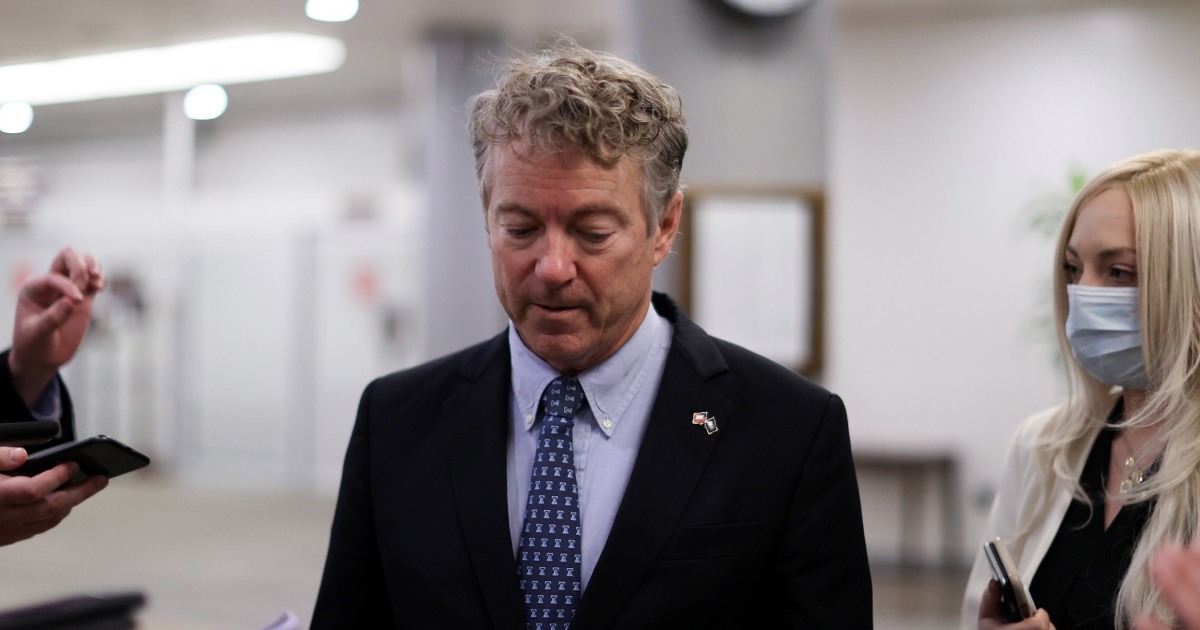
Rand Paul has been suspended from YouTube for 7 days for falsely claiming that masks are ineffective
 www.nbcnews.com
He then complained that the suspension was an infringement of his first amendment constitutional right to free speech
www.nbcnews.com
He then complained that the suspension was an infringement of his first amendment constitutional right to free speech
He gets puts straight on that matter here:
The guy who makes these videos is excellent - an educated redneck!!!!
Cheers
Bruce
YouTube suspends Sen. Rand Paul over a video falsely claiming masks are ineffective
The suspension was “a badge of honor," Paul tweeted.
www.nbcnews.com
He gets puts straight on that matter here:
The guy who makes these videos is excellent - an educated redneck!!!!
Cheers
Bruce
Similar threads


- Replies
- 3
- Views
- 201


