Essexsussex
Well-Known Member
Thank you everyone who has given me encouragement to have a go at loading. I started working up a round, and fired my first 12 (I think - note to self keep a log) rounds at the weekend. No case issues to speak of, they all went bang except one that wouldn't chamber. now I am loading to test grouping.
so as a complete novice, here is what I say to anyone thinking of loading who has seen a lee loader and wants to know more. Really easy and it really works! The following aimed at someone who hasn't read up on loading, like I was a few weeks ago, and might guide them a bit. Please read what you can including a manual before you start, and ask as many questions on here as required. I made myself look stupid several times but I am safer for it.
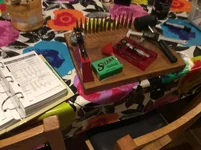
Hopefully I have uploaded my picture of the minimal kit required.
You have seen the box - the box is literally everything you need to make a round. If you use cartridges fired in your own gun or new, follow the instructions in the box, make the round the length it tells you and use the provided powder scoop with the powder they tell you to use, you will make rounds that work fine but aren't necessarily optimum for your gun.
The powder scoop will limit the amount of powder you use per round, and therefore the speed of the bullet, to a "safe" level. If this is ok for you, then end of, you can just use a Lee loader as per the instructions.
by the way, you do have to hit live ammo with a hammer. I have blown a primer which is mildly worrying but doesn't hurt. That part of the process happens before any powder is introduced. If you do things right you cannot blow the live round due to the design of the loader.
if you want to optimise the round somewhat, you have to "work up" your round. Buy a manual and read it at this point, but believe that you need all sorts of fancy kit to make a hunting round. This means using a low level powder charge, firing it in your own gun and inspecting the case for signs of stress. You then step this up by .5 of a grain in increments and keep looking until you get to the maximum charge in your loading book for exactly the same weight of bullet. To do this, you need scales to step up in the right accurate increments. You can see from my photo I bought a set of lee scales which are a bit cumbersome but work and are £20 or less used.
you then make groups of 3 or 5 in the weight increments that are safe and within your desired velocity range and shoot them and see which groups best. Then that is your round. Dedicated people with more gear and time will then vary the length of the cartridge to see if accuracy is improved, but as others have said on here you will get a good hunting round using the specified length.
Reasonably accurate home made rounds, end of, unless you get the bug of course...
so as a complete novice, here is what I say to anyone thinking of loading who has seen a lee loader and wants to know more. Really easy and it really works! The following aimed at someone who hasn't read up on loading, like I was a few weeks ago, and might guide them a bit. Please read what you can including a manual before you start, and ask as many questions on here as required. I made myself look stupid several times but I am safer for it.
Hopefully I have uploaded my picture of the minimal kit required.
You have seen the box - the box is literally everything you need to make a round. If you use cartridges fired in your own gun or new, follow the instructions in the box, make the round the length it tells you and use the provided powder scoop with the powder they tell you to use, you will make rounds that work fine but aren't necessarily optimum for your gun.
The powder scoop will limit the amount of powder you use per round, and therefore the speed of the bullet, to a "safe" level. If this is ok for you, then end of, you can just use a Lee loader as per the instructions.
by the way, you do have to hit live ammo with a hammer. I have blown a primer which is mildly worrying but doesn't hurt. That part of the process happens before any powder is introduced. If you do things right you cannot blow the live round due to the design of the loader.
if you want to optimise the round somewhat, you have to "work up" your round. Buy a manual and read it at this point, but believe that you need all sorts of fancy kit to make a hunting round. This means using a low level powder charge, firing it in your own gun and inspecting the case for signs of stress. You then step this up by .5 of a grain in increments and keep looking until you get to the maximum charge in your loading book for exactly the same weight of bullet. To do this, you need scales to step up in the right accurate increments. You can see from my photo I bought a set of lee scales which are a bit cumbersome but work and are £20 or less used.
you then make groups of 3 or 5 in the weight increments that are safe and within your desired velocity range and shoot them and see which groups best. Then that is your round. Dedicated people with more gear and time will then vary the length of the cartridge to see if accuracy is improved, but as others have said on here you will get a good hunting round using the specified length.
Reasonably accurate home made rounds, end of, unless you get the bug of course...
Attachments
Last edited:
 .
.