Not bTB - protostrongyle lungworm in roe

willie_gunn

Well-Known Member
Thought this might be of interest to others here.

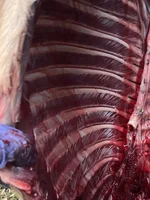
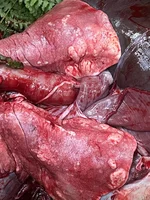
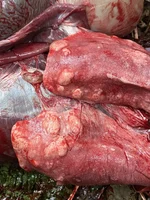
Back in early August I shot a roe buck that, upon examination, had some suspicious looking patches on the lungs:
IMG_0689.webp


IMG_0694.webp

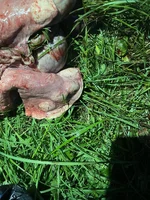
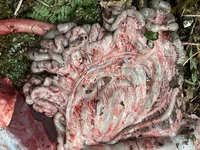
However nothing unusual with the retro-pharangyal, sub-maxillary or mesenteric lymph nodes:
IMG_0695.webp

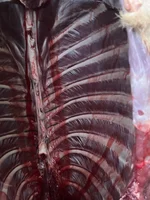
Nor in the pleural cavity:

IMG_0692.webp

IMG_0693.webp

As some will know, we are close to a known bTB hotspot and have encountered several cases of bTB in muntjac in the past, so on the precautionary principle I contacted APHA and, efficient as ever, they came out the very next day to take samples. The carcass was then double-bagged and disposed of via the local Hunt kennels for incineration.

Having done this, things then went cold, so I chased up with APHA this week and today received notification that the PCR test was negative. They will be sending samples on for bacteriological culture. However independent to this I also had the opportunity to share the photos with the BDS Chief Vet who diagnosed that, rather than bTB, this is instead a case of protostrongyle lungworm. The lack of lesions on the mesenteric was a signal indicator, and the lesions (if incised) would have been very different to those of bTB (red with possible signs of worm larvae, vs pistachio-coloured and cheesy/grainy).

In retrospect it was probably unnecessary to contact APHA and dispose of the carcass, but having never encountered lungworm in roe before this was a prime example of “every day is a school day”.

I hope the photos may help others should they come across anything similar.
 
Great pictures. Did you fondle the lungs? Those areas while harder than the lung would have been slightly soft. TB lesions that size I would expect to be quite solid.
I did, but I’d have struggled to say whether they were sufficiently soft or solid without having something to compare them to. It’s a good pointer, so thank you, and I’ll hopefully remember to do so should I come across another case in the future.
 
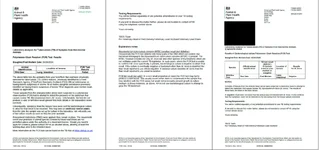
In case it may be of interest for future reference, these are the letters that APHA sent out after their bTB testing on the roe deer - the first is for the results of the PCR test whilst the second, received today, is for the results of the bacteriological culture:

1728634048267.png


I once again have nothing but praise for APHA, whether in terms of the speediness of response after notifying them of a suspected case of bTB, the help and assistance from the individual inspectors they sent out to collect the samples, or the testing that takes place and the timescale for the notification of the results. They certainly deserve credit for their work.
 
In case it may be of interest for future reference, these are the letters that APHA sent out after their bTB testing on the roe deer - the first is for the results of the PCR test whilst the second, received today, is for the results of the bacteriological culture:

View attachment 387679


I once again have nothing but praise for APHA, whether in terms of the speediness of response after notifying them of a suspected case of bTB, the help and assistance from the individual inspectors they sent out to collect the samples, or the testing that takes place and the timescale for the notification of the results. They certainly deserve credit for their work.
Thanks for posting, good follow up to your original post.
 
I wonder if the wet Summer has resulted in more incidences of it occurring?
Based on a relatively small sample (50 odd roe shot or shot by guests with me per season) the answer is yes, I usually get one bad infestation of lungworm every other year but had two this year (both in bucks) already
 
Thought this might be of interest to others here.

Back in early August I shot a roe buck that, upon examination, had some suspicious looking patches on the lungs:

View attachment 386270


View attachment 386272

However nothing unusual with the retro-pharangyal, sub-maxillary or mesenteric lymph nodes:

View attachment 386273

Nor in the pleural cavity:

View attachment 386274

View attachment 386275

As some will know, we are close to a known bTB hotspot and have encountered several cases of bTB in muntjac in the past, so on the precautionary principle I contacted APHA and, efficient as ever, they came out the very next day to take samples. The carcass was then double-bagged and disposed of via the local Hunt kennels for incineration.

Having done this, things then went cold, so I chased up with APHA this week and today received notification that the PCR test was negative. They will be sending samples on for bacteriological culture. However independent to this I also had the opportunity to share the photos with the BDS Chief Vet who diagnosed that, rather than bTB, this is instead a case of protostrongyle lungworm. The lack of lesions on the mesenteric was a signal indicator, and the lesions (if incised) would have been very different to those of bTB (red with possible signs of worm larvae, vs pistachio-coloured and cheesy/grainy).

In retrospect it was probably unnecessary to contact APHA and dispose of the carcass, but having never encountered lungworm in roe before this was a prime example of “every day is a school day”.

I hope the photos may help others should they come across anything similar.
I saw this a few days ago, but cannot let it go!
To recap, no TB indications in any lymph nodes, nothing in the pleural cavity, just some raised patches on the lungs. Yet the carcass was double bagged and incinerated as you and APHA thought it might be TB.
What was the trigger for assuming this, did you miss something out in your account? Lungworm is fairly common, any field guide would tell you this. If any doubt, cutting into the raised areas or palpating would show a different lung tissue substance than TB, as mr Buchan said.
Did you not wish to cut into the lungs and investigate?

I don’t wish to castigate you for being diligent and maybe overly cautious, but surely APHA need a slap around the back of the head, lungworm and TB are two entirely different things, it’s very hard to mix these up. Had they told you it was lungworm, you need not have ditched the carcase. The BDS vet managed to identify lungworm from your photos.
 
Back
Top