
You are using an out of date browser. It may not display this or other websites correctly.
You should upgrade or use an alternative browser.
You should upgrade or use an alternative browser.
Opinions on the best Knife Sharpener
- Thread starter GMan14
- Start date


jthyttin
Well-Known Member
There's no guided system that allows you to keep consistent angle throughout the blade. It's theoretically possible, but I'm not aware of any actual product.
Guided systems like Ruixin and others mentioned, really require you to keep the pressure similar and the angle on the blade depends on where you mount it (in two dimensions, how deep in to the blade holder and where you grab the blade lengthwise). And especially how the holder suits your blade, how much you use force to clamp it and how much you use force for sharpening (this is the Achilles heel of the system). You can especially see this in systems that allow you to rotate blade 180 degrees, sharpening both sides with single clamp. And by design, the angle varies along the blade when stone holder is fixed in single point and the radius is not matching the blade radius.
It's also 100% certain that nobody can keep constant angle on bevel that's at most few millimeters wide, by hand sharpening. It's difficult enough, or impossible if we measure accurately enough, when using puukko grind where bevel is like one centimeter wide (you can use secondary bevel if that's your understanding of puukko grind, and there are a lot of implementations called "scandi grind" that in fact more or less rape the idea of puukko).
Guided systems like Ruixin and others mentioned, really require you to keep the pressure similar and the angle on the blade depends on where you mount it (in two dimensions, how deep in to the blade holder and where you grab the blade lengthwise). And especially how the holder suits your blade, how much you use force to clamp it and how much you use force for sharpening (this is the Achilles heel of the system). You can especially see this in systems that allow you to rotate blade 180 degrees, sharpening both sides with single clamp. And by design, the angle varies along the blade when stone holder is fixed in single point and the radius is not matching the blade radius.
It's also 100% certain that nobody can keep constant angle on bevel that's at most few millimeters wide, by hand sharpening. It's difficult enough, or impossible if we measure accurately enough, when using puukko grind where bevel is like one centimeter wide (you can use secondary bevel if that's your understanding of puukko grind, and there are a lot of implementations called "scandi grind" that in fact more or less rape the idea of puukko).
For some reason I thought Sorby went the way of most of the others and was absorbed by Stanley at some point... Hard to beat old Sorby steel for chisels!Robert sorby pro edge. Expensive but great.

Longstrider.
No they got bought out by spear and Jackson and then by snh global who owns Neill tools spear and Jackson and Robert sorby. Still made in Sheffield as far as my quick Google search is aware.For some reason I thought Sorby went the way of most of the others and was absorbed by Stanley at some point... Hard to beat old Sorby steel for chisels!

Learn to sharpen well and it will save the user from owning a collection of blunt knives , its really that simple ! Once that's sorted the user really only need the one knife to see you through many years if you buy a good one .
The steel is less important than the heat treatment and geometry . This is where most factory knives fail to perform and its at two ends of the HT in my experiance , either too fast and too hot to cut production times creating a chippy knife prone to tip loss . Or the other end where the conversion hasn't had time or temp to correctly convert fairly resilient knife but not very hard one and impossible to draw a decent burr . The person sharpening often thinks it is lack of sharpening skills in themselves and although it can be a factor, it given a sort of sharp for a limited period , it will soon give it up and be another disappointment.
A good knife in good hands can certainly go over 100 deer without much degrading from field bleeding , gralloching
The steel is less important than the heat treatment and geometry . This is where most factory knives fail to perform and its at two ends of the HT in my experiance , either too fast and too hot to cut production times creating a chippy knife prone to tip loss . Or the other end where the conversion hasn't had time or temp to correctly convert fairly resilient knife but not very hard one and impossible to draw a decent burr . The person sharpening often thinks it is lack of sharpening skills in themselves and although it can be a factor, it given a sort of sharp for a limited period , it will soon give it up and be another disappointment.
A good knife in good hands can certainly go over 100 deer without much degrading from field bleeding , gralloching

Frank Homes
Well-Known Member
I am curious as to how long it should take to sharpen a stainless steel knife on average assuming you are not a pro?, i imagine a lot of people don't spend long enough at it and then they think they can't sharpen one properly. I can sharpen an Opinel without any bother but i reckon i give up too easily when it comes to knives with harder steel which have a thicker profile.Learn to sharpen well and it will save the user from owning a collection of blunt knives , its really that simple ! Once that's sorted the user really only need the one knife to see you through many years if you buy a good one .
The steel is less important than the heat treatment and geometry . This is where most factory knives fail to perform and its at two ends of the HT in my experiance , either too fast and too hot to cut production times creating a chippy knife prone to tip loss . Or the other end where the conversion hasn't had time or temp to correctly convert fairly resilient knife but not very hard one and impossible to draw a decent burr . The person sharpening often thinks it is lack of sharpening skills in themselves and although it can be a factor, it given a sort of sharp for a limited period , it will soon give it up and be another disappointment.
A good knife in good hands can certainly go over 100 deer without much degrading from field bleeding , gralloching
There's sharpening an
That's what I had. Hated the thing, slow and not able to get the same angle twice. Then I bought the Robert sorby.Has anyone mastered a tormek...fine with chisels etc. but can't get a good balanced edge with a knife.

Longstrider x2Longstrider.
Then buy one of his excellent strops and Smurf poo and learn how to use it.
I’ve murdered many blades on gadgets and stones and even I can keep my blades razor sharp with this.

It is now sharp 
It is indeed, thanks StuartIt is now sharp

Attrition rates are not directly linked to hardness , so its not of much use to go off time to sharpen . In fact a softer knife that struggles to raise a good burr will take longer in actual sharpening and will not support a thin edge so it will very likely need stroping sooner on average .I am curious as to how long it should take to sharpen a stainless steel knife on average assuming you are not a pro?, i imagine a lot of people don't spend long enough at it and then they think they can't sharpen one properly. I can sharpen an Opinel without any bother but i reckon i give up too easily when it comes to knives with harder steel which have a thicker profile.
Angle / grind type , is relevant to how sharp and edge is as friction is reduced by the thinner edge ( think razor blades and paper cuts) . The convex design of grind (think felling axe) is the opposite, its got a lot of support - likewise the scandi grind which also gives good support ( just dont fillet your fish with it Like Ray Meres did ) The dammed thing looked like he played tug of war with a bear for it ( high friction )

The Lansky 4-rod turn box is difficult to beat for simplicity and consistency. Of all the sharpening systems I have (and I have a lot) it is the one I use the most:

It also goes away with me when we go on holiday, as inevitably the knives provided in most rented cottages are blunt as bu55ery!
I do have the Spyderco Sharpmaker and the Lansky Deluxe, though I prefer the Lansky turn box above.
If you want to go down the therapeutic path, the Wicked Edge is worth a look. I bought mine when I was in the States, and if you're after mirrored bevels it is hard to beat:
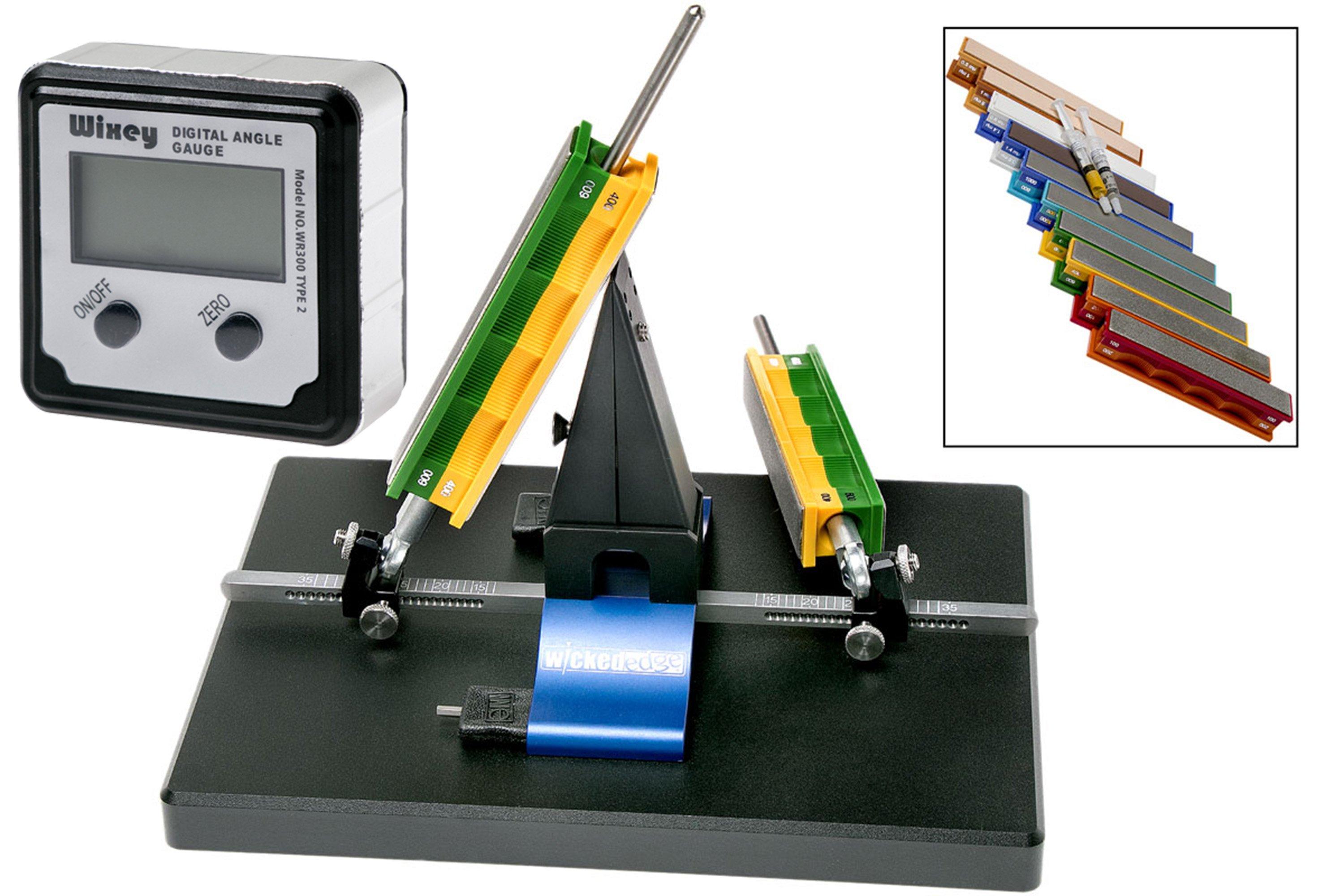
 www.knivesandtools.co.uk
In the larder I use the F Dick Hyper Steel to keep the edge on a knife. I prefer it to the similar designs from Bobet and Caribou (I have both):

 www.butchersequipment.co.uk
I do have a Tormek, though don't use that on knives but on gouges, chisels, etc.

It also goes away with me when we go on holiday, as inevitably the knives provided in most rented cottages are blunt as bu55ery!
I do have the Spyderco Sharpmaker and the Lansky Deluxe, though I prefer the Lansky turn box above.
If you want to go down the therapeutic path, the Wicked Edge is worth a look. I bought mine when I was in the States, and if you're after mirrored bevels it is hard to beat:
Wicked Edge Pro-Pack 2 sharpening system (2018)
Unique sharpening system to easily and quickly get your knives razor sharp. Luxury and heavy-duty version.
www.knivesandtools.co.uk
In the larder I use the F Dick Hyper Steel to keep the edge on a knife. I prefer it to the similar designs from Bobet and Caribou (I have both):
F Dick Silver Steel Hyper Drill
Sharpening made easy with the Silver Steel HyperDrill. Lean the knife blade slightly against one side of the slot while drawing the blade with light pressure through the rods.Use the spring action of the rods without bringing the knife to the bottom of the rod cycle.Repeat this action a few...
I do have a Tormek, though don't use that on knives but on gouges, chisels, etc.
Well i am a pro , sorry i seem to have missed your reply . Taking a long time to sharpen a knife generally means you did something wrong early stages, could be the heat treat or bad geometry . To take a knife from no edge at all to fully sharp ? 5 mins say ? This is for a deer knife as a part of a batch , set up time to add. ( flat ground polished ) time includes only to full sharp ie1. primary bevel and2. refinement,3. strop . Different knives require different times and different times spent on different designs . I tend to store any stock knives bluntI am curious as to how long it should take to sharpen a stainless steel knife on average assuming you are not a pro?, i imagine a lot of people don't spend long enough at it and then they think they can't sharpen one properly. I can sharpen an Opinel without any bother but i reckon i give up too easily when it comes to knives with harder steel which have a thicker profile.
PostmanPat
Well-Known Member
Hi - Interested to hear if you think the diamond stones are as good as a whetstone? I have used whet for many years but it is a lot of faff.ITS NOT THE TOOL IN THE HAND, ITS THE HAND ON THE TOOL !
Sharpening is very easy when you have been through about 100 knives correctly . Training and perfect practice and then you dont really think much at all about it
Oil or water stone no great difference so long you use honing oil ( nothing else ) on your oil stone and only water on your waterstone ( nothing else ) Never switch or you stone might never be of use again ! The flat Diamond stones are actually very good and way the easiest ( do not lube them with anything ) . A joiner / woodturner friend found some cheap Faithfull brand diamond stones . Set of three with the case that functions as a stand in use 400# ,600#, 100# . They are very cheap ! I put them in the truck a while for when folks are struggling at first but i soon got quite into them , those now live in the gunroom and they manage most sharpening tasks on our own kitchen knives . Perhaps i am someplace near 100 re- sharpening jobs now with them ? That's a lot for the average stalker of course and they are just fine ! The box is your stone holder and works well just plonked on the granite tops in the kitchen . They also avoid the stone slurry that creates such a mess or the kerosene based oilstone " oil" .
Just a final bit Sharpening steels dont really sharpen , they straighten up the cutting edge and polish a bit . Using to harshly will blunt your edge
In the Workshop i have one of my own build 2x72 belt grinders that i run at very slow speed along with a trizac belt for removing damaged edges , putting in the primary to the stage of burr on some new knives before moving to hand sharpening on my really old oil stone. Just for kicks i have a hand cranked sharpener that's likely at least 150 years old or more that i inherited , its some kind of sandstone and it needs to be quite well wetted in its bath before it does any good . Not really used it from my last show a few years before covid hit
Dont get into sharpening gadgets its not all about the tool and many knives sold today will simply not hold a burr modern lower price knives are cut to the bone on price running only just over 50 rockwell or under in some cases lower still on cheap supermarket stuff and those are not going to raise a workable burr.
I have a Worksharp power sharpener too but I stopped using it for knives (except re-profiling) as I nicked a few points of and have gone back to stones.
Thanks,
Generally i use a really old oilstone with the correct lubricant ( honing oil) . However I find myself using diamond stones more and more , faster to set up and put away and no lube means you can use them anyplace . I have never been keen on waterstones , there are soak times and mess to sort if used in the house and in the workshop there are the issues of dust contamination and they wear pretty fast and you end up doing a lot of flattening . I can however use them all and i believe firmly that practically any flat stone system used correctly by feel not by setting angles with gadgets are the best .Hi - Interested to hear if you think the diamond stones are as good as a whetstone? I have used whet for many years but it is a lot of faff.
I have a Worksharp power sharpener too but I stopped using it for knives (except re-profiling) as I nicked a few points of and have gone back to stones.
Thanks,
To correct damage or set a primary edge on most newly made knives i use a trizac fine belt run in reverse at a very , very slow speed , until i have established a burr

PostmanPat
Well-Known Member
Thanks. I've always used whetstone and get good results but it is all the soaking, flattening, sludge etc that has me thinking about buying some diamond stones. Surprised to hear such a good report on those cheap faithful onesGenerally i use a really old oilstone with the correct lubricant ( honing oil) . However I find myself using diamond stones more and more , faster to set up and put away and no lube means you can use them anyplace . I have never been keen on waterstones , there are soak times and mess to sort if used in the house and in the workshop there are the issues of dust contamination and they wear pretty fast and you end up doing a lot of flattening . I can however use them all and i believe firmly that practically any flat stone system used correctly by feel not by setting angles with gadgets are the best .
To correct damage or set a primary edge on most newly made knives i use a trizac fine belt run in reverse at a very , very slow speed , until i have established a burr

ajax2911
Member
Value for money wise, these get my vote: AnySharp Classic. The Safer Hands-Free Knife Sharpener
Similar threads


- Replies
- 22
- Views
- 2K


- Replies
- 6
- Views
- 782

