Question for the woodworkers - filling gaps in wooden table top

muddy42

Well-Known Member
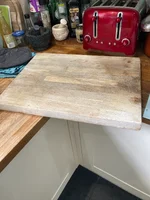
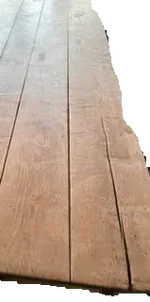
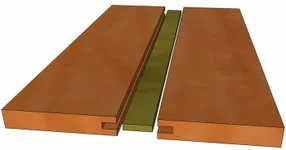
Please see photo of a large handmade wooden table that I use for butchery (personal consumption). Its great for spreading everything out and making a mess. However the gaps in the wood are annoying me and make cleaning up a pain and I would like to fill them without affecting the look of the table too much. The gaps are between 1-3mm wide and about 3mm deep. The planks are jointed all along their length in what I think is a spline joint (phot below). There are drawers fitted underneath, otherwise the table could be unassembled and rebuilt. The table is too large to leave the room.

I have reasonable woodworking skills and a router. The crack on right down a single plank is fine, I think I will rout out a strip and perform a dutchman repair with some bowties. The gaps between planks are a bit more challenging. The gaps are too uneven and shallow to accept wooden slithers. I was thinking of using a foodsafe epoxy filler, but Ive never done this before, any advice gratefully received?
1778058483950.webp1778058688324.webp
 
If you can create a temporary rim around the edge and get the gaps thoroughly clean an epoxy two part pour that is is used for ‘river’ tables might be the solution, the epoxy isn’t cheep…
 
I would rout them out and insert wooden splines, glued on one face only. (ie, the splines are only glued to one of the two boards you're inserting them between).
Fit the splines proud, then plane off the excess once the glue has dried.
 
Several options. I have an 80 plus year old wooden boat so reasonably proficient in wood.

Firstly wood swells and shrinks with moisture. Those gaps have opened up as the wood has shrunk and dried out. You could very easily reduce those gaps by regularly washing down the table after use and the wood will swell and gaps take up. To start with cover the table with some old sheets/ cloths / sacking, wet it down and leave it a few days. I possibly would get a load of salt sprinkle it over and then wet. Salt stops any rot and also kills bugs.

You could use a router run along a straight edge and take the splits into even grooves and then put in a spline. But you are now limiting the ability of the wood to swell.

Personally, I would just use the water route and rinse it down after every use.
 
If you can create a temporary rim around the edge and get the gaps thoroughly clean an epoxy two part pour that is is used for ‘river’ tables might be the solution, the epoxy isn’t cheep…
Thanks, I would just need to find a suitable epoxy.
I would rout them out and insert wooden splines, glued on one face only. (ie, the splines are only glued to one of the two boards you're inserting them between).
Fit the splines proud, then plane off the excess once the glue has dried.

Interesting idea to glue to one side only.

Several options. I have an 80 plus year old wooden boat so reasonably proficient in wood.

Firstly wood swells and shrinks with moisture. Those gaps have opened up as the wood has shrunk and dried out. You could very easily reduce those gaps by regularly washing down the table after use and the wood will swell and gaps take up. To start with cover the table with some old sheets/ cloths / sacking, wet it down and leave it a few days. I possibly would get a load of salt sprinkle it over and then wet. Salt stops any rot and also kills bugs.

You could use a router run along a straight edge and take the splits into even grooves and then put in a spline. But you are now limiting the ability of the wood to swell.

Personally, I would just use the water route and rinse it down after every use.

I get what you are saying, but. Personally I think the wood has stopped moving as the table is probably pre WW2 age. The room is a constant cold temperature, no sunlight. The wood has a deep oil finish, probably something like raw linseed oil. Water doesn't soak in at the moment and I wouldn't want to mess this up. One of the great things about these oil finishes are they are easy to add too.
 
Thanks, I would just need to find a suitable epoxy.


Interesting idea to glue to one side only.
If you were to glue both sides then the boards can no longer expand and contract independently of each other, so next time there was any movement it would either split your spline or tear a piece off the side of one of the boards. Or your glueline would fail (but modern glues are stronger than timber, so it's more likely the timber would give way first).
Either way, you'd find yourself having to rout it all out and start again, with a bigger repair this time.
I get what you are saying, but. Personally I think the wood has stopped moving as the table is probably pre WW2 age. The room is a constant cold temperature, no sunlight. The wood has a deep oil finish, probably something like raw linseed oil. Water doesn't soak in at the moment and I wouldn't want to mess this up. One of the great things about these oil finishes are they are easy to add too.
 
Don't route it out your joints will be massive. Use a thin saw blade and a straight edge, some blades only being 1.6mm wide up to about 3mm. Set to a depth of 10mm so not to cut the loose tongues off. Thin slithers of timber glued in with d4 pva will be ample and won't spoil the look of a nice table.
You could use the repair care epoxy resin system,which acts as a glue and is flexible too. Some resins are too brittle. But it doesn't look nice. The repair care stuff will need the joints cleaning and their epoxy primer using first. It's an excellent product but not cheap and is most often painted over, pretty bomb proof stuff though.
 
Don't route it out your joints will be massive. Use a thin saw blade and a straight edge, some blades only being 1.6mm wide up to about 3mm. Set to a depth of 10mm so not to cut the loose tongues off. Thin slithers of timber glued in with d4 pva will be ample and won't spoil the look of a nice table.
You could use the repair care epoxy resin system,which acts as a glue and is flexible too. Some resins are too brittle. But it doesn't look nice. The repair care stuff will need the joints cleaning and their epoxy primer using first. It's an excellent product but not cheap and is most often painted over, pretty bomb proof stuff though.
thanks. I like the idea of using saw blades to clean out. The gaps vary along their length from 1 - 3 mm, generally a constant depth. I know you can get slightly V shaped slithers, that would cope with some of the variation.
 
Why did this happen in the first place? How is the top mounted, is the wood able to move freely?
 
Why did this happen in the first place? How is the top mounted, is the wood able to move freely?

Not sure how the gaps emerged, as I say its definitely pre-WW2. The planks are spine jointed then screwed to the base from underneath. The planks arn't able to move freely. It would be a monumental job to take it apart and redo the spine joints and then reattach everything. Its beyond me, with my hand tools and hand planers. The table is about 10 ft long.
 
Last edited:
Here in Germany the bespoke high end mucho€€€€s table tops get their gaps filled with a black food safe epoxy then flatted off which looks quite nice.
 
Here in Germany the bespoke high end mucho€€€€s table tops get their gaps filled with a black food safe epoxy then flatted off which looks quite nice.

yup I am trying to decide between:
1) rebuild - lots of work so I would need to call in a pro
2) fill with epoxy - I think this would cause the lease disruption, but leaves less room for future movement. BUT I think the table has largely stopped moving. I wouldn't mind if small cracks emerged, its just the big ones that are a pain. Maybe there is a slightly flexible epoxy filler. I'm sure someone will have tackled a similar problem.
3) rout and glue in slithers - The uneven width and shallow depth makes this tricky.
 
yup I am trying to decide between:
1) rebuild - lots of work so I would need to call in a pro
2) fill with epoxy - I think this would cause the lease disruption, but leaves less room for future movement. BUT I think the table has largely stopped moving. I wouldn't mind if small cracks emerged, its just the big ones that are a pain. Maybe there is a slightly flexible epoxy filler. I'm sure someone will have tackled a similar problem.
3) rout and glue in slithers - The uneven width and shallow depth makes this tricky.
To be honest, given its age, and all the oil applied you will never good glue joints on it. Personally I would just accept it for what it is, give it a good oiling now and then.

And go and find some off cuts of oak type kitchen tops - the ones glued up from lots of pieces - 2 foot long or so and use those as chopping blocks on the table. Most of the shite will be on the blocks. The table just supports. This is what on our kitchen table and works well.

If you are really worried about the table, put on a vinyl waterproof table cloth.

Edit: what I use - mostly lives on the kitchen work top for chopping things on. Oak is naturally antiseptic, it’s get a good scrub in the sink with hot water when its all mucky after butchering. Every now and then I give it a good scrape with a cabinet scraper to freshen up the face. This bit is 20 years old.
image.webp
 
Last edited:
To be honest, given its age, and all the oil applied you will never good glue joints on it. Personally I would just accept it for what it is, give it a good oiling now and then.

And go and find some off cuts of oak type kitchen tops - the ones glued up from lots of pieces - 2 foot long or so and use those as chopping blocks on the table. Most of the shite will be on the blocks. The table just supports. This is what on our kitchen table and works well.

If you are really worried about the table, put on a vinyl waterproof table cloth.

Thanks. Vinyl is a no no - I tried that and underneath the wood went all sticky and horrible.

what about cleaning and then filling the cracks with some kind of thicker oil paste - raw linseed oil and sawdust? I could easily remove it if it failed. I have time over the summer to allow multiple layers to dry and harden slowly.
 
Thanks. Vinyl is a no no - I tried that and underneath the wood went all sticky and horrible.

what about cleaning and then filling the cracks with some kind of thicker oil paste - raw linseed oil and sawdust? I could easily remove it if it failed. I have time over the summer to allow multiple layers to dry and harden slowly.
Exactly what I did with bathroom floor. Old pine floor boards 150 years old. Sanded, then used a slurry of saw dust plus Danish oil into all the joints. Mostly still there.
 
Don't route it out your joints will be massive. Use a thin saw blade and a straight edge, some blades only being 1.6mm wide up to about 3mm. Set to a depth of 10mm so not to cut the loose tongues off. Thin slithers of timber glued in with d4 pva will be ample and won't spoil the look of a nice table.
You could use the repair care epoxy resin system,which acts as a glue and is flexible too. Some resins are too brittle. But it doesn't look nice. The repair care stuff will need the joints cleaning and their epoxy primer using first. It's an excellent product but not cheap and is most often painted over, pretty bomb proof stuff though.
The thin slither could be of a contrasting colour to make a feature of it
 
  • Like
Reactions: VSS
Back
Top