Should i upgrade my 20 year old S&B 3-12x50 for a 2.5-10x56 illuminated

For some years I had the 3-12x50 S&B with No4 and the 3-12x50 FD7 Zenith on two main rifles. The only disadvantage of the Zenith is the extra weight and maybe the wine bottle shape that might catch the pica rail. Against the low sun the Zenith seemed much better than the older version. At low light not a huge difference. The flash dot works really well, is quick to switch on and adjust, so much better than any rubber push button versions. Perfect also for quick offhand day shooting when going through cover. The fine FD7 reticle is also better for zeroing and longer range precision shooting. Saying that the classic had also served me very well over years.
edi
 
That’s a very interesting post, thank you for clearing that up.
Could you possibly expand/ explain the “artificially Limited Exit eye pupil “ scenario that you mentioned in your second to last paragraph? Is it that the 6 or 8 zoom scopes just don’t suit some people’s eyes or is it that they genuinely don’t let as much light through than the standard magnifying vari power scopes?
kindest regards, Olaf
Let me put up front that I am not an optician or engineer. So please excuse me if I am not always using the corrects terms or even fully correct explanations. I had to work this out myself as I became curios on the following subject:
Usually the exit pupil is determined by dividing the objective diameter by the magnification. So I said to myself, I should have the same exit pupil on e.g. a 2.5-10x50 Zeiss HT and a 1.8-14x50 Zeiss V8 if I set the magnification to the same value, say 6x. Then I started looking at the technical data of the V8 and it gives us an exit pupil of 10.3 - 3.7mm. That's strange, doing the math (Obj. dia./magn.) it should be 27.8 - 3.8mm. The deviation on the high end of the magnification is due to the fact that it isn't actually 14x but only 13.5x (so the technical data sheet says). So this fits.
On the low magnification end however the math doesn't go together with the technical data at all.
The same is true for the 2.5-10x50 HT but to a much lesser degree (mathematically 20-5mm vs. data sheet 15-5mm).

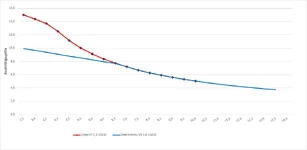
Now if I take all this data, do some interpolation, fill a table with it and put it into a graph it will look like this:

graph.png

Looking at this I asked myself two questions:

1.) Why is the blue line almost straight? I would have expected the HT to have a more or less straight line, as the abberation limitation is much less.
Answer: The line is a function of the percental variation of the magnification, not of the magnification itself. So if you increase from 4x to 5x you increase by 25%, whereas from 8x to 9x you only increase by 12.5%.

2.) Why the f*ck do they do this?
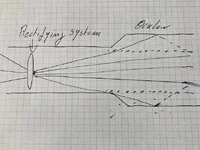
Answer: Imagine the light rays coming through the rectifying system and from there on being distributed into the ocular. On a very large exit pupil some of the light would 'bump' onto the side of the ocular before reaching the eye (dashed lines). This would produce stray light (or at least some kind of problem). Therefore they 'cut it off' (dotted lines) and thereby limit the size of the exit pupil below the physically possible value.

IMG_1578.jpg

What it all comes down to is that on the lower end of the magnification range the lower zoom scopes deliver more light than the highr zoom models do.

Phew, I hope I could somehow make myself clear :old::lol:.
 
One thing to watch for with illuminated reticles is if you have form stigmatism in your shooting eye.

Rather than a clear red dot it will look starry or blurred or coma shaped. Hold the scope up and rotate it - the star won’t with the scope.

i discovered I have a stigmatism after getting an illuminated reticle. I can use them if they are turned down very low, but anything brighter they are just irritating.
 
Let me put up front that I am not an optician or engineer. So please excuse me if I am not always using the corrects terms or even fully correct explanations. I had to work this out myself as I became curios on the following subject:
Usually the exit pupil is determined by dividing the objective diameter by the magnification. So I said to myself, I should have the same exit pupil on e.g. a 2.5-10x50 Zeiss HT and a 1.8-14x50 Zeiss V8 if I set the magnification to the same value, say 6x. Then I started looking at the technical data of the V8 and it gives us an exit pupil of 10.3 - 3.7mm. That's strange, doing the math (Obj. dia./magn.) it should be 27.8 - 3.8mm. The deviation on the high end of the magnification is due to the fact that it isn't actually 14x but only 13.5x (so the technical data sheet says). So this fits.
On the low magnification end however the math doesn't go together with the technical data at all.
The same is true for the 2.5-10x50 HT but to a much lesser degree (mathematically 20-5mm vs. data sheet 15-5mm).

Now if I take all this data, do some interpolation, fill a table with it and put it into a graph it will look like this:

View attachment 175992

Looking at this I asked myself two questions:

1.) Why is the blue line almost straight? I would have expected the HT to have a more or less straight line, as the abberation limitation is much less.
Answer: The line is a function of the percental variation of the magnification, not of the magnification itself. So if you increase from 4x to 5x you increase by 25%, whereas from 8x to 9x you only increase by 12.5%.

2.) Why the f*ck do they do this?
Answer: Imagine the light rays coming through the rectifying system and from there on being distributed into the ocular. On a very large exit pupil some of the light would 'bump' onto the side of the ocular before reaching the eye (dashed lines). This would produce stray light (or at least some kind of problem). Therefore they 'cut it off' (dotted lines) and thereby limit the size of the exit pupil below the physically possible value.

View attachment 175993

What it all comes down to is that on the lower end of the magnification range the lower zoom scopes deliver more light than the highr zoom models do.

Phew, I hope I could somehow make myself clear :old::lol:.
That’s a fantastic post and a superb description of how it works out in reality. Utterly impressed my friend. Thanks for the super reply to my question.
kindest regards, Olaf
 
Your scope is marginally lighter and I assume lower profile on the set up so my personal choice would be to stick. But I'm also a scopeaholic so I'd probably, no I would, buy the other to try it out and decide myself ;)
 
also you need to try scopes in low light regardless of the scope and quality your eyes are the real limiting factor and this degrades as you get older so you may not be able to use the higher light transmission or larger exit pupil (think the largest exit pupils are in teenage girls and this decreases so 50yr old men may only be able to use 5mm or less ) so a High-end scope may look the same as a low end one to you but not to another .
Same with binos only pay for performance you can see your self regardless of what others say (always try a recommendation but use your own judgment )
 
You can always choose not to use the illuminated reticle. For low light shooting 56mm objectives and illuminated reticles are a no brainer for me. I have both Zeiss HT and S&B Zenith in 56mm versions. I also have a plain jane S&B 8x56 hungarian which like your scope has a thickish reticle for target finding. If buying new I would deffo go illuminated ret.
 
Back
Top