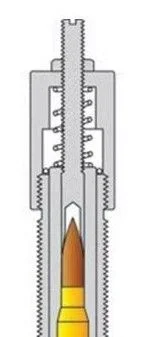
Variable COAL with Lee bullet seating die

This is rather misleading.

My own assembly of dies ranges in rough order of cost, from LEE & the other main US makers through to Triebel, Warner & up to dies I’ve commissioned to be made from scratch (including the reamers). They all work well in their specific roles - including the LEE.
matey you go and use your lee die,s, i dont care what you use, i dont use them, if you like them fair enough, there are better quality dies out there bs
 
Many thanks for all the opinions.

Just to answer a couple of questions that were asked....

Are the primers seated correctly? Yes. I checked that. It had already occurred to me that OAL inconsistency might be due to measuring off a non-flush primer. Not the case.

Have I trimmed or annealed the brass? No. I measured a sample and it was all well short of needing to be trimmed so I didn't bother. I don't anneal. I have enough once fired brass that I expect to be shooting it for years before any needs to be annealed.

How do they shoot? I haven't tried them yet, They are loaded with varying charges - so expect/hope that some will shoot better than others. I'm doing load development.

(Implied question) "why are you using cheap components?" - this ammo is for civilian service rifle competitions. That's ~100 rounds per day of competition. I need a reasonably accurate round that works well up to 500m, but cost is a consideration. I figured that I'd see how Magtech brass and PPU bullets work. If they're OK then that's nice and cheap. If they are not then I'll try upgrading the bullets. If I'm still chasing accuracy after that then I might try different brass (does it really make much difference?).
plenty of people shooting CSR are using GGG brass and PPU or other cases and PPU.... the gain from the like of SMK is only really evident if you are up in the top 2-5 consistently
 
(Implied question) "why are you using cheap components?" - this ammo is for civilian service rifle competitions. That's ~100 rounds per day of competition. I need a reasonably accurate round that works well up to 500m, but cost is a consideration. I figured that I'd see how Magtech brass and PPU bullets work. If they're OK then that's nice and cheap. If they are not then I'll try upgrading the bullets. If I'm still chasing accuracy after that then I might try different brass (does it really make much difference?).
If only you guys could order stuff from the US without all the import hassles...

.224 RMR 75 Gr. BTHP 3GH *NEW* (Read Description Before Ordering) | RMR Bullets
 
I've been reloading for 30 years and I cannot understand why case length would make any difference to ammunition oal.
Could somebody explai
It won’t!
For the hard of thinking - the bullet seating die is designed and set by the reloader to yield the desired consistent COL regardless of case or indeed bullet lengths, so the only variable possible is the bullet’s seating depth as determined by individual case lengths. Think of the same die seating a 70 grns bullet followed (without die adjustment) by a 180gns bullet - the COL will be the same but the two bullets’ seating depths will be hugely different and even dangerous!
Hence good practice is to trim all cases to the same length thus giving consistent COL, neck tension, etc. - as specified in loading data everywhere by those rather clever powder manufacture johnnies….
Simples.

🦊🦊
 
Then why were people including you I think asking if if the guy had checked his case lengths.
Easypeasy - I wasn’t!
Case length check is for safety and consistency. See extract of my response re inconsistent case length below:-
“At best you will get inconsistent seating depth and depending on your discipline/distance, inaccuracy and at worst a real problem should the case get so long that it has nowhere to go upon firing”.
🦊🦊
 
All loaders should know about trimming cases to the required length but it got involved in coal where it has no place and is just confusing things.
M.I.S.S.
Not relating to you.
 
Don't worry about it. The only thing that counts is tightness of the group on target and I have found that things one does with reloading makes little difference on target. I have tested clean brass vs dirty brass, trickled powder vs dropped powder, various seating depths etc. These factors are dwarfed by other factors such as trigger control, correct wind reading, correct DOPE, quality of bullets, quality of barrel on your rifle etc. I have lots of seater dies, including Forster bench rest, RCBS and Lee because I set up a seater die for a bullet type and then keep it for that bullet type. All of them show some variation in seating depth results and it has no detrimental effect on group size on target. I even use a spare .308 RCBS seater die to seat one of the bullet types in my .243 as it was going spare and again it has no detrimental effect even though the channel inside the .308 die is much wider than it should be for a .243.
 
Don't worry about it. The only thing that counts is tightness of the group on target and I have found that things one does with reloading makes little difference on target. I have tested clean brass vs dirty brass, trickled powder vs dropped powder, various seating depths etc. These factors are dwarfed by other factors such as trigger control, correct wind reading, correct DOPE, quality of bullets, quality of barrel on your rifle etc. I have lots of seater dies, including Forster bench rest, RCBS and Lee because I set up a seater die for a bullet type and then keep it for that bullet type. All of them show some variation in seating depth results and it has no detrimental effect on group size on target. I even use a spare .308 RCBS seater die to seat one of the bullet types in my .243 as it was going spare and again it has no detrimental effect even though the channel inside the .308 die is much wider than it should be for a .243.
:scared:
🦊🦊
 
they varied by only 0.12mm (vs 0.34mm for the finished rounds).
Protruding primers could easily produce that much variation. If the bullets can vary by 0.12mm, that leaves 0.22mm variation. Have you measured the primed case OAL? I have achieved 0.2 inch groups at 125 yards with Lee seating dies.
 
I am new to reloading, but I am responding as I have just started using a very similar setup to OP, and I have been collecting all the stats.

.223
Lee Seating Die
Once fired Magtech brass
55gr V-MAX

I loaded 50 rounds.
The ES of my COAL is 0.007" which is 0.178mm.
The ES of my CBTO is 0.003" which is 0.076mm.

So, my COAL variation is about half that of OP.

I agree that measuring off the Ogive is the way as can be seen from the above stats (ES is reduced by over 50%).

For reference, a box of 55gr Varmint Express measures as follows
ES of COAL is 0.003" which is 0.076mm.
ES of CBTO is 0.003" which is 0.076mm.

OP does not say which press they have, but perhaps inconsistent pressure on the handle could make a difference.

One thing I have learned in my short reloading history is that Lee kit often needs some fettling. I found the insert in the seating die did not centre very well inside the knurled adjuster. I improved the chamfer on the insert to make it ride easier inside the outer.

The PPU brass may not be as consistent as my Hornadys. I suggest the OP tries loading a different bullet to see if the figures are improved.

Of course, as others have said, if it shoots don't sweat it, but I'm a bit of a measurement nerd and it helps understanding when you're starting out.
 
Interesting and sensible thing to do as you set out on your journey to the dark side…..
Just as you have both found it is a common occurrence to find minor inconsistencies in bullet lengths - reassuringly this of course applies to anything machined - especially if you check it out in “thous” with a device that dare I say it, may be out a few thou itself!

“OP does not say which press they have, but perhaps inconsistent pressure on the handle could make a difference.”.
The above slightly annoying little vagaries aside, this most certainly will make a (very small) difference in lengths - especially if the handle is not brought to a dead stop by the case holder meeting the die every time. All that said for the purposes of shooting deer, fox, rabbit or even rats (now that would be fun - highly dangerous but fun), and provided you are not running very hot loads and/or very long rounds, a few thou either way will make no difference whatsoever in the accuracy you require.
Just work within the data limits provided by those nice powder manufacture people until you find the perfect-for-you recipe round, regularly clean the dies and enjoy the ride…..
🦊🦊
 
Oh, and I just found another post on here that mentions the exact problem I had with the Lee seating die. Their solution was to buy an RCBS die instead. OP might want to examine their seating die with reference to the photo in that post.
 
Nothing wrong with the die. Measuring COL is useless. Even the best bullets will vary that much in length. It is not your bullet tip that hits the lands, it's the ogive.
Example. I bought a box of Lapua match ammo a while back and measured the COL and they varied as much as yours if not more. Then I measured ogive and there was only 0.01mm variation (0.0004 inches in old money).
Buy yourself a Hornady bullet comparator kit and measure ogive. Or use another small pistol brass as someone suggested.
 
I'm using Lee seating dies for 22-250 & very recently, 22 Hornet. Using an RCBS Rockchucker Supreme press, a Hornady comparator and Moore & Wright digital calipers, I'm getting a spread of less than 1 thou in length from base to ogive. Once I have determined ogive length for a given bullet type & seating depth I don't bother measuring to the tip of the bullet any more, it's meaningless.
How the Lee dies perform for runout I couldn't say as I don't have the necessary equipment, suffice to say I am happy with my groupings for hunting purposes as I have no interest in target shooting.
As long as the die bottoms out onto the shell holder then no amount of extra force should alter the seating depth, regardless of which press you use, it is fundamentally impossible to compress either the shell holder or the die.
 
Back
Top