Thermal Imaging for Deer Recovery

Steve.243

Active Member
Hi All
Please forgive me if this has been covered before (any links to previous discussions would be great).
I'm considering the purchase of a thermal device for locating shot deer in thick cover, the ground I stalk on borders some very thick woodland and, if un-sighted after the shot, a deer can disappear in a very short distance.
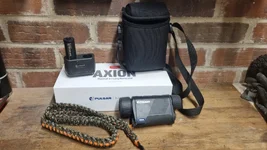
I've been looking a the Pulsar models (Axion Key XM22, 30 and 30s) and my budget would definitely not stretch beyond this.
It would need to detect a recently expired deer from a distance of no more than 200m.
Does anyone have any experience of using thermal optics for this purpose and have they found it the proper tool?

I'm grateful for any advice.
 
Hi All
Please forgive me if this has been covered before (any links to previous discussions would be great).
I'm considering the purchase of a thermal device for locating shot deer in thick cover, the ground I stalk on borders some very thick woodland and, if un-sighted after the shot, a deer can disappear in a very short distance.
I've been looking a the Pulsar models (Axion Key XM22, 30 and 30s) and my budget would definitely not stretch beyond this.
It would need to detect a recently expired deer from a distance of no more than 200m.
Does anyone have any experience of using thermal optics for this purpose and have they found it the proper tool?

I'm grateful for any advice.

If I can be of any help just let me know!

Toby
07954109314
 
I mainly use my thermal for either quick scans over large open areas to spot deer and foxes quickly so I can keep an eye on movements and numbers or for post shot recovery in thick undergrowth. SGA is right to say that a good dog is the best option but the thermal still has a place. I find in thick undergrowth and brambles etc it is a case of going to the POI and using all the normal skills of looking for blood trails, movement/noise and tracks and then using the thermal very methodically and at close range as you search. I personally find that in very thick cover it is easy to look too far ahead and be looking right over the top of the beast without picking it up on the thermal. The best way to describe what you are looking for in heavy cover is a sort of patch of shimmering light. As already said, you still need line of sight to pick heat up but what you tend to see is lots of small patches of heat through the cover and as I say it gives you an overall patch that sort of shimmers on the thermal image. My own experience is that using your stalking skills first and then using your thermal to add to them is better than totally relying on the thermal and walking around with it fixed to your eye.
 
Last edited:
I use a xq38 for foxing also muntjac, great but of kit but with a deep tractor rut (tramline) a fox will disappear leaving you to think you missed it.
Also if a muntjac makes the hedge (ditch) then the lovely white hot image is gone, the flip side watching them coming out of cover give you a better chance this time of year....

Tim.243
 
Something I have noticed with my thermal spotter, XP50, Is anything I spot with it seems to be left of centre in the screen, when checked out in relation to surrounding objects using the bino's, anyone had this?
 
I use and XQ30v for spotting when I am bunny shooting and fox shooting which is lower end compared to the top units but is still great for seeing whats about.

What I have found is if things go down in cover or long grass/ crop they are a pain to find and the thermal doesnt help as much as you think. Its fantastic for seeing stuff on open field i.e. a quick scan of a field can tell you straight off if anything is there so you can move on without messing about.

A case in point I shot a fox last week at about 70 yards int eh dark with my hornet and it looked to bounce about a despite the shot being a solid bib shot. When I went down to find it despite having the thermal it was not where I thought it was and in fact was the other side of the track in a bit of long grass having gone about 15 meters from the shot point. The only reason I spotted it through the thermal it I was only about 10 meters from it and could see a few patches of heat through some gaps in the grass.
Having had the thermal for about a year now I am still learning how difficult it can be to spot downed quarry in certain terrain and how well insulated their coats are. If you down a fox in for example damp ish early rape and its move any distance from the hit point you will have the devils own job finding it with thermal. However on a grass field that is short and dry they stand out like a beacon.

As I said this was with one of the lower end Pulsar units so mileage may vary with some of the top end stuff.


I hope this helps

Zetter
 
A half decent dog will always be the better option, having used a dog for thirty plus years and both thermal and dog for the past ten years. As above, you'd be as well try to follow the blood trail under the canopy yourself, which is why you should have a dog, it'll be miles better and quicker at it than you'll ever be yourself; I'd no sooner go shooting birds etc with the gun but without a dog than go stalking deer, IMO you're just storing up trouble for yourself come the day you have one take off after the shot; the dog will love to track and find it for you and you will appreciate it for its help. Sure you can find them in the open on easy terrain, but it won't always be like this.

At least try to find someone locally who does have a dog you could call upon if you don't have one yourself. Money is better spent first on a dog than a thermal, IMV.
 
Whilst no doubt a well trained dog would be a better option, that wasn't the OPs question so I'll stick to my views of thermals for tracking ;)

As others have said, thermals are handy when you can see bits of the animal - good in low light and open ground (or under a low canopy in a plantation) but any obstruction such as a ditch, fallen tree or heavy foliage will render them useless. So for me, finding a deer after it's been shot is very much a secondary to using them for spotting live animals.
 
A half decent dog will always be the better option, having used a dog for thirty plus years and both thermal and dog for the past ten years. As above, you'd be as well try to follow the blood trail under the canopy yourself, which is why you should have a dog, it'll be miles better and quicker at it than you'll ever be yourself; I'd no sooner go shooting birds etc with the gun but without a dog than go stalking deer, IMO you're just storing up trouble for yourself come the day you have one take off after the shot; the dog will love to track and find it for you and you will appreciate it for its help. Sure you can find them in the open on easy terrain, but it won't always be like this.

At least try to find someone locally who does have a dog you could call upon if you don't have one yourself. Money is better spent first on a dog than a thermal, IMV.

I have 2 spaniels for pigeons/ducks/picking up, not for deer. This time of year they only come with me on peas/late drilling's etc. Seeing Chip in the vets last time with a grass seed in his ear (then had to be knocked out) to remove it
was very distressing for him/me/ and the lady vet.
You won't find the tracking team turning out for a fox that was chipped, run and disappeared. :doh:

Tim.243
 
As most have suggested, thermal is another tool that aids, but does not guarantee, finding a runner. If it has not gone down a hollow, rut, etc, and the foliage is not too thick then you do stand a reasonable chance of finding it. I've "found" such animals in forests and clear fell, sometimes even before my dog by using my thermal! I've attached 2 links to YouTube videos of me taking a fallow doe at approx 80m in woodland and then following-up. The videos are taken from a Thermion XM38 being used off-rifle as a spotter by my daughter. Sadly, they do bounce around a lot, especially when she lowers the Thermion to look through her binos or whilst she was trying to walk and video at the same time. Stick with it - at the end you can see the 38kg carcass on the ground. (If you freeze the second one at 47 seconds you will see the fallow on the ground, also at 58 and then at the end but only from 4m). Its also interesting to see how one .308 round heats up the moderator on my Sako! Thermal is not infallible but it can and does help.
 
Last edited:
Thermal is such a useful tool! Its very helpful for follow up! In thick vegetation you will obviously struggle but you may just get a glimpse of a heat signature and that maybe all you need. There are a number of advantages to thermal, safety being up there as one of the top for me where you may have off piste walkers etc... Then there's the uses for censuses etc... Mine also gets used around the farm and for security... Great tool...
 
I think I can safely predict that at the moment you think you will only use a Thermal to find shot deer, but as soon as you have a Thermal, you will start to use it to find deer to be shot. At that point you will regret having purchased a low spec model. Therefore, as you are on a budget, search the market for a used Thermal that was top of the range some 3-5 years ago. Around £800-£1200 will get you one which is only marginally less good than an updated current top-of-the-range. However...you do have to accept the warranty is expired.
 
Used my XM30 on Arran in February would not have spotted the deer without it so i would recommend getting one
 
I have found them to be useful for locating downed game mine is a 900 euro jobbie but a game changer to me would be a cheapish drone fitted with a low end thermal to hover over the woods rather than looking through the trees which cuts the signature down greatly.
 
Weird - I’ve not found mine great for follow ups. Spotting before the shot yes but after, unless very little cover they are hard to see etc in long grass / heather it’s amazing how flat a dear deer is!

Useful, probably but not a game changer for finding stuff after the shot like it is before the shot.
 
  • Like
Reactions: 75
As most have suggested, thermal is another tool that aids, but does not guarantee, finding a runner. If it has not gone down a hollow, rut, etc, and the foliage is not too thick then you do stand a reasonable chance of finding it. I've "found" such animals in forests and clear fell, sometimes even before my dog by using my thermal! I've attached 2 links to YouTube videos of me taking a fallow doe at approx 80m in woodland and then following-up. The videos are taken from a Thermion XM38 being used off-rifle as a spotter by my daughter. Sadly, they do bounce around a lot, especially when she lowers the Thermion to look through her binos or whilst she was trying to walk and video at the same time. Stick with it - at the end you can see the 38kg carcass on the ground. (If you freeze the second one at 47 seconds you will see the fallow on the ground, also at 58 and then at the end but only from 4m). Its also interesting to see how one .308 round heats up the moderator on my Sako! Thermal is not infallible but it can and does help.

The doe showed back in cover however until she crossed the ditch then the kid came into view.


Tim.243
 
Back
Top