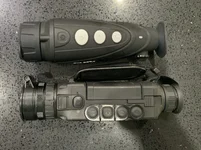
InfiRay Finder FH25R Thermal

The problem is not the sensor with that unit, its the rest of the guts inside and out.. it's built cheap, same when you come to sell it you will recoup less for it than other brands.. If build quality, replaceable battery, features, software control, residual value when you come to upgrade or sell is not an issue then there worth a look.

Second user Pulsar gear doesn't seem to support those statements!.
 
the Accolades retail at £4650.00, & have a base mag of 2.5x.

the Axion XQ38 LRF is well priced at £2130.00, but totally useless for me with a base mag of 3.5x !

I would ignore the magnification and look more at FOV , take for example the Axion Key 2.5x mag VS the Axion XM30S 4.5x magnification , FOV is identical the extra magnification comes down to the larger AMOLED display fitted to the XM30S, both have the exact same lens and sensor.

“Detection range” spec’s, are more for marketing, than practical use. Who on earth needs to spot, or range things at 1000m +, other than people shooting long range vermin, and then, they’d most likely using a far better range finder in the first place !
Detection range does paint a picture but its mainly the ability to detect one or two pixels of a man sized object at the units given detection range, this also translates into long range performance, if you buy a 400m detection range unit, its not going to be as good as a 1000m at distance, also some other manufacturers skew figures by using a VEHICLE as there detection range base object !

As for rangefinders the more powerful the unit, then it's going to be more consistent than a weaker unit, although design again would come into it, I'm sure we will see more advancements soon enough..

Why would you want to range find upto 1000m ? I asked this same question myself the answer, what if your someone who needs to measure the distance of a target, not for drop but to find out how far you have to travel to it also.
 
Second user Pulsar gear doesn't seem to support those statements!.
Pulsar has a strong residual value, you will always lose money regardless what you buy, but look at the less established brands carefully over a period of time, people spending thousands are a bit cautious, I watch the market continually, from a secondhand and new perspective.. Pulsar have always returned more money for the initial outlay, upto now anyway. Although the markets awash with thermals currently, it's only going to get more so when more units come out and people upgrade ..

Also If buying secondhand, would you want to buy a 3 year old fixed battery thermal unit ? Or a 3 year old Pulsar, with replaceable battery that you can also buy all the spares for ? You can still buy battery packs for 7-8 year old Quantum units and spares, I doubt when some of the lesser known brands, change models they will still be supplying parts 8 years later or replacing obsolete internal batteries on old models... again just to re-iterate my point of long term value.
 
Last edited:
I would ignore the magnification and look more at FOV , take for example the Axion Key 2.5x mag VS the Axion XM30S 4.5x magnification , FOV is identical the extra magnification comes down to the larger AMOLED display fitted to the XM30S, both have the exact same lens and sensor.

Ian,

I would agree, but FOV is related to the mag, and you need to make sure the figures you use, are based on "like for like".

So, please correct me if I'm wrong, but Iray give their FOV as an "X, & Y" axis, straight forward on a square/rectangular sensor. Pulsar state just one figure, which I understand to relate to the "diagonal", because just giving a single axis doesn't tell you much.

If this is correct, which unit gives the wider FOV, which makes sense, based on the lower mag ???

Detection range does paint a picture but its mainly the ability to detect one or two pixels of a man sized object at the units given detection range, this also translates into long range performance, if you buy a 400m detection range unit, its not going to be as good as a 1000m at distance, also some other manufacturers skew figures by using a VEHICLE as there detection range base object !

As for rangefinders the more powerful the unit, then it's going to be more consistent than a weaker unit, although design again would come into it, I'm sure we will see more advancements soon enough..

Why would you want to range find upto 1000m ? I asked this same question myself the answer, what if your someone who needs to measure the distance of a target, not for drop but to find out how far you have to travel to it also.

Some manufacturers will skew figures to suit, as do politicians, and other people too !

I guess some, including the Pulsar ranger finder may well be more accurate over a longer distance, but ultimately, the range finder only has to be accurate enough to be reliable over the distance, in which the hunter is comfortable to shoot ? What is the average distance people are happy to shoot at night, 200-300m ? Will a RF capable of 600m be good enough ? Personally, I've found the Finder RF to be fine, but I'm only ranging distances I want to shoot.

Ranging 100m +, comes back to what the individual hunter requires. I'm sure some hunters will spot deer, or fox's out to 1800m, and scurry across fields, farms, roads, etc', in an attempt to get close enough to shoot, before the animals are spooked, or move of their own volition.

Now, if we talk about just what the OP was asking, being able to spot rats, tell the difference between fox, & badgers, he certainly doesn't need the Accolade XP50 Pro, or whatever version there is now, or, to be fair, even the Finder, or the Axion XQ38RF, given he's now said he really doesn't need an RF...................

So based on the information he posted, what thermal spotter would you recommend now ?
 
A useful equation for horizontal FOV is:

(Pixel Pitch / Lens Focal Length) x Horizontal resolution of sensor = HFOV in Mils. Divide by 10 if you want Metres at 100M.

For some examples, the 1.5x magnification Finder FH25R would be:
(12/25) x 640 = 307.2 Mils or 30.72M at 100M

Accolade XP50 2.5x magnification would be:
(17/50) x 640 = 217.6 Mils or 21.76M at 100M

The V3 E6 Plus 2x magnification would be:
(12/35) x 640 = 219.5 Mils or 21.95M at 100M

Hopefully useful.


Cheers


Clive
 
A useful equation for horizontal FOV is:

(Pixel Pitch / Lens Focal Length) x Horizontal resolution of sensor = HFOV in Mils. Divide by 10 if you want Metres at 100M.

For some examples, the 1.5x magnification Finder FH25R would be:
(12/25) x 640 = 307.2 Mils or 30.72M at 100M

Accolade XP50 2.5x magnification would be:
(17/50) x 640 = 217.6 Mils or 21.76M at 100M

The V3 E6 Plus 2x magnification would be:
(12/35) x 640 = 219.5 Mils or 21.95M at 100M

Hopefully useful.


Cheers


Clive
I ended up with the E6 plus V3 I'm happy I looked at plenty in the shop and that's what I come away with.

Only downside is the laser doesn't work on that either
 
A useful equation for horizontal FOV is:

(Pixel Pitch / Lens Focal Length) x Horizontal resolution of sensor = HFOV in Mils. Divide by 10 if you want Metres at 100M.

For some examples, the 1.5x magnification Finder FH25R would be:
(12/25) x 640 = 307.2 Mils or 30.72M at 100M

Accolade XP50 2.5x magnification would be:
(17/50) x 640 = 217.6 Mils or 21.76M at 100M

The V3 E6 Plus 2x magnification would be:
(12/35) x 640 = 219.5 Mils or 21.95M at 100M

Hopefully useful.


Cheers


Clive

Clive,


Thanks for the information, and the equation, so people can work the "actual" spec's out.

So the RH25R FOV, is nearly 50% wider than the Accolade XP50......................impressive !
 
Ian,

I would agree, but FOV is related to the mag, and you need to make sure the figures you use, are based on "like for like".
FOV it not related to the mag entirely take for example the Axion Key and XM30S example I just gave you, magnification on an eye display doesn't mean it has less field of view. Take for example the Sightmark Wraith Against a Pard NV008P one claims 4.5x mag the other 6.5x, FOV is identical on both models, the much better OLED display and higher magnification on the Pard doesn't reduce field of view against a Wraith.

Some manufacturers will skew figures to suit, as do politicians, and other people too !

I guess some, including the Pulsar ranger finder may well be more accurate over a longer distance, but ultimately, the range finder only has to be accurate enough to be reliable over the distance, in which the hunter is comfortable to shoot ? What is the average distance people are happy to shoot at night, 200-300m ? Will a RF capable of 600m be good enough ? Personally, I've found the Finder RF to be fine, but I'm only ranging distances I want to shoot.

Ranging 100m +, comes back to what the individual hunter requires. I'm sure some hunters will spot deer, or fox's out to 1800m, and scurry across fields, farms, roads, etc', in an attempt to get close enough to shoot, before the animals are spooked, or move of their own volition.

Without beating around the bush, the LRF will work, but its diabolical, its very slow , stuck in metres, it's the worst I've ever used, but yes it does work eventually. The pulsar is better at close range has a much more legible readout, can be metres or yards, has horizontal true distance for shooting up inclines/declines and is much more consistent and quicker to read.

Now, if we talk about just what the OP was asking, being able to spot rats, tell the difference between fox, & badgers, he certainly doesn't need the Accolade XP50 Pro, or whatever version there is now, or, to be fair, even the Finder, or the Axion XQ38RF, given he's now said he really doesn't need an RF...................

So based on the information he posted, what thermal spotter would you recommend now ?
I've just this last half hour taken collection of another part exchange unit, the user upgraded his Helion XP50 original model to the latest Helion Pro model.

Its raining here and poor thermal transmission conditions, I've just updated the an iray E6 Pro the TOP END MODEL to the latest firmware, I looked out to 250 yds viewing people alongside the original Helion XP50, guess what the old Helion XP is light years ahead of the E6 Pro 12 micron unit, showing better background detail and target detail. The E6 pro image is diabolical for a 640 12 micron unit...in these conditions..

Helion XP was sent to forest mode with image boost on. E6 Pro was using ultra clear mode...

Years old unit against the top end iRay..

If I had a budget of less than £2.5k I would buy either a Helion XP50 or Helion 2 XP50 .probably pick one up from £2k - 2.5k . Anyone can buy what they like, but thats were my own hard earned would be going.

IMG_3703.webp

In fact, hang fire , I'm going to record some footage and show you exactly the performance difference...
 
Last edited:
FOV it not related to the mag entirely take for example the Axion Key and XM30S example I just gave you, magnification on an eye display doesn't mean it has less field of view. Take for example the Sightmark Wraith Against a Pard NV008P one claims 4.5x mag the other 6.5x, FOV is identical on both models, the much better OLED display and higher magnification on the Pard doesn't reduce field of view against a Wraith.


Without beating around the bush, the LRF will work, but its diabolical, its very slow , stuck in metres, it's the worst I've ever used, but yes it does work eventually. The pulsar is better at close range has a much more legible readout, can be metres or yards, has horizontal true distance for shooting up inclines/declines and is much more consistent and quicker to read.


I've just this last half hour taken collection of another part exchange unit, the user upgraded his Helion XP50 original model to the latest Helion Pro model.

Its raining here and poor thermal transmission conditions, I've just updated the an iray E6 Pro the TOP END MODEL to the latest firmware, I looked out to 250 yds viewing people alongside the original Helion XP50, guess what the old Helion XP is light years ahead of the E6 Pro 12 micron unit, showing better background detail and target detail. The E6 pro image is diabolical for a 640 12 micron unit...in these conditions..

Helion XP was sent to forest mode with image boost on. E6 Pro was using ultra clear mode...

Years old unit against the top end iRay..

If I had a budget of less than £2.5k I would buy either a Helion XP50 or Helion 2 XP50 .probably pick one up from £2k - 2.5k . Anyone can buy what they like, but thats were my own hard earned would be going.

View attachment 218318

In fact, hang fire , I'm going to record some footage and show you exactly the performance difference...

Just recorded footage , just waiting on people walking along to show target detail difference, all in rain conditions . … update got some !!

If I used a Helion Pro in this comparison instead of an Old XP model, it would be pretty embarrassing for the iRAY. E6 Pro.

Give me a bit to get this footage uploaded, the iRay won't connect to the MacBook, it needs a PC.
 
Last edited:
I'm afraid my technical knowledge regarding the workings of NV, and thermal, are at best limited. So I have no idea how, or why, the FOV on a Pard, is comparable with a Wraith, and to be honest, I don't need to.

I do know that as a rule of thumb, the lower the mag, the wider the FOV.

When I started comparing mag of the RH25R, to the Pulsars, you said, don't do that, compare FOV, well Clive did, and showed that the RH25R had a 50% wider FOV !

Now you want to introduce two totally unrelated N/V units, into a discussion about thermals. Do you think any of this, has been helpful to the OP :-|


I don't give two hoots what brand unit someone buys, only that they are given the best information, to make the right choice for "them", and NOT where you, or I, might put our money !
 
I'm afraid my technical knowledge regarding the workings of NV, and thermal, are at best limited. So I have no idea how, or why, the FOV on a Pard, is comparable with a Wraith, and to be honest, I don't need to.

I do know that as a rule of thumb, the lower the mag, the wider the FOV.

When I started comparing mag of the RH25R, to the Pulsars, you said, don't do that, compare FOV, well Clive did, and showed that the RH25R had a 50% wider FOV !

Yes because the lens size is much smaller and the RH is a 640 model which further increases FOV over a smaller sensor , although pixel pitch counter acts this also, meaning, smaller increases mag and reducing FOV and vice versa.
Now you want to introduce two totally unrelated N/V units, into a discussion about thermals. Do you think any of this, has been helpful to the OP :-|


I don't give two hoots what brand unit someone buys, only that they are given the best information, to make the right choice for "them", and NOT where you, or I, might put our money !

Two different units which highlight the fact a lower or higher magnification does NOT mean more FOV theres other criteria at hand..

I don't care either what someone buys, I'm just giving an honest option from a user who actually compares them all in the field and loves using it, money doesn't come into it from my part, I'd rather someone get the BEST they can for there money. I'm stating what I have found by my own blood, sweat, tears and risk..... you can lead a horse to water is the old saying.

If you want to use an iRay finder and it suits you, then that is entirely upto you... best to just ignore anything else if your happy, your happy end of..
 
Last edited:
Ian,

I use a unit that best suits the particular type of hunting I do. As I have already stated, Low mag, wide FOV is what I need, the RH25R for spotting, Thermion 2 XP50 for the sight works for me.

If I were foxing, I'd use the Rico RL42 to shoot with, but changing the RH25r to something else won't increase what I can spot, that I can also shoot, one jot.

The one thing the OP didn't need, is a £4600.00 Accolade, for ratting, something nearly twice the price of what he was asking about 🙄
 
Out of interest, has someone moaned about the laser on the infiray as well, like they did with the pard.
It's an R3 5mw. Please don't tell me someone has moaned about this one as well.
 
Out of interest, has someone moaned about the laser on the infiray as well, like they did with the pard.
It's an R3 5mw. Please don't tell me someone has moaned about this one as well.
Weird thing is the Finder is meant to have a laser pointer to allow you to move your laser range Finder splash to the same location , but it has been disabled in the firmware .

Some of the E3/E6 models have actual laser pointers , there all fitted with them , but some firmware they work, other firmwares there disabled there’s no consistency .
 
Weird thing is the Finder is meant to have a laser pointer to allow you to move your laser range Finder splash to the same location , but it has been disabled in the firmware .

Some of the E3/E6 models have actual laser pointers , there all fitted with them , but some firmware they work, other firmwares there disabled there’s no consistency .
I have just found how to activate it. But it does not line up with the screen dot. I'm just waiting for a reply on how to more either the laser or the screen dot.

press three buttons(image mode, digital zoom and photo button) till hear the shutter working sound to activate laser function. Then press and hold the Image mode button to open the laser pointer, and the same step to close it.
 
I feel some people on here are being more than disingenuous regarding the Finder. I bought mine to try against a Helion 2 XP50. I have owned - and used in the field - devices from IR Guide, Quantums, Helions. My own take is that they are all too sensitive. I want a unit to 'spot' a deer, not a rabbit/hare at 600+ yds. I looked at the Finder specs and thought - erroneously - it would be less 'sensitive'. Wrong!.
The little Finder still shows heat sigs from hares, rabbits and hedgehogs at massive distances, which I don't want.
The rangefinder and laser pointer functions have to be enabled before first use. I'm surprised at any retailer suggesting that this is a 'problem/fault'. Maybe there is more to his views/exhortations than meets the eye (pun intended).
My findings of the Finder after 3-4months continual use in the field: not as ergonomic as Pulsars offerings. In all other departments: way ahead.
Pulsar now for sale.
 
I feel some people on here are being more than disingenuous regarding the Finder. I bought mine to try against a Helion 2 XP50. I have owned - and used in the field - devices from IR Guide, Quantums, Helions. My own take is that they are all too sensitive. I want a unit to 'spot' a deer, not a rabbit/hare at 600+ yds. I looked at the Finder specs and thought - erroneously - it would be less 'sensitive'. Wrong!.
The little Finder still shows heat sigs from hares, rabbits and hedgehogs at massive distances, which I don't want.
The rangefinder and laser pointer functions have to be enabled before first use. I'm surprised at any retailer suggesting that this is a 'problem/fault'. Maybe there is more to his views/exhortations than meets the eye (pun intended).
My findings of the Finder after 3-4months continual use in the field: not as ergonomic as Pulsars offerings. In all other departments: way ahead.
Pulsar now for sale.
You can spot heat with any thermal , so to break it down, the Finder image up close is very good, but it’s not at a distance in comparison to the other models, the rangefinder is also rubbish although it does work.. I’ve spent enough time and money to know what’s what by now , if it was truly great I would keep one myself ..
 
I feel some people on here are being more than disingenuous regarding the Finder. I bought mine to try against a Helion 2 XP50. I have owned - and used in the field - devices from IR Guide, Quantums, Helions. My own take is that they are all too sensitive. I want a unit to 'spot' a deer, not a rabbit/hare at 600+ yds. I looked at the Finder specs and thought - erroneously - it would be less 'sensitive'. Wrong!.
The little Finder still shows heat sigs from hares, rabbits and hedgehogs at massive distances, which I don't want.
The rangefinder and laser pointer functions have to be enabled before first use. I'm surprised at any retailer suggesting that this is a 'problem/fault'. Maybe there is more to his views/exhortations than meets the eye (pun intended).
My findings of the Finder after 3-4months continual use in the field: not as ergonomic as Pulsars offerings. In all other departments: way ahead.
Pulsar now for sale.
After a few days using this infiray E6+ and a number of years using the quantum xq30v lite. I'm sort of going to say I know where your coming from. The iray is to good, maybe a little to good. In a weird sort of way, I still prefer the older pulsar with is little sensor. Yes, hard work spotting rabbits over 200 yards and fox over 400. Deer after 8-900 you really need to know your grounds and what should be there.
The pulsar had really done me very well for spotting heat blobs.

The iray picks up everything, at 1000+ I can see the branch's and on the trees. I can see all the pheasants in the trees too. Every mouse in the field, all the bats for stupid distance. I know it's just time to relearn and adjust to the new way, And i dare I have a few setting to sort out. The only reason I changed to better was I need to know what's on the ground on places I don't know. I need to know if a long walk will end up just being a badger or muntjac when I'm on the foxes. I need to be able to see the difference between a lamb and a fox in the lambing fields. So I changed.
Yes a few things I'm missing at the momnet but I'll get use to it. I'm blind as a bat and at night I put the glasses away, this means I can't see the time on my phone, the pulsar had the time in the corner. I liked that.
Also the two mounting points ment I could use the bino harness to stop the neck strain.
But, the main one is the white hot for the day time and a quick press of a button turned on the red with yellow hot for night, saving the eye burn.
As said, all new, just need time in the field with the E6+ and I'm sure it will be fine.
Just have to sell the pulsar off now haha
 
I feel some people on here are being more than disingenuous regarding the Finder. I bought mine to try against a Helion 2 XP50. I have owned - and used in the field - devices from IR Guide, Quantums, Helions. My own take is that they are all too sensitive. I want a unit to 'spot' a deer, not a rabbit/hare at 600+ yds. I looked at the Finder specs and thought - erroneously - it would be less 'sensitive'. Wrong!.
The little Finder still shows heat sigs from hares, rabbits and hedgehogs at massive distances, which I don't want.
The rangefinder and laser pointer functions have to be enabled before first use. I'm surprised at any retailer suggesting that this is a 'problem/fault'. Maybe there is more to his views/exhortations than meets the eye (pun intended).
My findings of the Finder after 3-4months continual use in the field: not as ergonomic as Pulsars offerings. In all other departments: way ahead.
Pulsar now for sale.

It's about business. A Pulsar dealer doesn't make money from people wanting Iray, unless they have stock over, from when they were also an Iray dealer, before they weren't !

Time, and again, people state their own "personal preference", which may, or may not be the same personal preference as someone else, but this is misleading, unless someone has had the opportunity to try both, side by side. A rare thing.

It's like arguing that Swarovski is better than Zeiss, or Leica, or visa versa. Personal preference, none are "bad", it depends on what your own eyes prefer.


"Marketing, is marketing", a "sales pitch", is a "sales pitch". Owners nearly always recommend what they have at the time, because that's what they either compared, and preferred, or they just bought into, and now need to justify their choice, mainly to themselves.

I deal with this type of cr*p all the time, people telling people something is the best thing since sliced bread, when it's the limit of their experience.

I don't rate one of these brands over another, but I do rate individual units, based on application, and "MY personal preference".

Do the same, and it's hard to go wrong !
 
Back
Top