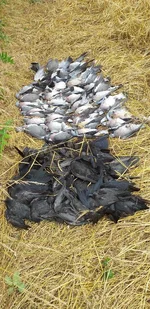
You have good numbers.

Also a lot more patience.

You have good numbers.

I have moreYou have good numbers.
Also a lot more patience.

That is serious and professional pigeon control Tim.I have morepatientsthan Harold Shipman View attachment 368692
That is serious and professional pigeon control Tim.
I am an amateur on the pigeons. Three or four, they fly off, some return, 3 more, at most a dozen in an hour or two, even with the benefit of covering a wide area of field.


I'm well versed with his opinion, it is not one I share. I have lambed my fair share too, I have seen mortality caused by all sorts. I have used various methods to prevent them.Don’t know if you read VSS earlier thread re lamb mortality, it opened your eyes to the bald fact due to losses it was going towards being a loss leader due solely on a very high mortality which wasn’t all down to foxes, in fact foxes were shown to take a lot less live or carrion food than problematic illness, cold and wet, albeit lower, the need to protect live lambs is even more important than previously thought when you gauge it against the overall cause of huge losses
Removing foxes should be stepped up all year round rather than a few short hectic lambing weeks it gives other wildlife a chance as well


 www.theguardian.com
In the absence of any other significant problems, it's almost invariably the 2nd one of twins that's taken, not the first, and it's dead before the fox takes it.I don't care how well regarded in animal husbandry anyone is. Unless they are clairvoyant you're not telling me that the twin lambs taken while the mother birthed the second was going to die anyway.
.

I’m not a shepherd I shoot foxes,prior to that proof buildings so as not allow access and where possible improve on the site overall firstly apply the the triangle - food, harbourage and water remove 2 of these most predators or pests will move on 2nd proofing and 3rd option removal that’s how I work in that order, given the losses excluding predators is very high for what ever reason my question was l there or should there be a process for keeping high loss animals inside 100% until they are past the danger time predator or at high risk due to other factorsI'm well versed with his opinion, it is not one I share. I have lambed my fair share too, I have seen mortality caused by all sorts. I have used various methods to prevent them.
I don't care how well regarded in animal husbandry anyone is. Unless they are clairvoyant you're not telling me that the twin lambs taken while the mother birthed the second was going to die anyway.
Some foxes become very adept at taking lambs, others will pass through picking up nothing more than the afterbirth. Of those weak lambs that are allegedly the only ones taken how many could be saved if found the following morning and treated? You'll never know. But I do know that the more predators there are the more prey species are eaten as a result. They with target whatever easy food source till it runs out. Then they either move on or starve.

Yep. They always find the last chink in the armour that’s for sure,Chicken range fencing does not keep fox's and badgers out! It just about keeps chickens in.
I shot one on the outskirts of the village for one of my beaters,it had been in after his chickens the night previous. It was walking along the top of a wood weave panel in his fence, just like a cat does.Yep. They always find the last chink in the armour that’s for sure,
I saw one in the thermal on a 8” corner post all 4 feet on the top, it jumped straight on stood there for a minute surveying the area, then casually jumped into the range on my side it’s one mistake
Fence post 6’2” in height, it didn’t blink an eye at it
Sounds like you shoot wood pigeons like other people shoot foxes.Wood pigeons, I shoot as many as possible though don't wait for them in a hide: using a .17 HMR once they are on the ground allows them to be dropped far beyond shotgun distances,

Agreed. Ewe has already established the bond with first. As she realises it's no longer right next to her, soon as she can she wants to get back after it even if that means abandoning the newly born one she hasn't bonded with yet. Obviously doesn't happen every time, not even most of the time thankfully, especially with proper maternal ewes. But that's a another mortality risk (abandonment) higher on list than fox KILLS.In the absence of any other significant problems, it's almost invariably the 2nd one of twins that's taken, not the first, and it's dead before the fox takes it.
This is why:
While the ewe is birthing her 2nd lamb, the first is wandering off. As it gets further away (say, anything more than 5 yards) the ewe gets more anxious about it, with the result that, as soon as she's expelled the 2nd lamb she rushes after the first. By the time she returns to the 2nd lamb to lick it clean it has drowned in the fluids and membranes, and becomes fox bait.

Can a decent shepherd save the abandoned one if found in time if he or she gets there before Charlie Ben?Agreed. Ewe has already established the bond with first. As she realises it's no longer right next to her, soon as she can she wants to get back after it even if that means abandoning the newly born one she hasn't bonded with yet. Obviously doesn't happen every time, not even most of the time thankfully, especially with proper maternal ewes. But that's a another mortality risk (abandonment) higher on list than fox KILLS.

Nicely written Tim, but you still judged someone you know absolutely nothing about!No, it's not a presumption. It's a conclusion based on many years experience.
Reducing lamb mortality is something I've devoted my life to. It has become my specialist subject. I've researched it, experimented, written about it, spoken at conferences, taught at agricultural colleges on the subject and run residential courses. And managed my own farm alongside all this.
For a significant proportion of my life I was a contract lambing "trouble shooter" (not to be confused with fox shooter). For five months every year (early December to early May) I did nothing but lambing, from lowland early lambing flocks in the South East to some of the highest mountain flocks in Wales, and every conceivable permutation in between. Always with the sole aim of reducing lamb mortality, and always successful. Not once did that involve culling foxes. Even on the farms that believed they had a fox problem (and there were many), it was always possible to determine why they had lambs that were vulnerable to predation and therefore deal with the problem at source. Shooting foxes is simply shutting the stable door after the horse has well and truly bolted.
If I could I would, with all good will, offer the same service to your shepherd friends, and make a real lasting difference, but unfortunately my health no longer permits it.
So, by all means cull foxes in areas of high population to protect ground nesting birds etc, or poultry, or game birds, or just because you enjoy shooting foxes, but don't kid yourself (or your shepherd friends) that shooting foxes will result in any improvement in the overall output of a sheep flock, because it won't. It will reduce the number of non-viable lambs eaten by foxes, but it will not reduce the number of non-viable lambs.

Aye, many don't think a badger is agile, I once watched one clime a damson tree for the fruit.it's not always foxes! A couple of years ago my farmer friend and I were having a drink and we heard a commotion in his large chicken run. We got the thermal and looked out the window. there were two badgers in the run. We nipped outside thinking they must have got through the wire netting. As we approached they saw us and left by the same way they got in, up and over the six-foot-high wire netting. Their weight had made the netting sag a bit, but if I hadn't seen it I wouldn't have believed it possible.