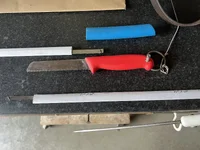
Butchers saw?

Any recommendations folks? Tbh the last one I bought wasn’t cheap and something snapped down near the handle where the blade usually clicks in/gets replaced - after a few months of cable ties to hold the blade in place, I’ve given up on it.

Is there an intermediate that would do in the field,(in a roe sack) for opening up a chest as well as in the kitchen? Maybe a folding saw?

All I tend to do is shorten the shanks and make a couple of cuts to the carcass to make it easier to handle in the kitchen.


Happy to buy another proper / full length one as well. Just need recommendations. Cheers!
All the sizes, all the blades, all the spares.

For the field, a David Stretton Bone Saw

Drill a hole in the handle end and clip it into your roe sack - so you don’t lose it!
 
Last edited:
The Stretton bone saw cuts on the pull stroke; the blades for replaceable blades butcher saws can be used as designed for, or otherwise.
I think the Stretton saw is designed as a chest saw for gralloching/field use, isn't it? So cutting on the pull to keep the chest cavity clean of debris. That's a bit different from a butcher's saw. But agreed, on most butcher's saws you could fit the blade either way around (the right way or the wrong way 😉) to suit yourself.
 
IMG_4587.jpeg
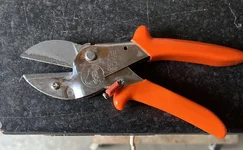
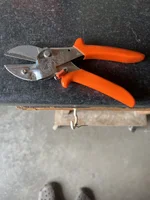
I only personally use the butcher’s saw for removing the lower part of the shank and the atlas joint/first inch of the neck on roe, and occasionally on the cleaned of meat ribcage on red deer, I use a pair of Lowe anvil secateurs for the rib bones on a roe.

IMG_4588.webp

For cutting trophies I use a 14tpi wood saw of the type per Rory’s suggestion at #7.

I’ve yet to deal with a deer sporting a wooden leg, but there’s aye a first time.. 😆
 

Attachments

  • image.webp
    image.webp
    239.4 KB · Views: 4
  • Like
Reactions: VSS
A butcher's saw is designed to cut on the push stroke.
So it seems, trying to search references (in English it's hard, in Finnish impossible...)

I did find some references to amputation saws working on pull stroke, presumably for same reason (more controlled and nicer cut) than Japanese style.

Of course the design in butcher's saw looks like push saw (regular hacksaw style that tensions the blade). Maybe the sources of my information have been confused with the field use chest saw you also mentioned in later post.
 
  • Like
Reactions: VSS
I was given one from a Slaughterhouse, I remember posting about filling the teeth back to a good edge
Usual SD reply "get a new blade" my answer was do you sharpen your chainsaw blade/pencil/stalking knife or get a new one :doh:
Years ago, all carpenters used to sharpen their Diston hand & tenon saws. When I started, a few of the old fellas still sharpened their own.
 
My butchers saws have all been forward cutting and I have often wondered about trying the blade the other way around. I find they can be hard to get started and skite about. Is it any better on one that cuts on the pull stroke or just a feature of cutting something slippery and relatively mobile?
 
  • Like
Reactions: jb1
My butchers saws have all been forward cutting and I have often wondered about trying the blade the other way around. I find they can be hard to get started and skite about. Is it any better on one that cuts on the pull stroke or just a feature of cutting something slippery and relatively mobile?
Cutting through the ribs on either brisket or flat ribs on a fore quarter with a saw cutting on a pull stroke would be frightening, the saw would be bouncing all over the place.
 
Buy a hackzall/sawzall and thank me later.

Stick a plastic bag over it and poke the blade through to save it getting too dirty.

Blades can be changed to make it better for splitting carcass/fine work.

I have had all manner of saws throughout my many years of life on this planet but wish I’d bought a reciprocating saw decades and decades ago.
 
Buy a hackzall/sawzall and thank me later.

Stick a plastic bag over it and poke the blade through to save it getting too dirty.

Blades can be changed to make it better for splitting carcass/fine work.

I have had all manner of saws throughout my many years of life on this planet but wish I’d bought a reciprocating saw decades and decades ago.
^^^^^ What he said
You can buy stainless blades to fit on Amazon.
You'll never use a handsaw again.
 
Buy a hackzall/sawzall and thank me later.

Stick a plastic bag over it and poke the blade through to save it getting too dirty.

Blades can be changed to make it better for splitting carcass/fine work.

I have had all manner of saws throughout my many years of life on this planet but wish I’d bought a reciprocating saw decades and decades ago.
That's interesting, thank you.
I really struggle to use a handsaw now (due to a debilitating degenerative medical condition), so I've been considering a reciprocating saw instead.
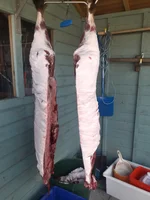
I know I can butcher a whole deer without using a saw at all, but the way I'm currently breaking down fallow carcasses to give me the best return on time and space does involve a few uses of the saw.
 
Cutting through the ribs on either brisket or flat ribs on a fore quarter with a saw cutting on a pull stroke would be frightening, the saw would be bouncing all over the place.
I have seen a well-known venison butcher, who does regular demos at the game fair etc, reversing the blade in order to cut the flat ribs on the pull stroke. Apparently, it resulted in less splintering.
Personally, I think that if you're getting a lot of splintering then you're using a blade that's too coarse and you're cutting at the wrong angle.
A finer blade makes a massive difference. Deer bone is nothing like pig or lamb bone. It's much denser. So a standard bone saw blade as used by conventional butchers is likely to be too coarse.

Incidentally, I wanted to order a new saw blade from Bushwear, so, being unable to find the information I wanted on their website, I phoned to ask how many teeth per inch the blade had. They didn't know.
"Have you got one in stock?" I asked.
"Yes".
"Well could you please count how many teeth per inch it has?"
"No, sorry, we can't do that. It's too dangerous".

Ffs! I really couldn't believe what I was hearing! Needless to say, I bought a blade from someone who was able to provide the necessary information.
 
Elf & safety gone mad.
Stanley kniives were banned in my last workplace because a bloke cut his face with one. No questions as to HOW, just bann them.

Splintering also depends on how much force you use on the saw..
 
On the smaller deer I find a reversed blade much easier especially on the ribs. You can start the cut without it catching and splintering.
 
In woodworking, Japanese have used saws that cut on the pull stroke for generations and produce very fine joinery work.

In the west we have used hand saws that cut on the push stroke and have done so for generations and produce very fine joinery work.

There is endless debate as to which is better. They are just different ways of getting to the same result.

Butchery - again there are differences in how animals are butchered all over the world. French butchery and cuts of meat are quite different to traditional British styles. Indeed pre supermarket days there was I suspect huge regional variations.

As there is in most trades and crafts.
 
Used by just about every butcher in the country, i have just check the price and the link above is about the best ive seen, and get spare blades when you order. 👍 ;)
Likewise, initial cost has been repaid many times over…..
 
Back
Top