Ban on lead shot what about old guns

Hydrowad

  • 100% plastic free, non-toxic and will degrade in a field over a period of time.
  • Biodegradable cup wad maintains tight patterns and aids barrel protection for use with steel shot
  • On a hot peg, Hydrowad leaves no residue in the barrels.
I've got some of those wads sitting out back. Been there 8 months now and I could reload them if I wanted!
It's bull****.
 
Nothing more nothing less.
I've got some of those wads sitting out back. Been there 8 months now and I could reload them if I wanted!
It's bull****.
Well at least they are trying to provide ammo for after the ban.

BASC once again f++K things up. Now there's something. 🤨

"The Hull Cartridge "Hydrowad" controversy stems from a disagreement between Hull Cartridge and shooting organizations regarding the use of non-lead shot and the development of biodegradable wads like the Hydrowad.

Specifically, the controversy involves the announcement by BASC and other organizations to phase out lead shot and single-use plastics in ammunition within five years, without prior consultation with UK cartridge manufacturers. This led to a public dispute and a call for rebuilding trust between the parties involved.


Key Points of the Controversy:
  • Lack of Consultation:
    The core of the issue is the lack of consultation between BASC and other shooting organizations with UK cartridge manufacturers before announcing the phase-out of lead shot and single-use plastics.

  • Product Viability:
    The shooting organizations were perceived to have looked at a limited number of products and assumed they were a viable alternative, which the manufacturers disagreed with.

  • Development of Non-Lead Alternatives:
    Hull Cartridge, along with other manufacturers, stated they were already developing alternative non-lead products, but wanted a collaborative approach to the transition.

  • Biodegradable Wad Technology:
    The Hydrowad, a biodegradable wad developed by Hull Cartridge, became a point of discussion, with some organizations questioning its effectiveness in comparison to traditional plastic wads.

  • Calls for Trust and Transparency:
    Hull Cartridge emphasized the need for a meaningful discussion to rebuild trust and transparency between all parties involved.
Hull Cartridge's Perspective:
  • Hull Cartridge, while acknowledging the need for non-lead alternatives, stressed the importance of a collaborative approach and the need for further research and development.

  • They highlighted the fact that they were already actively developing non-lead products and biodegradable wads like the Hydrowad.

  • They emphasized the need for organizations to understand the complexities of developing and implementing these changes.
-------

Also found this online

"People need to get their head around "biodegradable"

There's no time set for something to be "biodegradable", however, if it can be broken down by bacteria in the natural world, then it's infact biodegradable. To what extent though is debatable.

Eley wads are soluble more than biodegradable, that's why they go all mushy and sticky and essentially melt away.
Other bio plastics tend to get brittle and break down with exposure to the outside world but they don't leave behind any of the polymer chains like the photo degradable wads which just turn to micro plastics.

Everyone knows fibre wads are biodegradable yet I've seen them linger around for up to a year. I think people's expectations of what's classed as biodegradable are different to the scientific community "
------
Clay pigeons are in fact biodegradable. Really.

So realistically why hamstring ourselves with wads that could turn to mush, over time, if damp ----can you see a safety issue here?--

-but have wads that "comply" and don't turn to mush if damp in our lovely British climate.
 
Last edited:
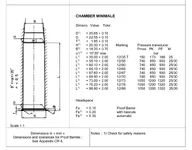
Is that the proof pressure or service pressure
For CIP

PE as i understand it and google AI 😂 Proof Pressure (PE):
The "PE" marking on a firearm indicates the pressure it was proofed at. This pressure is higher than the maximum pressure a standard cartridge should generate

When proofing the cartridges, statistics analysis is used to arrive at a CIP pass or failure.
CIP define the limits of average pressure for the gauge depending on chamber length this is known as Ptmax.
They also define statistical maximum pressure Pn <= Ptmax and Pn+(K2n x Sn)<= 1.15 Ptmax which is the maximum pressure that no single cartridge must exceed = PK

so for 12gauge 70 mm Ptmax is 740 bar PK 850 bar and PE 930 bar.

IMG_5460.webp
 
P25 of the manual.
"All Affinity shotguns are subjected to a 1370bar burst test at the Italian National Proof House in Gardone Val Trompia (Brescia - Italy),according to C.I.P. (Commissione Internazionale Permanente - Permanent International Commission) regulations. Affinity shotguns can use all cartridges in the gauge indicated on the firearm, in compliance with the C.I.P. (Commissione Internazionale Permanente - Permanent International Commission) regulations."

I quote from the Franchi manufacturers information.

The same with the Hull "imperial" carts post above.

Hydrowad

  • 100% plastic free, non-toxic and will degrade in a field over a period of time.
  • Biodegradable cup wad maintains tight patterns and aids barrel protection for use with steel shot
  • On a hot peg, Hydrowad leaves no residue in the barrels.

https://www.franchiusa.com/sites/de...ls/2020-08/affinity_intensity_manual_2013.pdf

Give your head a good shake.

Franchiusa will proof to SAAMI standards not CIP hence the difference of a few bar, just as they allow for faster steel shot velocity, momentum than CIP allows.
 
There's no time set for something to be "biodegradable", however, if it can be broken down by bacteria in the natural world, then it's infact biodegradable. To what extent though is debatable.

I agree we are not given any information on how long wads will take to biodegradable but there is a standard and it does set time limits, for plastic packaging it’s EN 13432 however none of the wads claim to meet this standard as far as I know.

As a new member you would do well to use the search facility as lots of information on SD about the lead ban and wads.
 
On reading that article it appears that the lead contamination happens more often because of shooting over stored wheat, as in indoor pest control, not in the field. Edit (As pointed out in post 68).
There is plenty of research into plant uptake of lead however.
Actually, we're all living longer, at great expense to the pension system and the NHS, so frankly I'm surprised that the government is so concerned that we are all poisoning ourselves. You'd have thought they would be encouraging people to an early grave.
Let's put this to bed ALL FOOD manufacturers have magnets and metal detectors. With the metal detector having four test pieces and one of them is lead.
 
It doesn't take a brain surgeon to realise that on large shoots there are going to be vast amounts of plastic wads lying around for decades.
Even if they use degradable types there will be an overlap year on year until the antis latch onto it and fight to get it banned.
Out the frying pan and into the fire we go. 🤦
 
The fact it's not proofed for non lead doesn't mean it won't work with non lead. It just means it wasn't tested for non lead at the time.
My understanding is that it's only likely to be the high velocity non lead that you wouldn't be able to use. Standard velocity non lead cartridges should be fine.
Correct depending on choke, which can be opened up if necessary
 
I agree we are not given any information on how long wads will take to biodegradable but there is a standard and it does set time limits, for plastic packaging it’s EN 13432 however none of the wads claim to meet this standard as far as I know.

As a new member you would do well to use the search facility as lots of information on SD about the lead ban and wads.

B&P Greencore is

EN 13432 certified​

Summary of BS EN 13432: ‘Compostable’ criteria

Key tests and Pass / Fail criteria are:

  • Disintegration – the packaging sample is mixed with organic waste and maintained under test scale composting conditions for 12 weeks after which time no more than 10 % of material fragments are allowed be larger than 2 mm.
  • Biodegradability - a measure of the actual metabolic, microbial conversion, under composting conditions, of the packaging sample into water, carbon dioxide and new cell biomass. Within a maximum of 6 months, biodegradation of the test sample must generate an amount of carbon dioxide that is at least 90 % as much as the carbon dioxide given off from the control / reference material.
  • Absence of any negative effect on the composting process.
  • Low levels of heavy metals (Potentially Toxic Elements) and no adverse effect of the quality of compost produced. Upper limits, in mg/kg of dry sample, are: zinc 150, copper 50, nickel 25, cadmium 0.5, lead 50, mercury 0.5, chromium 50, molybdenum 1, selenium 0.75, arsenic 5 and fluoride 100.
  • The composted packaging material must not have adverse effect on the bulk density, pH, salinity (electrical conductivity), volatile solids, total nitrogen, total phosphorus, total magnesium, total potassium and ammonium nitrogen characteristics of the compost.
Each of these tests is undertaken according to internationally agreed methods of test, as specified in BS EN 13432. Independent laboratory test results are then compared with the strict pass / fail limits set in the standard. Only if a material passes every ‘compostable’ test requirement is it proven to be ‘compostable’.

I have a load of wads sitting in water from a known date
Not expecting them to turn to mush anytime soon which will allay any fears of cartridges stored in your garage suddenly melting

However I am not conviced this definition of "compostible" is relevant
It requires physical breakdown to smaller size and is related to Industrial processes not natural broadcasting into the environment


Home compostable packaging and plastics

In addition to certification to BS EN 13432, it is also possible for a product to be deemed ‘home compostable’. At present there are no specific international or national standards for home compostable packaging and plastics, as the existing EU standards and their nationally adopted versions involve methods of test that simulate industrial scale composting and anaerobic digestion.
 
B&P Greencore is

EN 13432 certified​

Summary of BS EN 13432: ‘Compostable’ criteria

Key tests and Pass / Fail criteria are:
  • Disintegration – the packaging sample is mixed with organic waste and maintained under test scale composting conditions for 12 weeks after which time no more than 10 % of material fragments are allowed be larger than 2 mm.
  • Biodegradability - a measure of the actual metabolic, microbial conversion, under composting conditions, of the packaging sample into water, carbon dioxide and new cell biomass. Within a maximum of 6 months, biodegradation of the test sample must generate an amount of carbon dioxide that is at least 90 % as much as the carbon dioxide given off from the control / reference material.
  • Absence of any negative effect on the composting process.
  • Low levels of heavy metals (Potentially Toxic Elements) and no adverse effect of the quality of compost produced. Upper limits, in mg/kg of dry sample, are: zinc 150, copper 50, nickel 25, cadmium 0.5, lead 50, mercury 0.5, chromium 50, molybdenum 1, selenium 0.75, arsenic 5 and fluoride 100.
  • The composted packaging material must not have adverse effect on the bulk density, pH, salinity (electrical conductivity), volatile solids, total nitrogen, total phosphorus, total magnesium, total potassium and ammonium nitrogen characteristics of the compost.
Each of these tests is undertaken according to internationally agreed methods of test, as specified in BS EN 13432. Independent laboratory test results are then compared with the strict pass / fail limits set in the standard. Only if a material passes every ‘compostable’ test requirement is it proven to be ‘compostable’.

I have a load of wads sitting in water from a known date
Not expecting them to turn to mush anytime soon which will allay any fears of cartridges stored in your garage suddenly melting

However I am not conviced this definition of "compostible" is relevant
It requires physical breakdown to smaller size and is related to Industrial processes not natural broadcasting into the environment


Home compostable packaging and plastics

In addition to certification to BS EN 13432, it is also possible for a product to be deemed ‘home compostable’. At present there are no specific international or national standards for home compostable packaging and plastics, as the existing EU standards and their nationally adopted versions involve methods of test that simulate industrial scale composting and anaerobic digestion.

So we are picking up the wads to send to an industrial composting facility.

Please do not believe all they tell you, just because the material meets EN 13432 does not mean the product does.
Rich in carbon dioxide, so great on plant Mars.

The best biodegradable wads are the cardboard tube type as being cellulose microorganisms in the environment will eat the cardboard.

Re Green Core Wads

Dear gggggggg

The literature from states as follows

" degrades at least 90% in 6 months when subjected to an environment rich in carbon dioxide"
"when in contact with organic materials for a period of 3 months, the mass of the material decomposes for 90% from fragments less than 2mm in size"
"The material is EN13432 certified"

However, the time frames are not applicable to the UK climate. It will take longer to degrade . What shooters have to realise is that to retain the performance and ballistics of a plastic wad the bio wad needs to be rigid/stable enough to suffer the pressure sand heat when a cartridge is fired.

These wads will not degrade within weeks or a few months, they will degrade but there are many factors that determine the timeframe. Eg they will start to breakdown quicker in summer, they will breakdown quicker in the South West of the country compared to the north east / Scotland etc due to climate variation.

Also, we need the wads to have a good shelf life, so shooters can store them for a number of months without fear of the wad breaking down in storage. There must be some compromise. Even a fibre wad doesn't degrade within days/ weeks. It can remain for a while.


Kind Regards
xxxxxx@fiocchi.com
 
So we are picking up the wads to send to an industrial composting facility.

Please do not believe all they tell you, just because the material meets EN 13432 does not mean the product does.
Rich in carbon dioxide, so great on plant Mars.

The best biodegradable wads are the cardboard tube type as being cellulose microorganisms in the environment will eat the cardboard.

Re Green Core Wads

Dear gggggggg

The literature from states as follows

" degrades at least 90% in 6 months when subjected to an environment rich in carbon dioxide"
"when in contact with organic materials for a period of 3 months, the mass of the material decomposes for 90% from fragments less than 2mm in size"
"The material is EN13432 certified"

However, the time frames are not applicable to the UK climate. It will take longer to degrade . What shooters have to realise is that to retain the performance and ballistics of a plastic wad the bio wad needs to be rigid/stable enough to suffer the pressure sand heat when a cartridge is fired.

These wads will not degrade within weeks or a few months, they will degrade but there are many factors that determine the timeframe. Eg they will start to breakdown quicker in summer, they will breakdown quicker in the South West of the country compared to the north east / Scotland etc due to climate variation.

Also, we need the wads to have a good shelf life, so shooters can store them for a number of months without fear of the wad breaking down in storage. There must be some compromise. Even a fibre wad doesn't degrade within days/ weeks. It can remain for a while.


Kind Regards
xxxxxx@fiocchi.com
I have wads outside from Hull degrading. They have been out there 15 months now and think I could reload with them still.
They haven't degraded one bit.
So from that I conclude there will be an overlap after overlap each shot season.

Perfect for the next attack on shooting!
 
I've got some of those wads sitting out back. Been there 8 months now and I could reload them if I wanted!
It's bull****.
Compostable plastics typically require
industrial composting facilities—not home compost heaps or landfills—to decompose, needing specific, consistent, and elevated conditions. They require temperatures over
1772737382103.gif
(55-60°C
1772737382137.gif
), high moisture levels (
1772737382170.gif
), oxygen, and microorganisms to break down into water,
1772737382203.gif
, and biomass within roughly 90–180 days.
 
Back
Top