How far North are Muntjac these days

Heym SR20

Well-Known Member
Not interested in the so called mythical muntjac that may have appeared by Ifor Williams, but how far North are members on here regularly seeing them and culling them.

I suspect the railway and motorway corridors are the main migratory routes - these days effectively uninterrupted woodland.

Are they in Northumberland, Cumbria, Penines, or the Wolds?
 
Hard to tell, but based on conversations with people at the Non Native Species Secretariat the assessment is that the distribution stops being continuous around the Humber, though there are quite large self sustaining patches North of that, on either side of the A1, as far as Darlington/Bishop Auckland.

There are then small and probably not permanent patches scattered across Northumberland. There are periodic reports as far North as Dunbar and Torness. There were dead ones on the roads around Torness for a year or two in about 2019, but those seem to have disappeared again, so probably a local release.

The prediction is that the next area likely to develop a self sustaining established population will be the Lower Tweed valley, up as far as Kelso. Quite possibly this has already started but low numbers as yet.

There is also a strong expectation that they’ll ‘show up’ in the Lothians: the South Esk valley through Arniston down to Dalkeith Country Park; the North Esk through Penicuik estate and Roslin Glen; and almost all the Tyne valley from Pathhead to Tyninghame are all perfect habitat. Going further North, they are surprised they aren’t already established in numbers in Fife based on local releases (and in fact there is a suspicion they must be, but just in very localised clusters). Curiously, they are also predicting that it’s only a matter of time before someone releases CWD in Fife, either at Loch Leven or in the reed beds along the Tay estuary.
 
Not interested in the so called mythical muntjac that may have appeared by Ifor Williams, but how far North are members on here regularly seeing them and culling them.

I suspect the railway and motorway corridors are the main migratory routes - these days effectively uninterrupted woodland.

Are they in Northumberland, Cumbria, Penines, or the Wolds?
Not heard of any established in the east of Northumberland, other than the infamous one that was knocked down on the A1 south of Berwick, I have only heard of one sighting from a reliable source a few years ago but nothing since, regardless of their hardiness, they never seem to survive never mind thrive in the Northumbrian climate. Kielder might be a different story, if they get established there it will be a disaster
 
Regarding adaptability to climate, Reeves Muntjac natural range are from the temperate forests of China and Fareast / foothills of the Himalaya’s. Summers will be pretty much like UK, but winters - especially inland will be harsher. Also how quickly does natural evolution let species evolve and adapt. Current generation of Muntjac must be at least the 30th generation if not more from first escapes from Woburn. (Ie assuming that females can produce their first young at 18 to 24 months old.

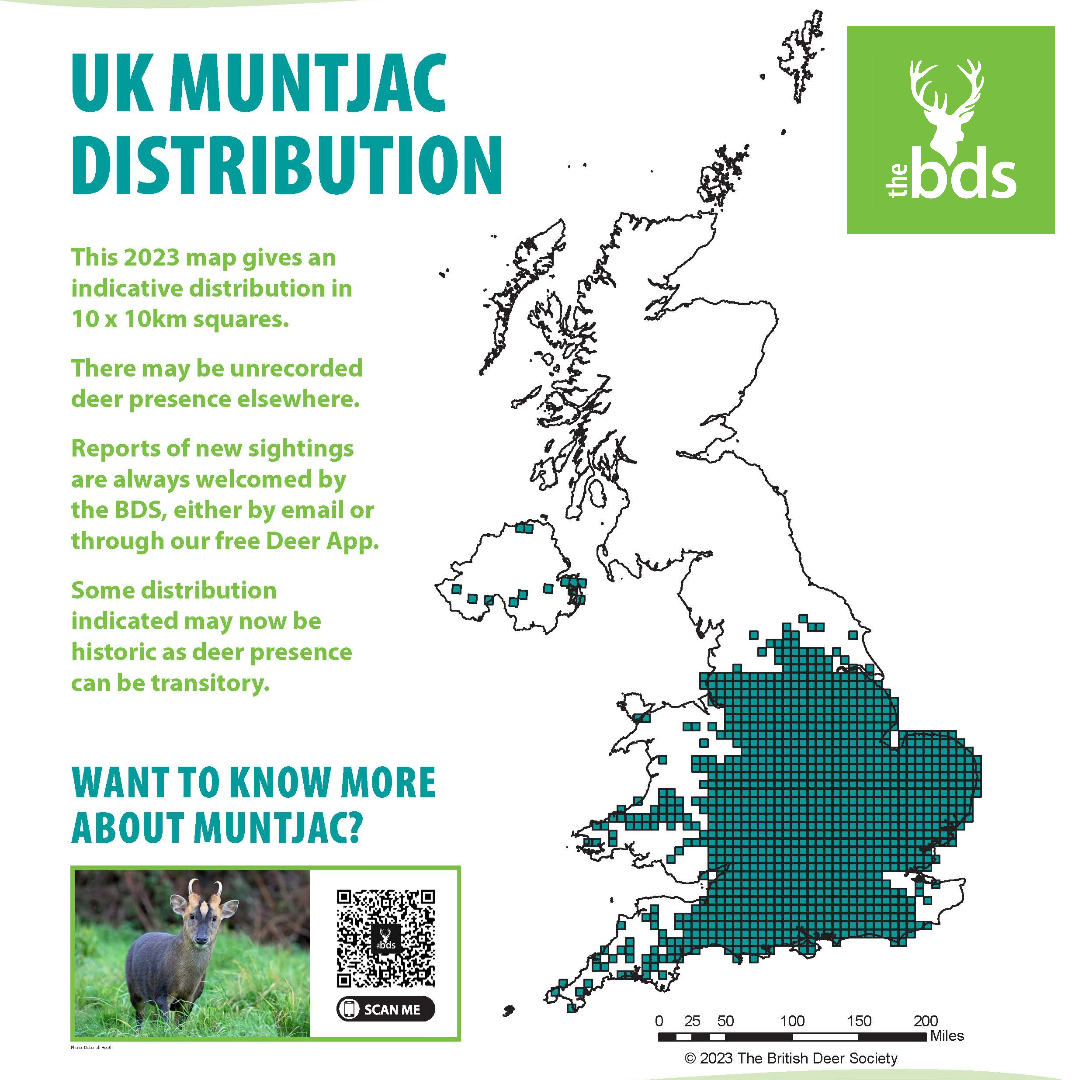
BDS map from 2023 shows them well North of the Humber

 
Regarding adaptability to climate, Reeves Muntjac natural range are from the temperate forests of China and Fareast / foothills of the Himalaya’s. Summers will be pretty much like UK, but winters - especially inland will be harsher. Also how quickly does natural evolution let species evolve and adapt. Current generation of Muntjac must be at least the 30th generation if not more from first escapes from Woburn. (Ie assuming that females can produce their first young at 18 to 24 months old.

BDS map from 2023 shows them well North of the Humber

BDS map is questionable at best… it has sika on Spurn head
 
Known Muntjac in Scotland for sure , Thing is one or two in a place with Muntjac are likely not going to be noticed until the population is very healthy .
Its said Muntjac cannot be stopped and will become the most prolific deer in the UK .
 
Looking at some of the modelling, it’s a reasonable bet within 10 years the people trying to release them in Scotland will succeed, in 3 places: (1) along the Forth between Stirling and Aberfolyle; (2) along the Earn as far as Comrie; and (3) along the Tay between Perth and Pitlochry. A simple rule of thumb is that where Rhododendrons and redwoods thrive, so will muntjac.
 
That said, there is a dietary element that’s still poorly understood. There are areas on acid soils where they don’t establish, even though the climate and cover looks perfectly hospitable.
 
Hard to tell, but based on conversations with people at the Non Native Species Secretariat the assessment is that the distribution stops being continuous around the Humber, though there are quite large self sustaining patches North of that, on either side of the A1, as far as Darlington/Bishop Auckland.
I shoot onnthe Border of Darlington and Bishop Auckland/ North Yorkshire and have yet to see any, would absolutely love to see them kicking about 🤞

They are over sedgfield I believe which is 20mins east of Bishop Auckland
 
Interesting to see mention of them in Fife, as a colleague and I were sure we had seen one between Dalgety Bay and Aberdour about ten years ago, but at the time dismissed it as very unlikely.
 
I shoot onnthe Border of Darlington and Bishop Auckland/ North Yorkshire and have yet to see any, would absolutely love to see them kicking about 🤞

They are over sedgfield I believe which is 20mins east of Bishop Auckland
So… as far as anyone can tell based on publicly available data (which is obviously very different from what’s actually happening on the ground…), they are around that area.

Almost certainly a mix of seasonal releases and pockets of breeding animals. Very localised, with a bit of spread here and there.

If you’re looking for them, look for areas outside traditional sporting estates (they’re pretty good at cleaning up any releases each winter). Look at areas with a high density of horse paddocks/livery stables, council county parks, disused and overgrown brownfield sites and old quarries (especially on neutral or alkaline soil). Essentially, look for unkeepered land with quite dense vegetation.

I saw muntjac in the woods west of Brandon before Covid…
 
So… as far as anyone can tell based on publicly available data (which is obviously very different from what’s actually happening on the ground…), they are around that area.

Almost certainly a mix of seasonal releases and pockets of breeding animals. Very localised, with a bit of spread here and there.

If you’re looking for them, look for areas outside traditional sporting estates (they’re pretty good at cleaning up any releases each winter). Look at areas with a high density of horse paddocks/livery stables, council county parks, disused and overgrown brownfield sites and old quarries (especially on neutral or alkaline soil). Essentially, look for unkeepered land with quite dense vegetation.

I saw muntjac in the woods west of Brandon before covid
Good to know thank you! I will certainly look harder now!
 
Interesting to see mention of them in Fife, as a colleague and I were sure we had seen one between Dalgety Bay and Aberdour about ten years ago, but at the time dismissed it as very unlikely.
They get released in Fife every year (prize for guessing where and who…).

It’s not yet clear if they’ve established a self sustaining population. I suspect they have in a couple places, though they don’t do anywhere near as well as they do in the Home Counties (and they get shot/run down by dogs as soon as they spread).

Dogs are the unmentioned variable that seems rather effective in Fife…
 
They are right through( Lincolnshire up to the Humber Bank. My brother has seen dead muntjac on both the on and off ramps to the Humber Bridge at Barton.

As far as I am aware there are non in East Yorkshire.

From Goole there are a number of shipping canals radiating west and south with steel piled banks which are effective / deadly barriers for muntjac. Although there are of course bridges.
 
They get released in Fife every year (prize for guessing where and who…).

It’s not yet clear if they’ve established a self sustaining population. I suspect they have in a couple places, though they don’t do anywhere near as well as they do in the Home Counties (and they get shot/run down by dogs as soon as they spread).

Dogs are the unmentioned variable that seems rather effective in Fife…
My guess would be near Cupar 😉
 
Never had a confirmed sighting N Lancs/S Cumbrias as far as I am aware-prepared to be put right on that. Some have been occasionally reported, investigated and found to be likely roe kids. I suspect there is the odd deliberate release but not a breeding population.
 
Hard to tell, but based on conversations with people at the Non Native Species Secretariat the assessment is that the distribution stops being continuous around the Humber, though there are quite large self sustaining patches North of that, on either side of the A1, as far as Darlington/Bishop Auckland.

There are then small and probably not permanent patches scattered across Northumberland. There are periodic reports as far North as Dunbar and Torness. There were dead ones on the roads around Torness for a year or two in about 2019, but those seem to have disappeared again, so probably a local release.

The prediction is that the next area likely to develop a self sustaining established population will be the Lower Tweed valley, up as far as Kelso. Quite possibly this has already started but low numbers as yet.

There is also a strong expectation that they’ll ‘show up’ in the Lothians: the South Esk valley through Arniston down to Dalkeith Country Park; the North Esk through Penicuik estate and Roslin Glen; and almost all the Tyne valley from Pathhead to Tyninghame are all perfect habitat. Going further North, they are surprised they aren’t already established in numbers in Fife based on local releases (and in fact there is a suspicion they must be, but just in very localised clusters). Curiously, they are also predicting that it’s only a matter of time before someone releases CWD in Fife, either at Loch Leven or in the reed beds along the Tay estuary.

If they get to Penicuik Estate its only a short hop to the major forests in Tweed Valley 😢
 
Back
Top