An interesting insight into MRI's and the concerns about various materials.
1) Source -
MR safety bullets
"Regardless of their metallic composition, bullets, shot, and bits of shrapnel do not produce significant RF-heating due to their overall small dimensions. Projectiles composed of only non-ferromagnetic materials (e.g., lead, copper, brass, or zinc) neither undergo heating nor significant translational or or rotational forces. They should thus be considered OK to scan under any conditions.
The primary safety concern is for projectiles containing ferromagnetic steel which can move significantly when placed in a strong external magnetic field".
MR safety bullets, shrapnel, FBs
mriquestions.com
There are references which can be found at the bottom of the article.
2) Source - UCSF - University of California and San Francisco Department of Radiology and Biomedical Imaging

radiology.ucsf.edu
Again reference to Ferromagnetic material such as Steel shot (albeit used in sand bags) as being a safety concern around MRI's.
3) Source - mrisafety.com
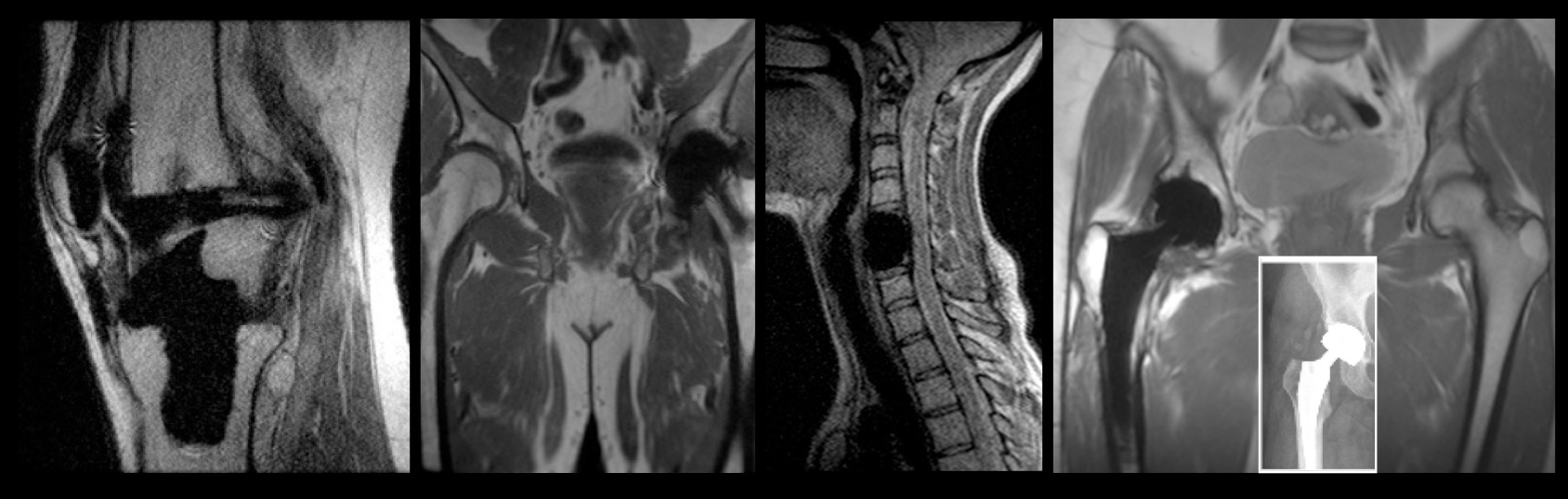
"In an effort to reduce lead poisoning in “puddling” type ducks, the federal government requires many of the eastern United States to use steel shotgun pellets instead of lead. The presence of steel shotgun pellets presents a potential hazard to patients undergoing MR procedures and causes substantial imaging artifacts at the immediate position of these metallic objects. In one case, a small metallic BB located in a subcutaneous site caused painful symptoms in a patient exposed to an MR system, although no serious injury occurred."
4) Source - Stanford University
The presence of metal can be a serious problem in MRI, because (1) Magnetic metals can experience a force in the scanner, (2) Long wires (such as in pacemakers) can result in induced currents and heating from the RF magnetic field and (3) Metals cause the static (B0) magnetic field to be...

med.stanford.edu
The presence of metal can be a serious problem in MRI, because (1) Magnetic metals can experience a force in the scanner, (2) Long wires (such as in pacemakers) can result in induced currents and heating from the RF magnetic field and (3) Metals cause the static (B0) magnetic field to be inhomogeneous, causing severe image degradation.
The first two of these problems are a DANGER to the patient, and are cause to not do an MRI. The third is not dangerous, but can result in severely distorted images using conventional MRI.
-----------------------------------------------------------------------------------------------------------------------------------------------------------------------------------------------
There are other links which can be found via various google searches which outline the concern of Ferromagnetic material in and around MRI.
I have not yet found any studies undertaken by the Society of Radiographers (UK) concerning Steel shot and MRI's, which may support the advice received by BASC that indicates a negligent risk.


.