

Well done for finishing the job
Last edited:


Good edit.Well done for finishing the job

I'm not sure. The copper penetrates a lot more. A monolithic may have (though so hard to say) smashed both shoulders and carried on into the cabbage.I think we can expect more of this kind of thing with the increasing use of "copper".
K

So you hear this said a lot, but other than confirmation bias, it’s not clear that it’s actually true.
Why would solids be more likely to veer off in strange directions? My rudimentary understanding of the physics leads me to think that something harder is more rather than less likely to keep going in a straight line?
That’s very useful - thank youThis isn't quite true but the design of solids is such that it becomes true - if you made a pointed solid then it would likely veer off in all sorts of completely random directions. Solids tend to have a flat front surface (expanding ammo tends to expand to achieve a relatively flat front surface) and this is stabilised due to the effects of the pressure in the fluid through which it is travelling. For a bullet to change direction the angle of this flat front surface has to change its "angle of attack" and this means that a proportion of the surface is ahead of the other parts. Because this bit is "out in front" so it is subject to more pressure as it is doing more work and so this tends to slow it down. As a result an object with a flat front face can be stabilised in flesh where, practically, spin stabilisation is impossible.
So in one sense you are correct, but it is usually because solids, such as you might use on an elephant, are designed with a flat front meplat and this stabilises them in flesh due to the changes in pressure on the front face if they try to change direction or tumble. Expanding bullets do something similar in the sense that, after expansion, they produce an approximately flat front face which also stabilises them, but there are a lot more variables with something that expands and so it has a greater chance of going wrong and probably absolutely straight line penetration is rare. This all comes back to your point that something very hard that doesn't deform can be made a lot more reliable in terms of straight line penetration, but it has to be designed for that job.
As a kid I remember us making bows and arrows, using sharpened sticks as arrows. I always remember our frustration when firing them into water that they never went straight but always headed off in completely random directions. If we'd had the sense to design a flat front for our arrows we'd have seen much better results.
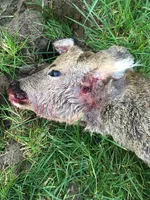
Well done for sharing. Great lesson / advice.This is possibly one of the strangest things that has happened to me in 20 years of stalking.
At the weekend I was stalking roe bucks in woodland at first light. I spotted a buck at 50 yards, sitting down in the grass looking at me side on. The deer was alert to my prescience, I sensed I had to be quick, raised the rifle to the sticks and fired. The point of aim was in the middle of the shoulder. In terms of shot reaction, the deer rolled, disappeared behind a tree and I could hear kicking. I repositioned myself, waited 30 seconds and could see the deer lying still on its side. That's one dead deer I thought, so I walked slowly towards it with the rifle reloaded, in my hands with safety on. However very quickly the deer jumped up and ran off unsteady on its feet with its head held low.
I wasn't worried at this stage, there was a fence downhill that should contain a short charge. I waited a full 20 mins before investigating. I followed a reasonable blood trail for 80 yards and over the fence (pools and spots of normal not frothy lung blood). Then under some mature conifers the trail stopped completely, I casted around on hands and knees - nothing. I went back to the car to get the dog. He made a promising start, sniffing and heading off in a straight line downhill. But then he lost interest - the hot weather didn't help. I went back uphill to where I started and we casted around for about 40 minutes. Nothing.
I was about to give up and call another dog, when I saw a buck walking slowly uphill, 100 metres to the left of where we were searching. The binos confirmed it was the same buck with identical antlers and it was walking very unsteadily on its feet in a jerking fashion. I raised the rifle and delivered a textbook H/L shot. On investigation, I noticed it had a broken front leg that was separate and some distance from the H/L entry and exit holes (and confirmed in the larder later). I feel terrible for causing an hour of pain and suffering.
I suspect that the deer's leg and was somehow in front of the shoulder when sitting. Its amazing that the 100gr 243 bullet fragmented on impact with leg bone and went no further, but that is what I think happened. Or my aim was lower than I recall, who knows? The second bizarre thing was I have known deer to lie up but never to walk back uphill (upwind) towards me and the shot site - arcing round for perhaps 400 meters in total.
Be careful with shooting sitting deer (or pass) the internals and limbs are arranged in a strange way. Study deer closely through the scope after the shot, they can lie still and stunned. Deer are incredibly tough survivors. Posting this as a caution to others. On reflection I am aware I made heaps of mistakes, consistent 'bang/flops" make you complacent.

Big fat no!I think we can expect more of this kind of thing with the increasing use of "copper".
K
You would think, but I’ve had some pretty strange things happen with 143grs shot from a 6.5CM at only 2550fps.Regarding how it happened, well you were using a very high velocity round at close range. That combination doesn't help bullets to hold together. The addition of it hitting relatively heavy bone on the way in won't have helped either. It's why I prefer the heavier/slower rounds for deer. Had you taken the same shot with say a 6.5x55, chucking an extra 40 grains of bullet at probably 300fps less velocity, I suspect it would have been an in one side and out the other shot, followed by a bit of kicking and maybe a short run as it was alert.
That's very true. Weird things can and do happen. But in this case the faster rounds are well known for it, especially with non premium bullets.You would think, but I’ve had some pretty strange things happen with 143grs shot from a 6.5CM at only 2550fps.
I don’t think there are really any firm rules with bullets. Sometimes weird sh*t just happens.


Yes, SD at its most useful.Thank you, great advice for beginners as well. I certainly wouldn’t consider shooting a deer in this situation now. Glad you found it

 www.thestalkingdirectory.co.uk




