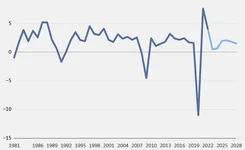
Effective, who knows

Significant barrier to implementing this, many public sector workers are employed in roles where productivity cannot be measured, I.e. crime prevention, health education, and where the workload is inconsistent and often sporadic, but have an impact on individuals and society as a whole.
Sheehy grappled with this issue and what did the police service get?
 
Significant barrier to implementing this, many public sector workers are employed in roles where productivity cannot be measured, I.e. crime prevention, health education, and where the workload is inconsistent and often sporadic, but have an impact on individuals and society as a whole.
Up to a point. But only up to a point. Whose productivity might be measured by crime prevention? There are sufficiently accurate measures of crime detection. Etc.
When you have public sector workers seeking to redefine their job in terms of the absence of work, that is part of the problem.
Much of the workload is not sporadic, is predictable and measurable.
The fact of the matter is that "reform", "productivity" and "performance" are very dirty words in the public sector.
Sheehy grappled with this issue and what did the police service get?
Nothing much because they refused to accept most of his recommendations. What did the public get? Shafted.
 
Up to a point. But only up to a point. Whose productivity might be measured by crime prevention? There are sufficiently accurate measures of crime detection. Etc.
When you have public sector workers seeking to redefine their job in terms of the absence of work, that is part of the problem.
Much of the workload is not sporadic, is predictable and measurable.
The fact of the matter is that "reform", "productivity" and "performance" are very dirty words in the public sector.

Nothing much because they refused to accept most of his recommendations. What did the public get? Shafted.
Agree, whilst there are measures of crime detection there are no measures of crime prevention, simply because you cannot measure something that has not happened.
The measures of crime detection, as they are, are fundamentally flawed. In fact many forces have whole departments set up to manipulate detection figures. What constitutes a detected crime?
The detection figures are further flawed in that they only show, as a %, detection of reported crime, not of all crime.

Have to disagree that much of the workload is predictable, unfortunately when dealing with people it is anything but predictable. Yes trends can be observed and workload predicted I.e. the winter effect on the elderly and the NHS.

‘When you have public sector workers seeking to redefine their job in terms of the absence of work, that is part of the problem’. You will have to explain and evidence this.

The fact of the matter is that "reform", "productivity" and "performance" are very dirty words in the public sector, having worked in both sectors I would say that this is as relevant to both. The private sector have the advantage that their performance targets, and much that falls out of attempting to attain performance measures, is not stipulated by our great and good governments whose ideas and agendas are often at odds with those of any organisation.

Yes, most of the recommendations were rejected, not by the Police Service, but by the Home Secretary Michael Howard. The Windsor review is also interesting reading for context.
 
Here is a report today on Germanys version of BBC1 (translation is at the end) of the effects after four years of independence from the EU).
Just saying, I am not banging a drum before the accusations begin to roll in.

Analyse Bilanz nach vier Jahren Brexit
Ernüchtertes Königreich
Stand: 31.01.2024 04:24 Uhr
Weniger Wachstum, die versprochenen Handelsabkommen sind immer noch nicht geschlossen, und es gibt viele neue Kontrollen: Vier Jahre nach dem Abschied aus der EU hadern viele Briten mit dem Brexit.
Die Befürworter des Brexits wurden seinerzeit nicht müde, die garantierte Souveränität Großbritannien außerhalb der EU zu preisen. So wie etwa der damalige Premierminister Boris Johnson. "Take Back Control" hieß der Slogan.
Die Idee war, die Handelsverträge der EU in aller Welt durch bilaterale Abkommen mit besseren Konditionen zu ersetzen. Doch pünktlich zum vierten Jahrestag des Brexits vermeldeten die Nachrichten das Scheitern von Freihandelsgesprächen zwischen Großbritannien und Kanada.

Kaum neue Handelsabkommen​

Nachdem die EU-Regeln nach einer Übergangsfrist gefallen waren, hatte Kanada hohe Importzölle auf Käse und Autos erhoben. Vier Jahre nach dem Brexit hat das Vereinigte Königreich bilaterale Handelsabkommen mit Australien und Neuseeland geschlossen und ist dem Pazifikpakt CPTTP beigetreten. Insgesamt ist das eine magere Ausbeute, erläutert Thomas Sampson, Wirtschaftswissenschaftler an der London School of Economics.
Einige Vorteile mag es durch die Abkommen geben, aber diese Länder sind allesamt weit weg. Die Regierung selbst schätzt jeden Vertrag auf ein Volumen von 0,1 Prozent des Bruttoinlandsprodukts. Das gleicht die Verluste durch den Wegfall des Zugangs zum EU-Binnenmarkt in keiner Weise aus.
Die wirtschaftlichen Einbußen durch den Brexit ganz präzise zu beziffern, sei schwierig, so Sampson. Sie liegen Modellen zufolge im Bereich von drei bis fünf Prozent des Bruttoinlandprodukts.
"Man muss sich das wie bei einem kleinen Loch im Autoreifen vorstellen, dass der Wirtschaft ganz langsam die Luft ausgeht", sagt Sampson. Sie sei seit dem Referendum ein kleines bisschen weniger gewachsen, als man ohne den Brexit erwartet hätte. "Investitionen sind wegen der Brexit-Unsicherheit zurückgegangen, insgesamt ist das Bruttoinlandsprodukt gesunken."

Nahrungsmittel werden teurer​

Und noch eine Hiobsbotschaft müssen die Briten zum Brexit-Jahrestag den Nachrichten entnehmen: Die Preise für Obst und Gemüse, aber auch Milch- und Fleischprodukte werden im Laufe des Jahres steigen, weil bisher verschobene Grenzkontrollen für Nahrungsmittelimporte aus der EU nun wirklich in Kraft treten und den bürokratischen Aufwand und Importkosten erhöhen. Branchenverbände rechnen mit rund 230 Millionen Euro Mehrkosten pro Jahr.
Dazu kommt ein Einwanderungs-Rekord im Jahr 2022: Auch das Brexit-Versprechen, nach Ende der EU-Freizügigkeit würden weniger Menschen auf die britische Insel kommen, wurde nicht erfüllt. 2022 kamen als Netto-Einwanderer 745.000 Menschen nach Großbritannien, deutlich mehr als die 212.000 jährlich, die die konservative Regierung in ihrem Wahlprogramm von 2019 unterschreiten wollte.
Mit Nachzugsverboten hat die Regierung nun reagiert. Sampson sieht das weniger als Wirtschaftsthema denn als ein politisches: "Bei dem Thema geht es nicht in erster Linie um wirtschaftliche Konsequenzen aus der gestiegenen Einwanderung, weil das ja auch viele Arbeitskräfte sind. Sondern es ist politisch aufgeladen: Wie sieht wünschenswerte Immigration aus?"

Ernüchterung vier Jahre später​

Umfragen aus dem vergangenen Jahr zeigen, dass knapp zwei Drittel, nämlich 63 Prozent der Briten, der Meinung sind, der Brexit sei eher kein Erfolg gewesen. Nur 12 Prozent sehen einen Erfolg. Einig sind sich aber 70 Prozent darin, dass die Regierung die Umsetzung vermasselt habe.
Unternehmer Richard Walker ist Chef der britischen Discount-Supermarktkette Iceland. Er trommelte 2016, als Außenseiter in einer importabhängigen Branche, für den Brexit. Er bereut das heute auch nicht, meint aber, die Chancen des Brexits seien einfach nicht genutzt worden. Das Ergebnis sei lächerlich.

Analysis of the balance after four years of Brexit
Disillusioned Kingdom

As of: January 31, 2024 4:24 a.m
Less growth, the promised trade agreements have still not been concluded, and there are many new controls: four years after leaving the EU, many Brits are struggling with Brexit.
At the time, Brexit supporters never tired of praising Britain's guaranteed sovereignty outside the EU. Like the then Prime Minister Boris Johnson. “Take Back Control” was the slogan.
The idea was to replace the EU's trade agreements around the world with bilateral agreements with better conditions. But just in time for the fourth anniversary of Brexit, the news reported the collapse of free trade talks between Great Britain and Canada. Hardly any new trade agreements.
After the EU rules fell after a transition period, Canada imposed high import tariffs on cheese and cars. Four years after Brexit, the UK has concluded bilateral trade agreements with Australia and New Zealand and joined the Pacific Pact (CPTTP). Overall, this is a meager yield, explains Thomas Sampson, economist at the London School of Economics.
There may be some benefits from the agreements, but these countries are all far away. The government itself estimates each contract to be worth 0.1 percent of gross domestic product. This in no way compensates for the losses caused by the loss of access to the EU internal market.
According to Sampson, it is difficult to quantify the economic losses caused by Brexit precisely. According to models, they are in the range of three to five percent of gross domestic product.
“You have to imagine it like a small hole in a car tyre, that the economy is slowly running out of air,” says Sampson. It has grown a little less since the referendum than would have been expected without Brexit. "Investments have declined due to Brexit uncertainty, and overall gross domestic product has fallen."
Food is becoming more expensive.
And the British have to take another bad message from the news on the Brexit anniversary: the prices for fruit and vegetables, but also dairy and meat products, will rise over the course of the year because previously postponed border controls for food imports from the EU are now actually coming into force increased bureaucratic effort and import costs. Industry associations expect additional costs of around 230 million euros per year.
In addition, there will be an immigration record in 2022: The Brexit promise that fewer people would come to the British island after the end of EU freedom of movement was also not fulfilled. In 2022, 745,000 people came to Great Britain as net immigrants, significantly more than the 212,000 annually that the Conservative government wanted to stay below in its 2019 election manifesto.
The government has now reacted with bans on immigration. Sampson sees this less as an economic issue than as a political one: "The issue is not primarily about the economic consequences of increased immigration, because that is a lot of workers. Rather, it is politically charged: What does desirable immigration look like?" 1738330782028.png
Disillusionment four years later
Surveys from last year show that almost two thirds, namely 63 percent, of Brits are of the opinion that Brexit was not a success. Only 12 percent see success. However, 70 percent agree that the government has botched the implementation.
Entrepreneur Richard Walker is head of the British discount supermarket chain Iceland. In 2016, as an outsider in an import-dependent industry, he drummed up support for Brexit. He doesn't regret it today, but he says the opportunities presented by Brexit were simply not taken advantage of. The result is ridiculous.
 
Significant barrier to implementing this, many public sector workers are employed in roles where productivity cannot be measured, I.e. crime prevention, health education, and where the workload is inconsistent and often sporadic, but have an impact on individuals and society as a whole.
Sheehy grappled with this issue and what did the police service get?
It’s an often quoted line that “ some roles/industries” can’t measure productivity, IMHO it’s mostly a myth. I have worked in productivity/improvements in manufacturing, outsourced services, Banking and Fintech covering multi nationals through to SME’s It largely depends on how keen you are to measure productivity/efficiency and picking the right measures. The main blocker is often these businesses don’t want to be measured, in the same way lots of people well overweight aren’t keen to stand on some scales and then develop a plan
 
Here is a report today on Germanys version of BBC1 (translation is at the end) of the effects after four years of independence from the EU).
Just saying, I am not banging a drum before the accusations begin to roll in.

Analyse Bilanz nach vier Jahren Brexit
Ernüchtertes Königreich
Stand: 31.01.2024 04:24 Uhr
Weniger Wachstum, die versprochenen Handelsabkommen sind immer noch nicht geschlossen, und es gibt viele neue Kontrollen: Vier Jahre nach dem Abschied aus der EU hadern viele Briten mit dem Brexit.
Die Befürworter des Brexits wurden seinerzeit nicht müde, die garantierte Souveränität Großbritannien außerhalb der EU zu preisen. So wie etwa der damalige Premierminister Boris Johnson. "Take Back Control" hieß der Slogan.
Die Idee war, die Handelsverträge der EU in aller Welt durch bilaterale Abkommen mit besseren Konditionen zu ersetzen. Doch pünktlich zum vierten Jahrestag des Brexits vermeldeten die Nachrichten das Scheitern von Freihandelsgesprächen zwischen Großbritannien und Kanada.

Kaum neue Handelsabkommen​

Nachdem die EU-Regeln nach einer Übergangsfrist gefallen waren, hatte Kanada hohe Importzölle auf Käse und Autos erhoben. Vier Jahre nach dem Brexit hat das Vereinigte Königreich bilaterale Handelsabkommen mit Australien und Neuseeland geschlossen und ist dem Pazifikpakt CPTTP beigetreten. Insgesamt ist das eine magere Ausbeute, erläutert Thomas Sampson, Wirtschaftswissenschaftler an der London School of Economics.
Einige Vorteile mag es durch die Abkommen geben, aber diese Länder sind allesamt weit weg. Die Regierung selbst schätzt jeden Vertrag auf ein Volumen von 0,1 Prozent des Bruttoinlandsprodukts. Das gleicht die Verluste durch den Wegfall des Zugangs zum EU-Binnenmarkt in keiner Weise aus.
Die wirtschaftlichen Einbußen durch den Brexit ganz präzise zu beziffern, sei schwierig, so Sampson. Sie liegen Modellen zufolge im Bereich von drei bis fünf Prozent des Bruttoinlandprodukts.
"Man muss sich das wie bei einem kleinen Loch im Autoreifen vorstellen, dass der Wirtschaft ganz langsam die Luft ausgeht", sagt Sampson. Sie sei seit dem Referendum ein kleines bisschen weniger gewachsen, als man ohne den Brexit erwartet hätte. "Investitionen sind wegen der Brexit-Unsicherheit zurückgegangen, insgesamt ist das Bruttoinlandsprodukt gesunken."

Nahrungsmittel werden teurer​

Und noch eine Hiobsbotschaft müssen die Briten zum Brexit-Jahrestag den Nachrichten entnehmen: Die Preise für Obst und Gemüse, aber auch Milch- und Fleischprodukte werden im Laufe des Jahres steigen, weil bisher verschobene Grenzkontrollen für Nahrungsmittelimporte aus der EU nun wirklich in Kraft treten und den bürokratischen Aufwand und Importkosten erhöhen. Branchenverbände rechnen mit rund 230 Millionen Euro Mehrkosten pro Jahr.
Dazu kommt ein Einwanderungs-Rekord im Jahr 2022: Auch das Brexit-Versprechen, nach Ende der EU-Freizügigkeit würden weniger Menschen auf die britische Insel kommen, wurde nicht erfüllt. 2022 kamen als Netto-Einwanderer 745.000 Menschen nach Großbritannien, deutlich mehr als die 212.000 jährlich, die die konservative Regierung in ihrem Wahlprogramm von 2019 unterschreiten wollte.
Mit Nachzugsverboten hat die Regierung nun reagiert. Sampson sieht das weniger als Wirtschaftsthema denn als ein politisches: "Bei dem Thema geht es nicht in erster Linie um wirtschaftliche Konsequenzen aus der gestiegenen Einwanderung, weil das ja auch viele Arbeitskräfte sind. Sondern es ist politisch aufgeladen: Wie sieht wünschenswerte Immigration aus?"

Ernüchterung vier Jahre später​

Umfragen aus dem vergangenen Jahr zeigen, dass knapp zwei Drittel, nämlich 63 Prozent der Briten, der Meinung sind, der Brexit sei eher kein Erfolg gewesen. Nur 12 Prozent sehen einen Erfolg. Einig sind sich aber 70 Prozent darin, dass die Regierung die Umsetzung vermasselt habe.
Unternehmer Richard Walker ist Chef der britischen Discount-Supermarktkette Iceland. Er trommelte 2016, als Außenseiter in einer importabhängigen Branche, für den Brexit. Er bereut das heute auch nicht, meint aber, die Chancen des Brexits seien einfach nicht genutzt worden. Das Ergebnis sei lächerlich.

Analysis of the balance after four years of Brexit
Disillusioned Kingdom

As of: January 31, 2024 4:24 a.m
Less growth, the promised trade agreements have still not been concluded, and there are many new controls: four years after leaving the EU, many Brits are struggling with Brexit.
At the time, Brexit supporters never tired of praising Britain's guaranteed sovereignty outside the EU. Like the then Prime Minister Boris Johnson. “Take Back Control” was the slogan.
The idea was to replace the EU's trade agreements around the world with bilateral agreements with better conditions. But just in time for the fourth anniversary of Brexit, the news reported the collapse of free trade talks between Great Britain and Canada. Hardly any new trade agreements.
After the EU rules fell after a transition period, Canada imposed high import tariffs on cheese and cars. Four years after Brexit, the UK has concluded bilateral trade agreements with Australia and New Zealand and joined the Pacific Pact (CPTTP). Overall, this is a meager yield, explains Thomas Sampson, economist at the London School of Economics.
There may be some benefits from the agreements, but these countries are all far away. The government itself estimates each contract to be worth 0.1 percent of gross domestic product. This in no way compensates for the losses caused by the loss of access to the EU internal market.
According to Sampson, it is difficult to quantify the economic losses caused by Brexit precisely. According to models, they are in the range of three to five percent of gross domestic product.
“You have to imagine it like a small hole in a car tyre, that the economy is slowly running out of air,” says Sampson. It has grown a little less since the referendum than would have been expected without Brexit. "Investments have declined due to Brexit uncertainty, and overall gross domestic product has fallen."
Food is becoming more expensive.
And the British have to take another bad message from the news on the Brexit anniversary: the prices for fruit and vegetables, but also dairy and meat products, will rise over the course of the year because previously postponed border controls for food imports from the EU are now actually coming into force increased bureaucratic effort and import costs. Industry associations expect additional costs of around 230 million euros per year.
In addition, there will be an immigration record in 2022: The Brexit promise that fewer people would come to the British island after the end of EU freedom of movement was also not fulfilled. In 2022, 745,000 people came to Great Britain as net immigrants, significantly more than the 212,000 annually that the Conservative government wanted to stay below in its 2019 election manifesto.
The government has now reacted with bans on immigration. Sampson sees this less as an economic issue than as a political one: "The issue is not primarily about the economic consequences of increased immigration, because that is a lot of workers. Rather, it is politically charged: What does desirable immigration look like?" View attachment 404025
Disillusionment four years later
Surveys from last year show that almost two thirds, namely 63 percent, of Brits are of the opinion that Brexit was not a success. Only 12 percent see success. However, 70 percent agree that the government has botched the implementation.
Entrepreneur Richard Walker is head of the British discount supermarket chain Iceland. In 2016, as an outsider in an import-dependent industry, he drummed up support for Brexit. He doesn't regret it today, but he says the opportunities presented by Brexit were simply not taken advantage of. The result is ridiculous.
Opinions, like the old saying are like rectums. This is an opinion.

Factually there has been a lot of water under the bridges since Brexit which affects economies worldwide, and unwrapping the economic picture now is frankly top say the least somewhat subjective.

Would the picture be he same if we had not had covid, would it be the same if covid had happened but we had adopted a Swedish approach, what if the Ukraine war had only lasted 3/6/9/12 months, etc, etc.

The 720k immigrants takes into account those form Ukraine and Hong Kong IIRC, so is inflated for good reasons.

Im always tickled by the notion that trade is only of value if it is to countries close by. And for sure there are some cost savings where that is the case, however, trade between China and the RoW takes place at scale, no one doubts this, nor the distances between China and many of its trade partners, China doesn't have a ratified trade deal with the EU and yet it is the EUs second largest trade deal. Neither does India, the EU s largest trade partner apparently. Proximity only counts for so , much as New Zealand lamb will know.

FWIW, the 'deal' for Brexit was basically struck by May, and Boris made silly claims about getting the EU to changes it. It was au fait accompli before he got into office.

IMHO it was always going to be the case that leaving was the start, not the end of the process.

For those who think re-joining would be a good idea, consider this, there are no major trading nations asking to join the EU, there is a good reason why.

Obama poked his nose in which is kind of ironic given their perspective on the RoW.

I am note sure the EU project is going so well, which is surprising, given that when one looks at the accession referenda in members states that the votes to join were one by small margins, and in effect by a minority of the eligible voting pool.

I you think leaving was bad, re-joining would be disastrous.


Candidate countries are Albania, Bosnia and Herzegovina, Georgia, Moldova, Montenegro, North Macedonia, Serbia, Turkey, and Ukraine.
 
Back
Top