"Hilar shot" - is this the expected reaction?

SD198

Well-Known Member
Hi all - I have a new permission that requires me to shoot deer so as to keep them from running too far. Not being keen on head/ neck shots I tried out a "Hilar" shot on a roe on another permission recently - and just wanted to check that the reaction from the deer was as is to be expected from a deer shot in that location (and that the location was where it should be).

It was a clear broadside shot and I placed the vertical cross-hair in line with front edge of foreleg, just below half way up body. The deer leap up high with an arched back and landed in a bush before jumping out and staggering about 5m before falling over - to my surprise it then tried to stand up but clearly had a broken foreleg (both broken as later became apparent) and couldn't rise - its head then bent backwards towards its spine and stayed there. Watching through the cross-hairs and could see its chest moving for what seemed like several minutes before stopping.

Upon inspection bullet entered just behind rib 3 and exited about rib 4 - both forelegs were broken with bullet entering and exiting at base, front edge of the shoulderbone and obliterating that joint on both side (shoulder meat mostly lost). Just the front tip of each lung was hit - the heart was untouched.

I believe this the intended POI for a Hilar shot- although I expected it to fall on the spot and expire quicker? Having said that, with most of my previous shots (nearly all double lung, with occasional inadvertent clipping of the heart) the deer has run around 20-40m before dropping (but expired quicker) - so this shot certainly dropped the deer significantly more quickly (as it would with both front legs taken out).

Cheers
 
I shot a youngish roe doe last week using this shot, but POI was higher (exactly where I intended). The shot was just over 200 yards with a 55gr Sierra HPBT from a 22-250. Shot reaction was almost a backflip, a few kicks and that was it out. Heart intact, both front shoulders pretty much lost (could have salvaged a wee bit maybe).
 
No I don’t think so, mine usually hit the deck instantly and don’t move. have you any photos of entrance/ exit and also details of calibre, bullet weight and construction?
 

Look at post #186 in thread above. From your description I’d say your point of aim was a touch too far forward perhaps?

Below paragraph taken from same post..

“The autonomic bang flop is very characteristic. Whereas a hit to the spine will result in a loss of motor control, and a dramatic collapse of the rear legs, the autonomic hit will simply cause the animal to tip over after a slight delay of a one or two seconds. It's like they register they've been shot but they're not quite sure what happens next. There's no arched backs, jumps or mad dashes. Just a stagger and a tipping over. Dead on the spot.”
 
If you've entered rib #3, broken both humerus leg bones, and only clipped the front lung, you're too far forward and too low. You need to be entering at rib #4-5, just in front of the top of the heart.

2F35EA45-5FF7-45CB-B8BD-3090D019F7E2.jpeg

The damage you are seeking looks like this, though this was a raking shot.

97436F39-7C39-4126-BDB7-E2B3C2084B43.jpeg

594482F1-8389-4F2B-9728-12C561BFA4C3.jpeg

This has some close up of the organ damage you're after.

 
As Woodsy and Dodgyknees have said, and looking at the pic posted by DK, your POA should be further back. For Roe, with a perfect broadside shot, I would use the back of the foreleg and in the centre of the 'depth' of the chest. Good results from this shot placement with .308 usually has the beast drop on the spot.
 
As Woodsy and Dodgyknees have said, and looking at the pic posted by DK, your POA should be further back. For Roe, with a perfect broadside shot, I would use the back of the foreleg and in the centre of the 'depth' of the chest. Good results from this shot placement with .308 usually has the beast drop on the spot.
+1
This is a perfect description of the shot placement, IMHO, and the best way to take aim: follow the back of the foreleg up until the line bisects the centre of the chest. Fall when hit.
 
Using either side of the foreleg as a guide does come with a degree of risk, as the animal will naturally angle its leg according to the gradient of the ground it is standing on. This is particularly true when the animal has been leaning forward and down to browse, one leg will be much further forward than the other, and vice a versa.

(From the range I'm usually shooting them at, the vertical post on the reticle will usually obscure most of the leg anyway so picking a side is somewhat pointless.)

Whilst several of the descriptions called for a standing broadside shot, I can say with absolute clarity from years shooting the Hilar target on deer, that a raking shot is extremely effective. It takes a little bit of experience to pick the entry point according to the angle at which the animal is standing, but it's not hard to get the hang of it. It is the best non-spine bang flop option for meat saving, because almost all the time the bullet will pass behind the lower shoulder within the rib cage and not cause any peripheral bruising.

From what I have observed in dozens of cases of deer that run, it is extremely tempting for guys to put the shot too far back on animals that are quartering towards the shooter. I did it the other day on a large very sick stag, I think I've put the video on my YouTube. If the animal is quartering towards you, to clean up the Hilar zone you need to be putting the shot in front of the shoulder on the side of the brisket. Around the position of a rib #1. If it is a roughly 45° angle quartering towards the bullet will exit around ribs 7&8.
 
As above, and this is a fairly practical demonstration of angled aiming points to achieve the same thing.
culling_roe_angles.jpg
 
Using either side of the foreleg as a guide does come with a degree of risk, as the animal will naturally angle its leg according to the gradient of the ground it is standing on. This is particularly true when the animal has been leaning forward and down to browse, one leg will be much further forward than the other, and vice a versa.

(From the range I'm usually shooting them at, the vertical post on the reticle will usually obscure most of the leg anyway so picking a side is somewhat pointless.)

Whilst several of the descriptions called for a standing broadside shot, I can say with absolute clarity from years shooting the Hilar target on deer, that a raking shot is extremely effective. It takes a little bit of experience to pick the entry point according to the angle at which the animal is standing, but it's not hard to get the hang of it. It is the best non-spine bang flop option for meat saving, because almost all the time the bullet will pass behind the lower shoulder within the rib cage and not cause any peripheral bruising.

From what I have observed in dozens of cases of deer that run, it is extremely tempting for guys to put the shot too far back on animals that are quartering towards the shooter. I did it the other day on a large very sick stag, I think I've put the video on my YouTube. If the animal is quartering towards you, to clean up the Hilar zone you need to be putting the shot in front of the shoulder on the side of the brisket. Around the position of a rib #1. If it is a roughly 45° angle quartering towards the bullet will exit around ribs 7&8.
What's your youtube name ?
 
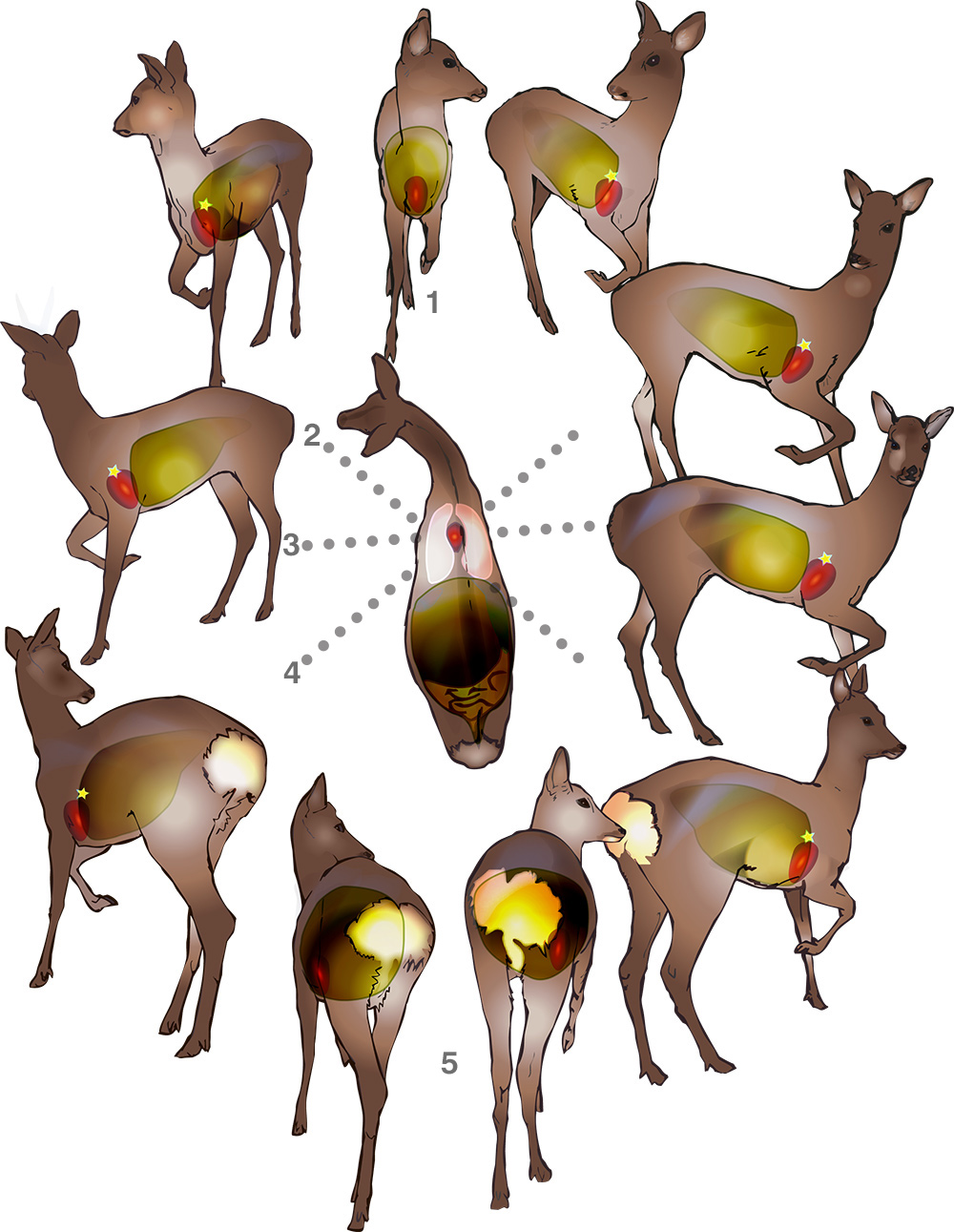
The following images, which come from Tenessee Hunting Club ( Shooting at Deer from Different Angles | Tennessee Hunting Club ) demonstrate the need to change one's shot placement to nail the shot properly.

The bad;
angles_1.jpg


The good;
angles_2.jpg

Reading the example text above The Good, The Bad and with many youtube examples The Ugly would come out tops from the many YT clips out of the US I have seen....

As I said earlier you can repeat the shot but each reaction and bullit path with be different, an example was a 70 yard MJ neck shot went through the neck in the ns rear leg turned and carried on to blow the os lear leg to bits...
Shot loads in the neck but that one was the most extreme....

The best example for me was close to " C " on a 40kg fallow 175 yards with the .243, it was moving through rows of a re-plant. I got out of the seat as the sun was warming this area up so I moved down 100 yards to exploit the warmth of the sun.
I can see it as I type the shower of pins in the scope after I pulled the trigger, the fallow collapsed on the spot..
Also remember dragging it the 175 yards then down and up a ditch...lol

Tim.243
 
I think that was a touch forward. Not sure if it’s the Hilar or not but when I’m after bang-flop without pinning and head/neck isn’t on I follow the same line I would for a heart shot but 1/3 down the depth of the beast down from the ridge of the back (as opposed to 1/3 up from the underside for a heart shot). Tucks it about the 4th-5th rib in and just under the spine which knocks them flat.
 
In every single scenario illustrated the neck is fully available, so why not give it a go? Certainly a better option than the placement on #5.
I think '5' is just to illustrate how occuluded the heart/lung area is. There isn't a white star, indicating where to aim, as far as I can see on '5'.
Neck shooting is a whole different topic, with a smaller margin for error than the 'bolier room' area. Not seen as a problem if you already have figured it all out and are comfortable taking the shot.
 
Back
Top