
I use a minimalist reloading procedure: wipe off soot, mud etc with a tissue. Neck size/decap. Reprime, charge with an RCBS Uniflow powder dropper then seat bullet. This is a recent example of the results produced (BSA Hunter in .222 at 300yds).
You are using an out of date browser. It may not display this or other websites correctly.
You should upgrade or use an alternative browser.
You should upgrade or use an alternative browser.
New brass vs reloaded cases….. insufficient prep?
- Thread starter Andy seatrout
- Start date


Andy seatrout
Well-Known Member
I’m weighing the powder dispenser charge, last night for example ten weighted charges were all either 44.4gr or 44.3gr…… I’m using RS60 powder.Not relevant.
No you are not.
Both loads are, let us say, "unacceptable".
Forget tumbling, cleaning, trimming, your problems do not lie there. What you are seeing are probably symptoms of poor combustion.
If you are handloading and the sd is 20 then really it is twice what you should be aiming for. So I would not be thinking about 36 is worse than 20, more that that level of variation is pointing to "big" inconsistencies in (probably) powder weight, maybe neck tension or maybe a primer problem. Could be a poor powder choice.
So if it was me, I would be full length resizing some cases from the same batch of brass, trimming to length then getting really picky on loading to an exact powder weight. If the numbers were still poor then I would be changing powder. Never loaded 6.5 Swede so can't recommend the go to powder.
Last night I measured all my fired and re-sized cases/ they’re still shorter than the ‘trim line’ so I’m not certain trimming is the answer…. They were all fairly consistent within a two thousandth of an inch…
In terms of unacceptable, the batch showing an SD of twenty is ‘close’ to the factory Hornady of 13.5? If I could get to that I’d be happy….
But powder choice isn’t something I’d considered nor neck tension- they all go through the same seating die…. I’ve not set it to crimp the bullet as there seemed to be no issue with the brass holding the bullets firmly….would this achieve better consistency of neck tension.
Thanks for the advice…
I pop out the primers and wet tumble all fired cases in batches of maybe 300/400, dry them and then full length resize them. I then trim them all to length, deburr, chamfer and clean the primer pockets etc.
I anneal after every second firing, so 2, 4, 6. I check every case to make sure there are no splits, damaged necks or big bashes.
I use a FX120i scale which is brilliant and I weigh every charge down to 0.02grains of variation. In the past, I used a Hornady Lock and Load scale, a Gempro 250 and a Lyman Gen6 scale and found all of them to be too inconsistent.
I seat the heads and factory crimp the cases.
I am looking for a decent grouping and a SD of between 5 and 10 from a 5 shot group.
As mentioned above, a cold bore shot can be faster or slower than the next 4 shots and so can affect the results.
I anneal after every second firing, so 2, 4, 6. I check every case to make sure there are no splits, damaged necks or big bashes.
I use a FX120i scale which is brilliant and I weigh every charge down to 0.02grains of variation. In the past, I used a Hornady Lock and Load scale, a Gempro 250 and a Lyman Gen6 scale and found all of them to be too inconsistent.
I seat the heads and factory crimp the cases.
I am looking for a decent grouping and a SD of between 5 and 10 from a 5 shot group.
As mentioned above, a cold bore shot can be faster or slower than the next 4 shots and so can affect the results.

Utectok
Well-Known Member
Cleaning your cases makes no difference to the load btw. That’s been thoroughly tested by clever people than me… I’ve stoped cleaning my cases and can’t say I’ve noticed any difference 
Neck tension is a real big thing though and can change sd and MV putting it up by about 90fps for me if it’s tight…
Neck tension is a real big thing though and can change sd and MV putting it up by about 90fps for me if it’s tight…
Andy seatrout
Well-Known Member
On balance on the comments - and I’ve checked a few things so I’m comfortable that;
1) my cases are not too long as yet, within the trimming parameters and fairly consistent
2) my powder measure is consistent within 0.1 of a grain- surely that wouldn’t lead to a 30+ SD spread?
3) my primers are ok now ( I had a problem which was related to too much headspace) but they all go bang.
4) my case prep of cleaning the primer pocket and using a brush inside the case is probably enough for the time being- looking at other ‘minimal prep’ examples on here.
So I’m left with the powder not combusting correctly- due to shortages of supply, there’s not a lot of choice out there at present….. and secondly potentially neck tension.
Whilst I seat the cases with a hornady seating die, it will crimp as well…… so I’m going to work on the basis that if there is variance to the size of the neck volume ( resulting in some bullets sitting snugger than others) if I crimp, then the resultant shaping will crimp all to the same tension…?
1) my cases are not too long as yet, within the trimming parameters and fairly consistent
2) my powder measure is consistent within 0.1 of a grain- surely that wouldn’t lead to a 30+ SD spread?
3) my primers are ok now ( I had a problem which was related to too much headspace) but they all go bang.
4) my case prep of cleaning the primer pocket and using a brush inside the case is probably enough for the time being- looking at other ‘minimal prep’ examples on here.
So I’m left with the powder not combusting correctly- due to shortages of supply, there’s not a lot of choice out there at present….. and secondly potentially neck tension.
Whilst I seat the cases with a hornady seating die, it will crimp as well…… so I’m going to work on the basis that if there is variance to the size of the neck volume ( resulting in some bullets sitting snugger than others) if I crimp, then the resultant shaping will crimp all to the same tension…?

Heym SR20
Well-Known Member
What are your goals here?
Are you trying to win long range precision target shooting disciplines where the difference between top of the table and bottom is measured in fractions of an ants ball hair on final shot from a 20 round string at xxx,000m
Or are you wanting a hunting load that can put the first bullet into the kill zone of a Roe or muntjac at 200m?
From what have read, and my own experience key for an accurate load is to get uniform pressure behind the bullet before it starts moving out of the chamber and accelerating down the barrel. If you don’t this consistent start you won’t get consistent muzzle velocities.
There are two ways of dealing with this:
1) load the bullet so that is just off the rifling. Any slight pressure build up moves the bullet into the lands where it won’t go any further until consistent high pressure has built. I believe some benchrest shooters completely ignore neck tension and load bullets long so they hit the lands and pushed back into the case when chambered. Gives great consistency, but if you unload an unfired round you leave the bullet in the rifling and powder all through the action.
2) have good neck tension on the case so pressure builds in the case before it releases. Lots of things come to play here in terms of sizing of dies, and in particular the expander die etc and bullet diameter. I suspect you can spend an awful lot of time energy and money playing around with this. But there is a very simple shortcut.
CRIMPING - most seating dies, in particular Hornady have a tapered section on the seating die, that can squeeze the case walls tight onto the bullet. I find that this gives my hunting reloads good accuracy, and all else is much less important. You can set the die up to both seat and crimp in the same stroke, but I prefer to do in two stages. 1) I back the die out a touch, and set the bullet depth to the standard loaded cartridge length - seat all the bullets. 2) back out the bullet depth adjuster, and then wind it in till the taper just touches the case mouth on a loaded cartridge, when the handle is fully down. Then turn it in quarter of a turn.
You will see on the cartridge a slight taper inwards and bullet is firm in the case.
Or you can use a lee factory crimp die.
I take the view that factory ammo is crimped and this gives consistency across many different rifles. It also makes your ammo much more robust. Hunting ammo lets face gets bounced in vehicles, put in pockets, then dropped on the ground when you load up the magazine. It goes in and out of the chamber a few times, gets dropped on the floor again when unloading and occasionally will be sent downrange into a deer.
Having cartridges loaded with minimal neck tension just leads to a pocket full of powder!
Are you trying to win long range precision target shooting disciplines where the difference between top of the table and bottom is measured in fractions of an ants ball hair on final shot from a 20 round string at xxx,000m
Or are you wanting a hunting load that can put the first bullet into the kill zone of a Roe or muntjac at 200m?
From what have read, and my own experience key for an accurate load is to get uniform pressure behind the bullet before it starts moving out of the chamber and accelerating down the barrel. If you don’t this consistent start you won’t get consistent muzzle velocities.
There are two ways of dealing with this:
1) load the bullet so that is just off the rifling. Any slight pressure build up moves the bullet into the lands where it won’t go any further until consistent high pressure has built. I believe some benchrest shooters completely ignore neck tension and load bullets long so they hit the lands and pushed back into the case when chambered. Gives great consistency, but if you unload an unfired round you leave the bullet in the rifling and powder all through the action.
2) have good neck tension on the case so pressure builds in the case before it releases. Lots of things come to play here in terms of sizing of dies, and in particular the expander die etc and bullet diameter. I suspect you can spend an awful lot of time energy and money playing around with this. But there is a very simple shortcut.
CRIMPING - most seating dies, in particular Hornady have a tapered section on the seating die, that can squeeze the case walls tight onto the bullet. I find that this gives my hunting reloads good accuracy, and all else is much less important. You can set the die up to both seat and crimp in the same stroke, but I prefer to do in two stages. 1) I back the die out a touch, and set the bullet depth to the standard loaded cartridge length - seat all the bullets. 2) back out the bullet depth adjuster, and then wind it in till the taper just touches the case mouth on a loaded cartridge, when the handle is fully down. Then turn it in quarter of a turn.
You will see on the cartridge a slight taper inwards and bullet is firm in the case.
Or you can use a lee factory crimp die.
I take the view that factory ammo is crimped and this gives consistency across many different rifles. It also makes your ammo much more robust. Hunting ammo lets face gets bounced in vehicles, put in pockets, then dropped on the ground when you load up the magazine. It goes in and out of the chamber a few times, gets dropped on the floor again when unloading and occasionally will be sent downrange into a deer.
Having cartridges loaded with minimal neck tension just leads to a pocket full of powder!
Heym SR20
Well-Known Member
Yes crimping in my view gives consistent tension all the time. Or at very least plenty of tension and in some plenty plus a little bit more - much better than none and some and bullets starting to move. See my post.On balance on the comments - and I’ve checked a few things so I’m comfortable that;
1) my cases are not too long as yet, within the trimming parameters and fairly consistent
2) my powder measure is consistent within 0.1 of a grain- surely that wouldn’t lead to a 30+ SD spread?
3) my primers are ok now ( I had a problem which was related to too much headspace) but they all go bang.
4) my case prep of cleaning the primer pocket and using a brush inside the case is probably enough for the time being- looking at other ‘minimal prep’ examples on here.
So I’m left with the powder not combusting correctly- due to shortages of supply, there’s not a lot of choice out there at present….. and secondly potentially neck tension.
Whilst I seat the cases with a hornady seating die, it will crimp as well…… so I’m going to work on the basis that if there is variance to the size of the neck volume ( resulting in some bullets sitting snugger than others) if I crimp, then the resultant shaping will crimp all to the same tension…?
Whenever I've got new lapua brass i find they have tight necks so I'll run the necks through a mandrel and chamfer/debut to ensure they're as uniformed as possible to what they'll be after the first firing. Prime, drop powder, seat bullet and make them go bang.
This gives me results im happy with of averaging .3 or .4 MOA
This gives me results im happy with of averaging .3 or .4 MOA
Andy seatrout
Well-Known Member
I’ve just loaded ten rounds with the Hornady set as a crimp….. I’ll be off to test them in five mins….What are your goals here?
Are you trying to win long range precision target shooting disciplines where the difference between top of the table and bottom is measured in fractions of an ants ball hair on final shot from a 20 round string at xxx,000m
Or are you wanting a hunting load that can put the first bullet into the kill zone of a Roe or muntjac at 200m?
From what have read, and my own experience key for an accurate load is to get uniform pressure behind the bullet before it starts moving out of the chamber and accelerating down the barrel. If you don’t this consistent start you won’t get consistent muzzle velocities.
There are two ways of dealing with this:
1) load the bullet so that is just off the rifling. Any slight pressure build up moves the bullet into the lands where it won’t go any further until consistent high pressure has built. I believe some benchrest shooters completely ignore neck tension and load bullets long so they hit the lands and pushed back into the case when chambered. Gives great consistency, but if you unload an unfired round you leave the bullet in the rifling and powder all through the action.
2) have good neck tension on the case so pressure builds in the case before it releases. Lots of things come to play here in terms of sizing of dies, and in particular the expander die etc and bullet diameter. I suspect you can spend an awful lot of time energy and money playing around with this. But there is a very simple shortcut.
CRIMPING - most seating dies, in particular Hornady have a tapered section on the seating die, that can squeeze the case walls tight onto the bullet. I find that this gives my hunting reloads good accuracy, and all else is much less important. You can set the die up to both seat and crimp in the same stroke, but I prefer to do in two stages. 1) I back the die out a touch, and set the bullet depth to the standard loaded cartridge length - seat all the bullets. 2) back out the bullet depth adjuster, and then wind it in till the taper just touches the case mouth on a loaded cartridge, when the handle is fully down. Then turn it in quarter of a turn.
You will see on the cartridge a slight taper inwards and bullet is firm in the case.
Or you can use a lee factory crimp die.
I take the view that factory ammo is crimped and this gives consistency across many different rifles. It also makes your ammo much more robust. Hunting ammo lets face gets bounced in vehicles, put in pockets, then dropped on the ground when you load up the magazine. It goes in and out of the chamber a few times, gets dropped on the floor again when unloading and occasionally will be sent downrange into a deer.
Having cartridges loaded with minimal neck tension just leads to a pocket full of powder!
A good hunting round is what I’m after, not benchrest, tbh is I got close to factory that’s good enough for me ( and any deer inside 200 yards)
Andy seatrout
Well-Known Member
Well I’m back, took an hour to make up for a whole four hrs of meetings this afternoon….
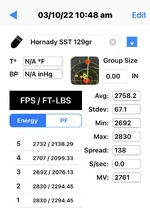
So. In summary inconclusive….. I think I have a chronograph alignment issue as ‘err2’ cropped up on the first batch of shots, with seven of the crimped set being fired resulting in only five shots recorded and a SD of 67.1…….. but look at the group size much tighter than I have been getting…. One bad round where I wasn’t focussed…..
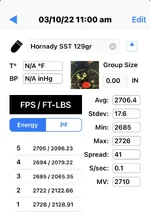
Repositioned the chrono about three inches higher, no error readings…. And on the uncrimped Rounds I got a wider group but an SD of 17.6 and a spread of 41.
Now I’m going to lift the ‘table’ in which the chrono is mounted and try again tomorrow at lunchtime with some more crimped rounds shooting lower into the chronograph…..I’m thinking the group is better on the crimped and maybe vagaries of the chrono is potentially the issue….
So. In summary inconclusive….. I think I have a chronograph alignment issue as ‘err2’ cropped up on the first batch of shots, with seven of the crimped set being fired resulting in only five shots recorded and a SD of 67.1…….. but look at the group size much tighter than I have been getting…. One bad round where I wasn’t focussed…..
Repositioned the chrono about three inches higher, no error readings…. And on the uncrimped Rounds I got a wider group but an SD of 17.6 and a spread of 41.
Now I’m going to lift the ‘table’ in which the chrono is mounted and try again tomorrow at lunchtime with some more crimped rounds shooting lower into the chronograph…..I’m thinking the group is better on the crimped and maybe vagaries of the chrono is potentially the issue….
Attachments
Heym SR20
Well-Known Member
Forget the chronograph. What matters is how it groups down range. And what really matters is how it groups from a cold clean barrel. Deer can't tell the difference between 17 fps. Nor can they really tell the difference between being hit an inch or two either side of the point of aim. They do notice if the bullet is a a bit far away from point of aim cos it leads to a painful death. They don't mind a complete miss.Well I’m back, took an hour to make up for a whole four hrs of meetings this afternoon….
So. In summary inconclusive….. I think I have a chronograph alignment issue as ‘err2’ cropped up on the first batch of shots, with seven of the crimped set being fired resulting in only five shots recorded and a SD of 67.1…….. but look at the group size much tighter than I have been getting…. One bad round where I wasn’t focussed…..
Repositioned the chrono about three inches higher, no error readings…. And on the uncrimped Rounds I got a wider group but an SD of 17.6 and a spread of 41.
Now I’m going to lift the ‘table’ in which the chrono is mounted and try again tomorrow at lunchtime with some more crimped rounds shooting lower into the chronograph…..I’m thinking the group is better on the crimped and maybe vagaries of the chrono is potentially the issue….
A chronograph is useful to measure your final velocity if you are then going to shoot long distances and want to predict drops etc. But I doubt it substitutes for range time and actually shooting groups at 200, 250, 300, 350, 400 etc etc. and seeing where they actually hit. This is how I am planning on setting up my 223 - I will mark my turret settings for all the different ranges I shoot at.
Andy seatrout
Well-Known Member
Well I’m going to persevere with the crimping, I’ll give it another go tomorrow - the ‘bad’ SD group had six shots inside an inch ( or thereabouts) with one ‘leftie’ ……. So the crimping definitely had an impact on the group.Forget the chronograph. What matters is how it groups down range. And what really matters is how it groups from a cold clean barrel. Deer can't tell the difference between 17 fps. Nor can they really tell the difference between being hit an inch or two either side of the point of aim. They do notice if the bullet is a a bit far away from point of aim cos it leads to a painful death. They don't mind a complete miss.
A chronograph is useful to measure your final velocity if you are then going to shoot long distances and want to predict drops etc. But I doubt it substitutes for range time and actually shooting groups at 200, 250, 300, 350, 400 etc etc. and seeing where they actually hit. This is how I am planning on setting up my 223 - I will mark my turret settings for all the different ranges I shoot at.
I know you say forgot about the chrono….. but I’d ideally like it to corroborate that I’m not a complete duffer. As I’ve said before; I’m just looking for good consistent hunting loads, not benchrest accuracy

Utectok
Well-Known Member
I’m not sure if this has been covered but if you are seeking to lower your sd you must first find a powder node. This involves a lot of testing but is the only way. Once you have found a node then you faff about with seating depths… more testing then worry about neck tension… well that’s what I do

Andy seatrout
Well-Known Member
It’s a Caldwell G3….. couldn’t justify anything more expensive…. I think I’ve not got it centred properly…. Going to have another play with it tomorrow lunchtime….What chrono? That would be my first suspect here from your posts?
You could hire a lab radar or magnetospeed from Edinburgh Rifles for a weekend and get some good dataIt’s a Caldwell G3….. couldn’t justify anything more expensive…. I think I’ve not got it centred properly…. Going to have another play with it tomorrow lunchtime….
Andy seatrout
Well-Known Member
I tried a ladder test but I’m afraid I probably didn’t apply myself as well as I should….. I shoot a short distance (85 yards) so working out where the node is versus my generally variable accuracy was difficult…zI’m not sure if this has been covered but if you are seeking to lower your sd you must first find a powder node. This involves a lot of testing but is the only way. Once you have found a node then you faff about with seating depths… more testing then worry about neck tension… well that’s what I do
So instead I loaded batches of five rounds, at not the lowest powder charge but maybe one grain above lowest ….. then up to the maximum ….. finding a sweet spot that offered no horrid recoil and the best grouping……. For a 130gr bullet RS60 gives a max of 46.1gr…... from memory (I’ve got it printed off on a laminated card) and I seem to have found some accuracy with new cases at 44.4gr…. Min is 41gr and it didn’t group well with that load, but started to improve past 43gr- I used one grain increments…. From 42.1 up to 46.1…… 44.1 was good and tweaked to 44.4 but there was no great science to it….
As per my original post, most of my issues have been with reloading fired cases …… although it’s been pointed out that SDs of 17 with new cases are nothing to be proud of….. true, but I’m new to this plenty of room for improvement….
Andy seatrout
Well-Known Member
I’ll bear that in mind….You could hire a lab radar or magnetospeed from Edinburgh Rifles for a weekend and get some good data
Utectok
Well-Known Member
Your not looking for a accuracy node your looking for velocity node. First fire a lot of charges at say .2 gn intervals. Chronograph them and find charges with similar MV. There will be a couple of spots where increase in charge won’t affect MV. It’s irrelevant the groups at this stage. Then do some more testing round the node say 3-5 rounds at each charge to test sd and MV. Then test groups and do more tests at different bullet seating depths to tweak accuracy.I tried a ladder test but I’m afraid I probably didn’t apply myself as well as I should….. I shoot a short distance (85 yards) so working out where the node is versus my generally variable accuracy was difficult…z
So instead I loaded batches of five rounds, at not the lowest powder charge but maybe one grain above lowest ….. then up to the maximum ….. finding a sweet spot that offered no horrid recoil and the best grouping……. For a 130gr bullet RS60 gives a max of 46.1gr…... from memory (I’ve got it printed off on a laminated card) and I seem to have found some accuracy with new cases at 44.4gr…. Min is 41gr and it didn’t group well with that load, but started to improve past 43gr- I used one grain increments…. From 42.1 up to 46.1…… 44.1 was good and tweaked to 44.4 but there was no great science to it….
As per my original post, most of my issues have been with reloading fired cases …… although it’s been pointed out that SDs of 17 with new cases are nothing to be proud of….. true, but I’m new to this plenty of room for improvement….
Utectok
Well-Known Member
You need a decent chrono though magnospeed or something borrow one ?Your not looking for a accuracy node your looking for velocity node. First fire a lot of charges at say .2 gn intervals. Chronograph them and find charges with similar MV. There will be a couple of spots where increase in charge won’t affect MV. It’s irrelevant the groups at this stage. Then do some more testing round the node say 3-5 rounds at each charge to test sd and MV. Then test groups and do more tests at different bullet seating depths to tweak accuracy.
Similar threads


- Replies
- 34
- Views
- 2K

- Replies
- 33
- Views
- 1K

