Started this thread to avoid distracting the OP on "Thinking of reloading" with engineers' discussion of fine tuning items or just reloading items of interest that make no difference to the grouping.
On that original thread, Deermanagement suggested that a couple of thou error in the bullet concentricity, leads to 13 thou variation at the lands, which is interesting and I promised to do some measurements and post.
I happened to have some rounds sitting here that are ideal for this test as they cover the absolute full range of seating depths.
These are 100 rounds of 0.270 and 100 rounds of 0.284: I made them to check out Lapua's rep's reported remark that the texture on the tail end of Lapua bullets improves accuracy and Eric Cortina's claim that taking that texture further by counterboring the rear of the bullets (moving the CoG forwards), improves accuracy over a 1000 yard range: he had a 1.78" group at 1000 yards by doing that.
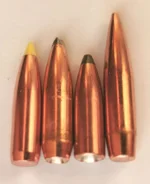
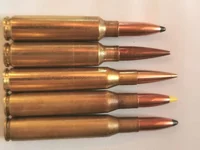
I attach photos of these unusual bullets and rounds I made. I shot 40 of these so far with results that seem to debunk Eric's claim, turning a 0.7" group at 200 yards on a slightly breezy day to into an 8" group! But before declaring Mr Cortina's claim debunked, I am trying it again, by spanning the full range of seating depths using five different bullets (boat tail and flat), and bullet weights from 130gn to 180gn, in two different calibres (0.270 and 0.284) to get a range of twist rates. The loads all use RS60, in a charge weight thats works fine for normal bullets in the two rifles involved in the test.
For the 0.270 loads I am using Nosler Accubonds and Speer, both 130gns, the former taking 56gn of RS60 and the latter 57gn, (using abbreviation gn instead of the ISO gr). I have also taken some Perigrine 0.270s 110gn, removed the bullet, machined it, and reseated to the standard depth to compare with the factory version.
For 0.280 I am using Sierra Gameking 160gn and Berger 180gn, with 52gns of RS60: don't copy it in another rifle - it is "quite" a high pressure load especially on jam but with no pressure signs in that rifle which has a rather heavy barrel. Seating using modified RCBS die for 0.270 and Franklin Arsenal comp die for 0.284 (much nicer). All cases were annealed before loading with my RF annealer, posted on another thread.
For seating depth, I am using the entire range, from bullets seated so deep the neck is right up to the Ogive, though to bullets seated so lightly that they are at hard jam and only just held by the neck. These bullets are ideal therefore exploring Deerhunter's observations.
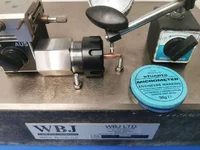
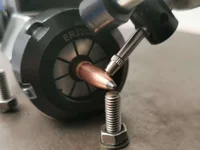
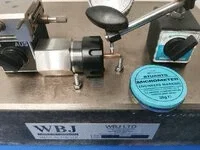
The first problem was how to hold them to get an accurate measurement of concentricity: Deermanagement's measurements are in the 2''' range so looking for a means to holding the neck at 0.1''' (1/10,000") concentricity. Tried a watchmakers lathe first - it holds the base, which is not well aligned with the neck (visibly miles out). Of course a normal 3 jaw chuck won't work, because centre on normal 3 jaw chucks depends on which socket one puts the chuck key into last. Ended up using a collet chuck and collet block, on a granite bench.
Pictures of the concentricity measurement setup will be in the 2nd post (ones done today are a bit dark with bands as the lights strobe with the camera, will do more tomorrow with better lights on).
Measurements: not surprisingly, cheap bullets, short bullets, shallow seated do not seat as concentrically as expensive long bullets deep seated. Concentricity deviation on the shortest bullet in a Winchester case, hardly seated, was up to 10'''. Berger and Accubonds are 0.5 to 0.6''' concentricity error. So this ties in with Deermanager's observations.
Next step will be blue these up and see how much seating deviation there is, though the geometry based on the measured concentricity does give support to Deermanagement's numbers.
On that original thread, Deermanagement suggested that a couple of thou error in the bullet concentricity, leads to 13 thou variation at the lands, which is interesting and I promised to do some measurements and post.
I happened to have some rounds sitting here that are ideal for this test as they cover the absolute full range of seating depths.
These are 100 rounds of 0.270 and 100 rounds of 0.284: I made them to check out Lapua's rep's reported remark that the texture on the tail end of Lapua bullets improves accuracy and Eric Cortina's claim that taking that texture further by counterboring the rear of the bullets (moving the CoG forwards), improves accuracy over a 1000 yard range: he had a 1.78" group at 1000 yards by doing that.
I attach photos of these unusual bullets and rounds I made. I shot 40 of these so far with results that seem to debunk Eric's claim, turning a 0.7" group at 200 yards on a slightly breezy day to into an 8" group! But before declaring Mr Cortina's claim debunked, I am trying it again, by spanning the full range of seating depths using five different bullets (boat tail and flat), and bullet weights from 130gn to 180gn, in two different calibres (0.270 and 0.284) to get a range of twist rates. The loads all use RS60, in a charge weight thats works fine for normal bullets in the two rifles involved in the test.
For the 0.270 loads I am using Nosler Accubonds and Speer, both 130gns, the former taking 56gn of RS60 and the latter 57gn, (using abbreviation gn instead of the ISO gr). I have also taken some Perigrine 0.270s 110gn, removed the bullet, machined it, and reseated to the standard depth to compare with the factory version.
For 0.280 I am using Sierra Gameking 160gn and Berger 180gn, with 52gns of RS60: don't copy it in another rifle - it is "quite" a high pressure load especially on jam
but with no pressure signs in that rifle which has a rather heavy barrel. Seating using modified RCBS die for 0.270 and Franklin Arsenal comp die for 0.284 (much nicer). All cases were annealed before loading with my RF annealer, posted on another thread.For seating depth, I am using the entire range, from bullets seated so deep the neck is right up to the Ogive, though to bullets seated so lightly that they are at hard jam and only just held by the neck. These bullets are ideal therefore exploring Deerhunter's observations.
The first problem was how to hold them to get an accurate measurement of concentricity: Deermanagement's measurements are in the 2''' range so looking for a means to holding the neck at 0.1''' (1/10,000") concentricity. Tried a watchmakers lathe first - it holds the base, which is not well aligned with the neck (visibly miles out). Of course a normal 3 jaw chuck won't work, because centre on normal 3 jaw chucks depends on which socket one puts the chuck key into last. Ended up using a collet chuck and collet block, on a granite bench.
Pictures of the concentricity measurement setup will be in the 2nd post (ones done today are a bit dark with bands as the lights strobe with the camera, will do more tomorrow with better lights on).
Measurements: not surprisingly, cheap bullets, short bullets, shallow seated do not seat as concentrically as expensive long bullets deep seated. Concentricity deviation on the shortest bullet in a Winchester case, hardly seated, was up to 10'''. Berger and Accubonds are 0.5 to 0.6''' concentricity error. So this ties in with Deermanager's observations.
Next step will be blue these up and see how much seating deviation there is, though the geometry based on the measured concentricity does give support to Deermanagement's numbers.
Attachments

Last edited: