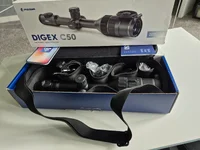
I've been using the C50 for a couple of weeks now. In 3 foxing outings I've had 5 dog foxes dropped on the spot. The daylight colour image is as good as you need for hunting (assuming you take your binos as well). The shift to twilight colour gives you another 30 minutes' "daytime" viewing after everything gets desaturated to the naked eye (the C50's real party trick -and it's a good one). After that you get another 20 minutes of really good b/w viewing without the IR. Then you'll need to put the IR on. The beam is impressively even, albeit at the cost of reach (200m). If you prefer a tight spotlight, get the cheaper C50 model without the IR unit (which comes with a mounting ring) and fit your preference. The Pulsar IR is by no means a "paperweight", just a different approach, and one that IMO is better suited to the majority of NV engagements.
All the mode changes are really easy to do, although each needs a small tweak of the focus, too. Also, you are likely to grab the aperture ring instead of the focus ring at first (you soon learn the difference).
The C50 zeroed easily and remains bang on target. However, while I could see my 2.5cm roundels, I couldn't see small-calibre bullet holes on paper. Having 1cm @100m clicks (actually 11mm) is convenient for fine adjustments. I prefer to shoot on 3.5x without the IR and on 7x with it. I don't expect 14x to give me a more workable image. I mostly hunt with thermal on 3x-5x so am comfortable hunting at "low" magnification.
Overall, the C50 is a premium item, scoring on overall quality instead of raw specifications. Others include mounts, IR and even an LRF, and at a lower overall cost, but those elements are only a benefit when it's your first "rodeo" (I already have a selection to choose from). In any case, I know my ranges and drops (from the old habit of making up a range card for any OP), plus, with the .204R or .17FB, it's almost always point-and-shoot.