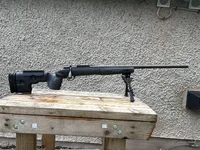
Rifle safety: a salutary tale

full auto are not legal for civilian use.
semi auto ie, self loading are in 22, and shotguns [with mag limit restrictions, unless sec 1 fac]
I was thinking it was a reference to semi auto, as opposed to full auto.
ruger 10/22 in a self loader, ie, it reloads automatically, as does an auto shotgun, recoil operated. neither are capable of full auto firing, ie continuous fire on a single pull of the trigger.

Most are capable if people get a bit over excited stoning sears.

The vast majority of civilian semi autos are that only (bar a few that can switch between BA and SA) so there is no switching to auto. I don’t have a major issue with mr apocalypse referring to it just wondered why he feels the need.

From another recent thread

Used to shoot offhand with an air rifle. After that only shot offhand when forced to, usually at moving things. When doing this I normally flicked over to auto, that worked ok for me, and I hit them.
☻☻☻
 
Most are capable if people get a bit over excited stoning sears.

The vast majority of civilian semi autos are that only (bar a few that can switch between BA and SA) so theare is no switching to auto. I don’t have a major issue with mr apocalypse referring to it just wondered why he feels the need.

but your adding stuff that's irrelevant surely, of course its possible to alter a semi auto to operate as a full auto ,stoned sears, bump stocks, [until recently] but its totally illegal and has nothing to do with gun safety. and not what this thread is about.
 
but your adding stuff that's irrelevant surely, of course its possible to alter a semi auto to operate as a full auto ,stoned sears, bump stocks, [until recently] but its totally illegal and has nothing to do with gun safety. and not what this thread is about.

Only to illustrate the point that it was not what TFH was talking about.
(And the bit about full auto is obviously illegal but plenty have done it trying for a a lighter trigger)
 
When most of us were in nappies, old men like @The fourth Horseman were young men who put themselves in harm's way in order to keep us kiddies back home safe. As far as I'm concerned, he can say what he likes and the rest of us can show him and his kind the respect that his service deserves.

Kind regards,

Carl

Wonder if he knows Paddy Mayne
S
 
I think many are missing the point.

Neither a Tikka, nor a Remington, nor a Sako, nor a Howa, has as true "safety catch".

That can only be implemented either by de-cocking the bolt (or whatever other mechanism), or by having a mechanism that absolutely prevents the firing pin from striking the primer.

These exist. I could list a few that I know of, but I'm no expert in these matters.

Basically I have been taught, from the beginning, that as soon as you get onto your land the rifle should be loaded. The "safety catch" may be a nice to have, but not trustworthy. Neither the trigger.

Muzzle awareness, sh(it) happens, we can trip, drop our guns, stumble just crossing a fence or stile, never mind the realities of getting up to and down from a high seat, into and out of vehicles, out before dawn, back after last light. No visibility. Passing over a "hot" rifle to a partner whilst doing things even as basic as having a pee or tying up a loose boot lace.

Procedures for making the rifle safe before and after any such manoeuvre. Taught then learned by rote.

Mechanisms can fail, maintenance not so good, is it just one screw, or two pins, or an impeccable impregnable mechanism that absolutely seems impossible to fail holding the trigger in ? Or do we just want a little lever that we usually push forwards or sometimes pull backwards to fire, now that's also confusing.

Anyway it's just a little lever. Might work, might not, same as the trigger. Might be reliable, might be erratic, might have been fiddled with, might go off with a thump or small drop, maybe a screw could have come loose, or it was just a rubbish design from the start.

Having grown up target shooting, ISTM that the only safe rifle is the one with the bolt removed. Or no ammunition inside. But that's absolutely not how it has to be done in the field.
.

Totally agree that most rifles don't have a safety per-se. Only Mauser type rifles with a safety on the bolt shroud truly blocks the firing pin, and also the Blaser type Klickspanners mean the pin can't fire.

However when I did my DSC1 20 odd years ago I took real issue with the instruction that a rifle should be loaded - ie a round up the spout as soon as you are on the ground, and I would take issue with anybody who instructed novices in this regard. A rifle or any other gun should only be loaded when a shot is imminent. If it means you miss the occasional fox or deer then so be it.
 
  • Like
Reactions: WW.
Totally agree that most rifles don't have a safety per-se. Only Mauser type rifles with a safety on the bolt shroud truly blocks the firing pin, and also the Blaser type Klickspanners mean the pin can't fire.

However when I did my DSC1 20 odd years ago I took real issue with the instruction that a rifle should be loaded - ie a round up the spout as soon as you are on the ground, and I would take issue with anybody who instructed novices in this regard. A rifle or any other gun should only be loaded when a shot is imminent. If it means you miss the occasional fox or deer then so be it.
when I was taken on my first stalk, the professional stalker had me load the rifle...after he had spent a considerable time teaching me how to carry it in a safe manner, I have always followed his instructions to the letter, and have never considered the action unsafe or reckless. if you are on the hill in Scotland or open ground then loading before the shot is fine, in wooded areas the distance to target and time factor means you will lose more than you shoot, also the time spent trying to load is better spent in confirming the safety of the backstop IMHO.
Each to their own I guess.
 
  • Like
Reactions: Kjf
when I was taken on my first stalk, the professional stalker had me load the rifle...after he had spent a considerable time teaching me how to carry it in a safe manner, I have always followed his instructions to the letter, and have never considered the action unsafe or reckless. if you are on the hill in Scotland or open ground then loading before the shot is fine, in wooded areas the distance to target and time factor means you will lose more than you shoot, also the time spent trying to load is better spent in confirming the safety of the backstop IMHO.
Each to their own I guess.

Don't disagree with you in woodland - a shot is often imminent and rifle is in hand. But I have seem load up a rifle with one up the spout, then stick on their shoulder or in their pack and then go marching up up a munro, or across fields climbing over fences etc. With practice you can load a bolt action rifle quietly and take a shot quickly. Get rifle ready confirm backstop load and fire.
 
So you often see/hear people saying to check the chamber with a finger.

Why? If you open the bolt and can account for the round that was ejected (ideally, you are now holding it), it is a physical impossibility for a round to also still be in the chamber...
 
So you often see/hear people saying to check the chamber with a finger.

Why? If you open the bolt and can account for the round that was ejected (ideally, you are now holding it), it is a physical impossibility for a round to also still be in the chamber...

Humans are fallible.

I think the habit was formed from firing magazine-fed weapons (at a rate not normally associated with stalking) while not necessarily counting rounds, at night, under high stress conditions.
The high stress conditions is probably the key reason. While your logic of ‘if I can account for a round it’s not in the breech’ is fair, under less than ideal conditions there’s only one way to know if something is in the breech or not.
Sight can be deceptive, as humans often see what they expect to see, not what’s actually there.

No harm in the habit transferring over to stalking.
 
Humans are fallible.

I think the habit was formed from firing magazine-fed weapons (at a rate not normally associated with stalking) while not necessarily counting rounds, at night, under high stress conditions.
The high stress conditions is probably the key reason. While your logic of ‘if I can account for a round it’s not in the breech’ is fair, under less than ideal conditions there’s only one way to know if something is in the breech or not.
Sight can be deceptive, as humans often see what they expect to see, not what’s actually there.

No harm in the habit transferring over to stalking.

I sort of agree. However, I also have problems with that logic. I do a lot of teaching and assessing of practical skills. We find that silly mistakes start to happen when people slavishly follow rote learned patterns without engaging their brains to actually think about what they’re doing.

I would say that for a stalker (rather than a soldier in the heat of battle), it’s probably better to drop open the bolt, and then ask yourself ‘can I account for the extracted round’ - ideally, confirm that you are now holding it. Fingering the chamber is a ‘dead’, redundant action if you are holding the extracted round, and as a rote action, it allows the person to disengage brain.

Worse, as a rote action, it is often done in a very cursory ‘going through the motions’ manner. There is an enormous amount of evidence to show (exactly as you said above) that people find what they expect to find when doing this. So they are substantially more likely to miss a real round of it’s actually there. Far better to look in your hot little hand and confirm that it does indeed contain a round. If it does, that round CANNOT PHYSICALLY BE IN THE CHAMBER.!

But I am in a minority on this. People are very devoted to their learned behaviours, especially if it makes them look a little bit hard core and military.
 
So you often see/hear people saying to check the chamber with a finger.

Why? If you open the bolt and can account for the round that was ejected (ideally, you are now holding it), it is a physical impossibility for a round to also still be in the chamber...
It probably does come from the military, but is no worse for that, IMO.
It works if you cannot account for the round immediately, and/or at night, especially if you have not got a torch.

I agree with you that we often see what we want/expect to see. The good bit about stuffing a finger into the breech is that a round feels totally different, and that should shock you into removing it, and wondering if any of the rest of your unload was done wrong.
 
It probably does come from the military, but is no worse for that, IMO.
It works if you cannot account for the round immediately, and/or at night, especially if you have not got a torch.

I agree with you that we often see what we want/expect to see. The good bit about stuffing a finger into the breech is that a round feels totally different, and that should shock you into removing it, and wondering if any of the rest of your unload was done wrong.

Totally agreed if you can’t account for the round.

Ideally, there is no need for a torch: it should be in your hand. But yes - if you open the bolt, and you don’t have it in your hand, then finger the chamber.

As for feeling completely different: yes. Except for rifles where it’s hard to get your hand in there (like those with a very small ejection port). Here, I’ve seen lots of people just vaguely poke their finger in and wiggle it about. No way they would ever know if there was or wasn’t a round in there. But they’re going through the motions as they’ve been taught, without engaging brain.
 
Carl and I had a similar conversation whilst at his place last year

He and I keep our mauser actioned rifles in a similar state - rounds in the mag, an empty chamber and eased springs

The ONLY difference between us is, when closing the bolt (with rounds in the mag or mag box) on an empty chamber, he pulls the trigger to ease springs (barrel pointed in a safe direction) - I always ease springs using the bolt and trigger combined to ease the firing pin down (to do this I work the bolt with the non shooting hand)

This was how I was taught originally and I never now deviate from it

Errors result when deviation occurs, or when adopted practice is unsafe in the first place, or indeed when no discipline exists at all

Stressful situations often reveal inadequacies or failures in procedure

My rifle, in the carry, is always in a state of ''eased springs on a full mag with empty chamber''

Others I'm sure will have other procedures - for me, the important thing is that those procedures work and are never deviated from

Munroe's comment about 'rote replacing brain' (my words) is an interesting one

Perhaps it is not enough to have a well rehearsed procedure - brain must also be engaged

On the other hand, under stressful conditions the brain doesn't always engage, so muscle memory and 'rote' needs to be there too

the 'pinky in the chamber' check is also one I use (having first slid the bolt half way closed) as often eyes are on your quarry or dangerous situation, not on the rifle
 
Back
Top