and it might help if companies all sang from the same hymn sheet,
Hornady book says a 55g bullet with N-133 powder , 19.8g, 20.8g 21.8g and max 22.7g
vihtavuori says with the same bullet and powder, start 21.5g and max load, 25g.
Different powder manufacturers have different lawyers/barristers, that drive how conservative the data is. Hence why you should "work up a load for your rifle". The books are just a guide (and in some cases, a pretty crappy one. Some are so conservative, that you end up wasting a lot of time, only to find that the load data is considerably lower than it needs to be. <looking at you Hornady>).
Case in point: Hornady shows 41.5grs of H4350 for their max load with a 140gr ELD-Match bullet. But when they sold the factory ammo with the load data on the box, it clearly stated 42.5grs of H4350. Smh...Hodgdon's is just as bad. Extremely conservative load data. Sierra has typically been pretty close to ground truth IME.
In retrospect, Hodgdon did have a good reason (initially) for having conservative load data. When they bought IMR and Alliant (I think Alliant that was the other one), none of the load data for their powders were evaluated the same. Some were measured in CUP, some in PSI. Some were 30 year old data that hadn't been revisited since, and some was fairly current data. It was a mix match of data, that ultimately required them to go back and test ALL powders against a single test method. Somewhere in there though, they got overly cautious, and it never reverted back to, no crap, real world test data. It got dumbed down.
I remember Muir and I being at SHOT Show one year, and the Hodgdon guy telling us this, as we were both at pressure gun/universal receiver maker's booth, ordering equipment for our respective customers' ballistics labs.
Anyways, food for thought...
ETA: Another thing to remember, is that they test to the twist rate of the original SAAMI spec. Which can (and does) hose up results. For example, go look in your load manual at .223. It clearly states that the test barrel is a 1-12 twist. Then look at the 80gr bullet load data. Now ask yourself this, how do they test an 80gr bullet, accurately, out of a 1-12 twist barrel. When I called them up asking, they said "The SAAMI test barrel is 1=12 twist, so that's what we test with." When I asked how they could test something that would have a bullet impact sideways onto the target with that twist rate, they said "The SAAMI test barrel is 1=12 twist, so that's what we test with." Reloading books are a guide. But understand what they are, and their limitations. As you gain experience reloading, you'll begin to see where things in those manuals tends to be far too conservative. For the record: DO NOT start with max loads; that's not what I'm implying. What I am saying is that some reloading manuals' max load data is no where near the max load. Especially in a modern firearm, in good condition. But you need to work up a load, in your rifle, to understand sometimes, what that max load really is.


 I don't reload vast amounts and do brass once back so small volumes. Saves ££ on leccy lol

 quick dab of autosol on some wire wool, or will just wire wool do


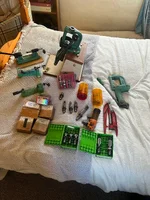
 realoading gear turned up so set the press up on the bench, saving the rest for tomorrow