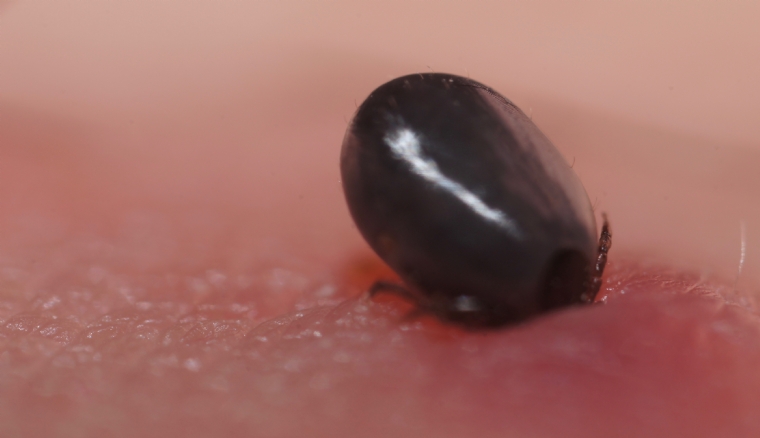
Tick tock - boom!

interesting, thank you- curious, what did you dilute it with please?
[/QUOTE]

Sorry fella should have put that that in there. Distilled water. It also has lots of other uses which it works amazingly on. Dogs, Chicken coop mite, fleas and other such thing that serve no purpose existing 👍🏻
 
Thanks, chaps.

@awmc is running a useful thread on ticks & Lyme disease, well worth keeping up. There are a couple of Rovince videos, a recent one and one from 5 or 6 years ago which would be worth posting there (@Monarch Country Products). The commentary in the older video mentions the then noticeably rising tick numbers and increasing prevalence of Lyme disease (that's Lyme not 'Lymes') and TBE (tick-borne encephalitis) in Germany, nothing has changed, they are on the up.

A recent and as yet unpublished report from southern Germany notes tick numbers again at record levels, to quote:

" ... numbers of ticks, Ixodes ricinus, are again at a record level. More than 520 nymphs per 90 minutes sampling have been collected during a standardised tick-sampling activity in May this year [2020]. Comparative tick sampling from 2009 to 2017 in the same location in May gave an average of 242 tick nymphs. This year is the third year with consecutive record tick numbers. In addition, in 2020 in the studied areas, a 3-fold increase of adult ticks in comparison to last year [2019] was observed. In some TBE foci even higher absolute numbers of adult ticks than nymphal ticks have been found ... " [edited].

I'll add to this thread with news and comment on hybrid ticks and tick range expansions and wrap in reports on CCHF and TBE in Europe where relevant and as time allows, and please chip in, many thanks.
 
An article in SwissInfo yesterday reports more than twice as many cases of tickborne encephalitis (TBE) in Switzerland this year compared to last.

215 reports since the beginning of this year (2020) compared to 97 in the same period last year.

The incidence of TBE in Switzerland has increased by about 50% since 2000. The Swiss government has a proactive TBE vaccination program, the Federal Office of Public Health (FOPH) advises anybody who may be exposed to ticks, for example hunters, and hikers, especially in forests, to be vaccinated.
 
I’m going stalking next month to a very tick infested area.
Not having much dealings with ticks, what are the areas To be mindful of and areas on my body to check after stalking?

I have a tick tweezers and have ordered sprays which contain both permethrin and DEET and will wash my stalking gear in tick repellent stuff which I have ordered from bush wear. I will also wear wellies rather than my stalking boots to stop them climbing up under my trousers.

Any help on the body checks would be great 👍 I have heard they go to your groin area but not 100%

Cheers
 
@James0586 - the simple answer is to check everywhere. You may find stalking in boots + gaiters far more comfortable than wellies which can act as a funnel for bugs in tall cover or if crawling.

The travel and hiking brand Craghoppers do a summer boot with permethrin treated fabric.

PHE have a tick awareness toolkit, below in pdf, which has a few general tips and pointers.
 

Attachments

There is a product called RID from Australia used to get it from the safari store in London. Never had a tick latch on, a Scottish midge or a mozi bite either here or in Africa when applied but been told it's now banned from sale in the uk. This stuff is mustard and must be harmful if over used but the ticks could be a bigger risk. You can still get it abroad so if you know any international lorry drivers fill your boots.
 
There is a product called RID from Australia used to get it from the safari store in London. Never had a tick latch on, a Scottish midge or a mozi bite either here or in Africa when applied but been told it's now banned from sale in the uk. This stuff is mustard and must be harmful if over used but the ticks could be a bigger risk. You can still get it abroad so if you know any international lorry drivers fill your boots.

Appears to be mainly DEET

 
Jam hot today. If you haven't already and if you have time read this thread from the beginning – thanks.


" ... The sixth report in the State of the UK Climate series confirms that 2019 was the 12th warmest year in a series from 1884.

Although sitting outside the top ten warmest years in the series (all since 2002), 2019 was most remarkable for setting four UK high temperature records, including:

A new all-time record (38.7° C) 25 July, Cambridge University Botanic Gardens (Cambridgeshire)
A new winter record (21.2° C) 26 February, Kew Gardens (London); the first time 20 C has been reached in the UK in a winter month.
A new December record (18.7° C) 28 December, Achfary (Sutherland).
A new February minimum record (13.9° C) 23 February, Achnagart (Highland)
The all-time and winter records also created new high-temperature records for February and July.

No national low-temperature records were set during the year ... "

Regardless of the causes the consequences are fairly evident.
 
A recent and as yet unpublished report from southern Germany notes tick numbers again at record levels

With reference to the above, recorded tick-borne encephalitis (TBE) cases in Germany are approaching record numbers this year.

To date, more than 530 human cases have been reported to the German govt. agency Robert Koch-Institute
and from an analysis “ … districts with altitudes of 550 to over 600 meters are more heavily affected with increased numbers of human cases, while the districts in lower altitudes show case numbers comparable to recent years … “

Staycations this year may account for some of the increase although record numbers of ticks, Ixodes ricinus, have been observed for three consecutive years with unusually high numbers of TBE virus (TBEV)-infected adult ticks in 2020.

Record temperatures and mild winters are apparently the reason for the better survival of ticks and their occurrence at higher altitudes and for intensified virus circulation among vectors.

There are highly likely to be some changes to the TBE vaccination recommendations for residents and visitors.
 
Not breaking science, just a timely reminder of how some can roll.

Parthenogenesis – the females of some tick species are capable of reproducing in the absence of a male :


“ … Due to the nature of this pest, the female ticks can reproduce without a male, so it only takes one tick to create an established population in a new location … “

Makes one wonder of the capabilities of hybrid ticks.
 
Onwards and upwards.


Illustrates how some pathogens including the TBE virus and Borrelia, influence tick behaviour making host-seeking and feeding, and hence pathogen transmission, more successful !
 
Updated figures for TBE cases in Germany this year:


In full:

" Through Sept. 7, 535 cases have been reported; which is an increase of 14 percent over the same period in 2018, a record year for TBE in Germany.

Eighty-nine percent of the cases (477) have been reported from Baden-Württemberg and Bavaria states in southern Germany.

Health officials suggest the increase may be due to the recommended measures to contain COVID-19, where people may spent increased amount of their leisure time outdoors and thus have an increased risk of exposure.

In 2020, high numbers of ticks were also be observed in places that are regularly sampled. In particular, the number of adult tick stages is unusually high this year. This tick stage has a higher virus carrier rate than the nymph stage. It can be assumed that this tick season in the known TBE risk areas also increases the probability of being bitten by an infected tick.

TBE is an illness caused by a virus spread through tick bites. You can also get TBE by eating or drinking unpasteurized dairy products (such as milk and cheese) from infected goats, sheep, or cows, according to the Centers for Disease Control and Prevention (CDC).

Symptoms include fever, achiness, loss of appetite, headache, nausea, and vomiting. Swelling of the brain and/or spinal cord, confusion, and sensory disturbances occur in 20-30% of people with TBE. One percent of people die from this infection.

TBE is found in many parts of Europe and Asia (from eastern France to northern Japan and from northern Russia to Albania). Several thousand cases are reported each year, but there are probably many other cases that do not get reported. The highest number of cases occurs in Russia. "
 
I removed a tick 2 weeks ago.
About 7 days ago the classic swelling and 10cm purple-red circular mark appeared.
Currently on Doxycycline antibiotics for upto 3 weeks.
 
The risk from animal produce is very small indeed.


To quote:

" France has identified its first outbreak of tick-borne encephalitis from consumption of raw milk products, with more than 40 people affected.

The infections are linked to eating a brand of raw milk goat cheese in Ain, in the Rhone-Alpes region, between April and May this year [2020], according to Santé publique France.

The cheese producer is GAEC des Chevrettes du Vieux Valey, based at Condamine in Haut-Bugey, Ain. It is thought ticks carrying the virus contaminated a goat, then its milk, then the cheeses, and finally consumers.

A total of 42 cases of lymphocytic meningitis, encephalitis and infectious syndromes have been identified in people living in the commune of Oyonnax, within a radius of 30 kilometres. Two additional people live in Loire-Atlantique and Jura but consumed the implicated raw milk goat’s cheese. Cases occurred between the week of April 13 to 19 and May 18 to 24 with a peak from April 20 to 26. "
 

To quote:

" Consommation de lait ou d'un produit laitier non pasteurisé

Une étude en République tchèque (zone endémique d'EAT) a montré que près de 1 % des cas d'EAT (où la personne non vaccinée n'avait pas le souvenir d'avoir été mordue par une tique) étaient d'origine alimentaire, essentiellement du lait de chèvre non pasteurisé, les enfants présentant un risque 2,5 fois plus élevé d'infection que les adultes 8 .

Plus récemment, une enquête en Slovaquie9 a confirmé le risque lié au lait de chèvre dans les zones endémiques.

La transmission de l'EAT par des produits laitiers non pasteurisés semble augmenter ces dernières années en Europe. Une étude norvégienne récente10, concernant 112 prélèvements de lait de vache analysés par RT-PCR, a permis de noter la présence du TBEV dans 5,4 % des échantillons (des études ultérieures sont nécessaires pour vérifier si ces laits peuvent être infectants).

Les vaches correspondant à ces échantillons positifs étaient négatives lors de la recherche d'anticorps sériques neutralisants alors que 15 vaches, sur 17 testées dans la région d'Arendal, se sont révélées positives pour cette recherche d'anticorps (mais négatives pour leur lait). La région d'Arendal est aussi celle où les taux d'EAT notifiés sont les plus importants.

Ce risque lié aux produits laitiers non pasteurisés dans les régions infestées par les tiques et où des cas d'EAT sont signalés démontre qu'une évaluation du risque alimentaire est nécessaire pour définir éventuellement des mesures de prévention. Ceci concerne en particulier les personnes atteintes d'EAT et n'ayant pas le souvenir d'avoir été mordues par une tique (alors qu'une morsure de tique a pu effectivement avoir lieu). "

En anglais :

" Consumption of raw milk or dairy products

A study in the Czech Republic (endemic area of TBE) showed that almost 1% of the cases of TBE (where the unvaccinated person did not remember having been bitten by a tick) were of food origin, mainly unpasteurized goat milk; children have a 2.5 times higher risk of infection than adults.

More recently, an investigation in Slovakia confirmed the risk linked to goat milk in endemic areas.

The transmission of TBE by unpasteurized dairy products seems to have increased in recent years in Europe. A recent Norwegian study, concerning 112 cow's milk samples analyzed by RT-PCR, made it possible to note the presence of TBEV in 5.4% of the samples (further studies are necessary to check if these milk products can be infectious).

The cows corresponding to these positive samples were negative when searching for neutralizing serum antibodies while 15 cows, out of 17 tested in the Arendal region, were positive for this antibody search (but negative for their milk). The Arendal region is also the one where the rates of notified TBE are the highest.

This risk linked to unpasteurized dairy products in regions infested with ticks and where cases of TBE are reported shows that an evaluation of the dietary risk is necessary to possibly define preventive measures. This concerns people with TBE who do not remember having been bitten by a tick (although a tick bite may have actually occurred). "
 
Back
Top