
You are using an out of date browser. It may not display this or other websites correctly.
You should upgrade or use an alternative browser.
You should upgrade or use an alternative browser.
What's this cartridge?
- Thread starter J111
- Start date


enfieldspares
Well-Known Member
Looks very early 215 grain bullet .303 to me! Does it have a R /|\ L on the base? Though the cracked neck is typical of Eley cases from the early 20th Century. I think it isn't parallel enough, nor fat enough, to be 32-40. All black staining of a case, done at the factory, was for a grenade firing blank. But, of course, that would have no bullet. Is there a small exposed lead tip?
Last edited:


Claret_Dabbler
Well-Known Member
303 was my first reaction. If it really is 8mm, could it be a Lebel?
enfieldspares
Well-Known Member
Not 8mm Lebel, no. That cartridge, as its rifle used a tubular magazine, is seriously cone shaped. So that the points of the bullets don't lie touching the primers of the rounds in front of them.

A pic of the head stamp will sort out any guessing or bun fights use green pan cleaner and jiff that will clean it up
Come on Paul the Gun God has said what it is so be a good lad and take note....

Tim.243

paul o'
Well-Known Member
my turn to copy and paste:---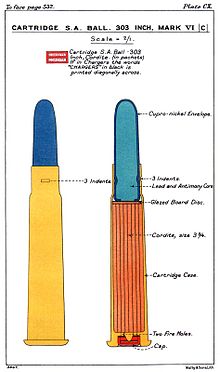 [h=3]History and development[edit][/h]During a service life of over 70 years with the British Commonwealth armed forces the .303-inch cartridge in its ball pattern progressed through ten marks which eventually extended to a total of about 26 variations.[SUP][7][/SUP] The bolt thrust of the .303 British is relatively low compared to many other service rounds used in the early 20th century.
[h=3]Propellant[edit][/h]The original .303 British service cartridge employed black powder as a propellant, and was adopted for the Lee–Metford rifle, which had rifling designed to lessen fouling from this propellant. The Lee–Metford was used as a trial platform by the British Committee on Explosives to experiment with many different smokeless powders then coming to market, including Ballistite, Cordite, and Rifleite.[SUP][8][/SUP][SUP][9][/SUP][SUP][10][/SUP] Ballistite was a stick-type smokeless powder composed of soluble nitrocellulose and nitroglycerine.[SUP][10][/SUP] Cordite was a stick-type or 'chopped' smokeless gunpowder composed of nitroglycerine, gun-cotton, and mineral jelly, while Rifleite was a true nitrocellulose powder, composed of soluble and insoluble nitrocellulose, phenyl amidazobense, and volatiles similar to French smokeless powders.[SUP][9][/SUP][SUP][10][/SUP] Unlike Cordite, Riflelite was a flake powder, and contained no nitroglycerine.[SUP][10][/SUP] Excessive wear of the shallow Lee–Metford rifling with all smokeless powders then available caused ordnance authorities to institute a new type of barrel rifling designed by the RSAF, Enfield, to increase barrel life; the rifle was referred to thereafter as the Lee–Enfield.[SUP][8][/SUP] After extensive testing, the Committee on Explosives selected Cordite for use in the Mark II .303 British service cartridge.[SUP][8][/SUP]
[h=3]Projectile[edit][/h]The initial .303 Mark I and Mk II service cartridges employed a 215-grain, round-nosed, copper-nickel full-metal-jacketed bullet with a lead core. After tests determined that the service bullet had too thin a jacket when used with cordite, the Mk II bullet was introduced, with a flat base and thicker copper-nickel jacket.[SUP][11][/SUP]
The Mk II round-nosed bullet was found to be unsatisfactory when used in combat, particularly when compared to the dum-dum rounds issued in limited numbers in 1897 during the Chitral and Tirah expeditions of 1897/98 on the North West Frontier of India.[SUP][11][/SUP] This led to the introduction of the Cartridge S.A. Ball .303 inch Cordite Mark III, basically the original 215-grain (13.9 g) bullet with the jacketing cut back to expose the lead in the nose.[SUP][11][/SUP] Similar hollow-point bullets were used in the Mk IV and Mk V loadings, which were put into mass production. The design of the Mk IV hollow-point bullet shifted bullet weight rearwards, improving stability and accuracy over the regular round-nose bullet.[SUP][11][/SUP] These soft-nosed and hollow-point bullets, while effective against human targets, had a tendency to shed the outer metal jacket upon firing; the latter occasionally stuck in the bore, causing a dangerous obstruction.[SUP][11][/SUP] The Hague Convention of 1899[SUP][11][/SUP] later declared that use of expanding bullets against signatories of the convention was inhumane, and as a result the Mk III, Mk IV, and Mk V were withdrawn from active service. The remaining stocks (over 45 million rounds) were used for target practice.
The concern about expanding bullets was brought up at the 1899 Hague Convention by Swiss and Dutch representatives. The Swiss were concerned about small arms ammunition that "increased suffering", and the Dutch focused on the British Mark III .303 loading in response to their treatment of Boer settlers in South Africa. The British and American defense was that they should not focus on specific bullet designs, like hollow-points, but instead on rounds that caused "superfluous injury". The parties in the end agreed to abstain from using expanding bullets. As a result, the Mark III and other expanding versions of the .303 were not issued during the Second Boer War (1899–1902). Boer guerrillas allegedly used expanding hunting ammunition against the British during the war, and New Zealand Commonwealth troops may have brought Mark III rounds with them privately after the Hague Convention without authorization.[SUP][12]
end ) [/SUP][SUP] more about this can be found @ [/SUP]https://en.wikipedia.org/wiki/Main_Page .303 british
 [h=3]History and development[edit][/h]During a service life of over 70 years with the British Commonwealth armed forces the .303-inch cartridge in its ball pattern progressed through ten marks which eventually extended to a total of about 26 variations.[SUP][7][/SUP] The bolt thrust of the .303 British is relatively low compared to many other service rounds used in the early 20th century.
[h=3]Propellant[edit][/h]The original .303 British service cartridge employed black powder as a propellant, and was adopted for the Lee–Metford rifle, which had rifling designed to lessen fouling from this propellant. The Lee–Metford was used as a trial platform by the British Committee on Explosives to experiment with many different smokeless powders then coming to market, including Ballistite, Cordite, and Rifleite.[SUP][8][/SUP][SUP][9][/SUP][SUP][10][/SUP] Ballistite was a stick-type smokeless powder composed of soluble nitrocellulose and nitroglycerine.[SUP][10][/SUP] Cordite was a stick-type or 'chopped' smokeless gunpowder composed of nitroglycerine, gun-cotton, and mineral jelly, while Rifleite was a true nitrocellulose powder, composed of soluble and insoluble nitrocellulose, phenyl amidazobense, and volatiles similar to French smokeless powders.[SUP][9][/SUP][SUP][10][/SUP] Unlike Cordite, Riflelite was a flake powder, and contained no nitroglycerine.[SUP][10][/SUP] Excessive wear of the shallow Lee–Metford rifling with all smokeless powders then available caused ordnance authorities to institute a new type of barrel rifling designed by the RSAF, Enfield, to increase barrel life; the rifle was referred to thereafter as the Lee–Enfield.[SUP][8][/SUP] After extensive testing, the Committee on Explosives selected Cordite for use in the Mark II .303 British service cartridge.[SUP][8][/SUP]
[h=3]Projectile[edit][/h]The initial .303 Mark I and Mk II service cartridges employed a 215-grain, round-nosed, copper-nickel full-metal-jacketed bullet with a lead core. After tests determined that the service bullet had too thin a jacket when used with cordite, the Mk II bullet was introduced, with a flat base and thicker copper-nickel jacket.[SUP][11][/SUP]
The Mk II round-nosed bullet was found to be unsatisfactory when used in combat, particularly when compared to the dum-dum rounds issued in limited numbers in 1897 during the Chitral and Tirah expeditions of 1897/98 on the North West Frontier of India.[SUP][11][/SUP] This led to the introduction of the Cartridge S.A. Ball .303 inch Cordite Mark III, basically the original 215-grain (13.9 g) bullet with the jacketing cut back to expose the lead in the nose.[SUP][11][/SUP] Similar hollow-point bullets were used in the Mk IV and Mk V loadings, which were put into mass production. The design of the Mk IV hollow-point bullet shifted bullet weight rearwards, improving stability and accuracy over the regular round-nose bullet.[SUP][11][/SUP] These soft-nosed and hollow-point bullets, while effective against human targets, had a tendency to shed the outer metal jacket upon firing; the latter occasionally stuck in the bore, causing a dangerous obstruction.[SUP][11][/SUP] The Hague Convention of 1899[SUP][11][/SUP] later declared that use of expanding bullets against signatories of the convention was inhumane, and as a result the Mk III, Mk IV, and Mk V were withdrawn from active service. The remaining stocks (over 45 million rounds) were used for target practice.
The concern about expanding bullets was brought up at the 1899 Hague Convention by Swiss and Dutch representatives. The Swiss were concerned about small arms ammunition that "increased suffering", and the Dutch focused on the British Mark III .303 loading in response to their treatment of Boer settlers in South Africa. The British and American defense was that they should not focus on specific bullet designs, like hollow-points, but instead on rounds that caused "superfluous injury". The parties in the end agreed to abstain from using expanding bullets. As a result, the Mark III and other expanding versions of the .303 were not issued during the Second Boer War (1899–1902). Boer guerrillas allegedly used expanding hunting ammunition against the British during the war, and New Zealand Commonwealth troops may have brought Mark III rounds with them privately after the Hague Convention without authorization.[SUP][12]
end ) [/SUP][SUP] more about this can be found @ [/SUP]https://en.wikipedia.org/wiki/Main_Page .303 british
The Lebel round for the tubular magazine Lebel Rifle was a flat point FMJ but when the French produced the Mannlicher-Berthier chambered for the Lebel, they converted to a spitzer bullet. This is neither FL or Spitzer, of course. Looks 303 to me.~MuirNot 8mm Lebel, no. That cartridge, as its rifle used a tubular magazine, is seriously cone shaped. So that the points of the bullets don't lie touching the primers of the rounds in front of them.
my turn to copy and paste:---
During a service life of over 70 years with the British Commonwealth armed forces the .303-inch cartridge in its ball pattern progressed through ten marks which eventually extended to a total of about 26 variations.[SUP][7][/SUP] The bolt thrust of the .303 British is relatively low compared to many other service rounds used in the early 20th century.
Propellant[edit]
The original .303 British service cartridge employed black powder as a propellant, and was adopted for the Lee–Metford rifle, which had rifling designed to lessen fouling from this propellant. The Lee–Metford was used as a trial platform by the British Committee on Explosives to experiment with many different smokeless powders then coming to market, including Ballistite, Cordite, and Rifleite.[SUP][8][/SUP][SUP][9][/SUP][SUP][10][/SUP] Ballistite was a stick-type smokeless powder composed of soluble nitrocellulose and nitroglycerine.[SUP][10][/SUP] Cordite was a stick-type or 'chopped' smokeless gunpowder composed of nitroglycerine, gun-cotton, and mineral jelly, while Rifleite was a true nitrocellulose powder, composed of soluble and insoluble nitrocellulose, phenyl amidazobense, and volatiles similar to French smokeless powders.[SUP][9][/SUP][SUP][10][/SUP] Unlike Cordite, Riflelite was a flake powder, and contained no nitroglycerine.[SUP][10][/SUP] Excessive wear of the shallow Lee–Metford rifling with all smokeless powders then available caused ordnance authorities to institute a new type of barrel rifling designed by the RSAF, Enfield, to increase barrel life; the rifle was referred to thereafter as the Lee–Enfield.[SUP][8][/SUP] After extensive testing, the Committee on Explosives selected Cordite for use in the Mark II .303 British service cartridge.[SUP][8][/SUP]
Projectile[edit]
The initial .303 Mark I and Mk II service cartridges employed a 215-grain, round-nosed, copper-nickel full-metal-jacketed bullet with a lead core. After tests determined that the service bullet had too thin a jacket when used with cordite, the Mk II bullet was introduced, with a flat base and thicker copper-nickel jacket.[SUP][11][/SUP]
The Mk II round-nosed bullet was found to be unsatisfactory when used in combat, particularly when compared to the dum-dum rounds issued in limited numbers in 1897 during the Chitral and Tirah expeditions of 1897/98 on the North West Frontier of India.[SUP][11][/SUP] This led to the introduction of the Cartridge S.A. Ball .303 inch Cordite Mark III, basically the original 215-grain (13.9 g) bullet with the jacketing cut back to expose the lead in the nose.[SUP][11][/SUP] Similar hollow-point bullets were used in the Mk IV and Mk V loadings, which were put into mass production. The design of the Mk IV hollow-point bullet shifted bullet weight rearwards, improving stability and accuracy over the regular round-nose bullet.[SUP][11][/SUP] These soft-nosed and hollow-point bullets, while effective against human targets, had a tendency to shed the outer metal jacket upon firing; the latter occasionally stuck in the bore, causing a dangerous obstruction.[SUP][11][/SUP] The Hague Convention of 1899[SUP][11][/SUP] later declared that use of expanding bullets against signatories of the convention was inhumane, and as a result the Mk III, Mk IV, and Mk V were withdrawn from active service. The remaining stocks (over 45 million rounds) were used for target practice.
The concern about expanding bullets was brought up at the 1899 Hague Convention by Swiss and Dutch representatives. The Swiss were concerned about small arms ammunition that "increased suffering", and the Dutch focused on the British Mark III .303 loading in response to their treatment of Boer settlers in South Africa. The British and American defense was that they should not focus on specific bullet designs, like hollow-points, but instead on rounds that caused "superfluous injury". The parties in the end agreed to abstain from using expanding bullets. As a result, the Mark III and other expanding versions of the .303 were not issued during the Second Boer War (1899–1902). Boer guerrillas allegedly used expanding hunting ammunition against the British during the war, and New Zealand Commonwealth troops may have brought Mark III rounds with them privately after the Hague Convention without authorization.[SUP][12]
end ) [/SUP][SUP] more about this can be found @ [/SUP]https://en.wikipedia.org/wiki/Main_Page .303 british
What no politics slipped in Paul....lol
Tim.243


Sinistral
Well-Known Member
Standard Mk6 .303 (1939) cordite is my guess, but I’m no expert. There are 11 versions of the cartridge with countless head-stamps. A few ECRA members collect nothing but. Why not get your caliper out & take some measurements?That's the best I got if that helps. Sure looks like a 303 based on that info someone put up. Looks longer than most 303 I've seen I thought.


[TD="width: 592"] [FONT=Arial,Helvetica,sans-serif] [/FONT][FONT=Arial,Helvetica,sans-serif] Colour Coding of .303 Ammunition Colour coding appears in several forms on small arms ammunition. The most common system with the .303 cartridge used coloured bullet tips or colour around the annulus of the primer cap. Other methods include colouring of part or the whole of the cartridge case. Originally markings arose from the need to make a quick visual check of the arrangements in a machine gun belt and they are now universally applied. As a general rule the absence of colour coding indicated a standard ball cartridge. United Kingdom & Commonwealth Countries before 1955 including Australia, Canada, India, New Zealand and South Africa Bullet Type Colour of Tip Colour of Annulus Armour Piercing Green Green Ball None Purple Incendiary Blue Blue Observing Black Black Proof None Yellow Tracer Short Range White Red Tracer Dark Ignition Grey Red Tracer Long Range Red Red Belgium Bullet Type Colour of Tip Colour of Annulus Incendiary Lt Blue None Tracer Red None Finland Bullet Type Colour of Tip Colour of Annulus Armour Piercing Lt Blue None Italy Bullet Type Colour of Tip Colour of Annulus Armour Piercing None Green Armour Piercing Incendiary(Phosphorus) Blue None Armour Peircing Incendiary(Thermite) Green None Observation Black None Tracer Red None Letter codes other than Manufacture’s Codes on .303 Headstamp AA Pomeroy explosive Incendiary Mk 2 Bullet (circa 1917) B Incendiary Bullet C Cordite Propellant charge(pre 1912) D Drill Round E Smoke Bomb Projector F Semi Armour Piercing FG Semi Armout Piercing Tracer G Tracer bullet H Grenade Discharger J Illuminating K Brock explosaive incendiary bullet (circa 1918) L Blank O Observation Bullet P Practice Round PG Practice Tracer Q Proof Round R Explosive Bullet SPG Tracer made before 1927 U Dummy Round W Armour piercing bullet WG Armour Piercing Tracer Z Nitrocellulose Propellant Charge [/FONT] |
[TD="width: 596"][FONT=Arial,Helvetica,sans-serif] IDENTIFING A .303 CARTRIDGE:
So you have a cartridge but would like to know what it is. Well that can be done by following the following steps. Most Commonwealth manufactures identified their product with a headstamp. These stamps Identifies who made it, what year, model of mark, the type of powder and occasionally if it was special purpose ammo the use.
STEP 1 Identifing the Maker. Looking at the headstamp compare it to the chart below which identifies most of the ammuniton manufacturers that produces the .303 cartiridge. It usually is a two letter code sometimes seperated by a broad arrow,
STEP 2 Identifing the Year of Production. The year is either shown in two or four digits. For example it would say 1942 or 42.
STEP 3 Identifing the Mark or Model. These were roman numerals that numbered from one to eight. I, II, III, IV, V, VI, VII, VIII Most WWII cartriges were Mk VII.(See the .303 Bullet Page for More Detail).
STEP 4 Identifing the propellant. "C" following the mark indicates that CORDITE was used (See the .303 Bullet Page for More Detail). "Z" following the mark indicated that Niro Cellulose powder was used but this was droped since most later cartridges used this as the propellant.
STEP 5 Identifing the Purpose. If there are markings on the headstamp left over these may indicate a special purpose round. There is a chart at the bottom of this page that covers all of the commonly encountered special purpose rounds.
[/FONT]
[FONT=Arial,Helvetica,sans-serif] [/FONT][FONT=Arial,Helvetica,sans-serif] Known Manufacturers
A Pretoria West Metal Pressings, Pretoria SOUTH AFRICA
A Artillerie Inrichingen, Hemberg, NETHERLANDS
AE Arsenal do Ejecito, Libson, PORTUGAL
AF Small Arms Ammunition Factory, Footscray, Melbourne, AUSTRALIA
AIF Small Arms Ammunition Factory No 1, Footscray, Melbourne, AUSTRALIA
AOC Bombrini, Parodi et Delfino, Rome, ITALY
APX Atelier dr Construction de Puteaux, FRANCE
AI Artillerie Inrichingen, Hemberg, NETHERLANDS
A-VE Atelier de Construction de Valence, FRANCE
A.VIS Atelier de Fabrication de Vincinnes, FRANCE
B Brimingham Metal and Munitions Co Ltd, Birmingham, UNITED KINGDOM
BD Halls Telegraph Co Burghfield, UNITED KINGDOM
BE Royal Ordinance Factory, Blackpole, Worchester, UNITED KINGDOM
BLANCH J Blanch & Sons of Fenchurch St., London, UNITED KINGDOM
BM British Munitions Co Ltd., Millwall, London UNITED KINGDOM
BPD Bombrini, Parodi et Delfino, Rome, ITALY
C Pirotecnico di Capua, ITALY
CAC Colonial Ammunition Co., Auckland, NEW ZEALAND
CAC Colonial Ammunition Co. Melbourne, AUSTRALIA
CIL Canadian Industies Ltd., Montreal, CANADA
CP Crompton Parkinson Ltd., Guiseley, Yorkshire, UNITED KINGDOM
C18F1 Government Cartridge Factory No 1, Blackheath, UNITED KINGDOM
C-P Crompton Parkinson Ltd., Doncaster, Yorkshire, UNITED KINGDOM
C..F3 Government Caartridge Factory No 3, Blackpole, Worc, UNITED KINGDOM
D Dominion Cartridge Co., Brownsberg, Quebec, CANADA
DA Dominion Arsenal, Montreal, CANADA
DAC Dominion Arsenal, Quebec, CANADA
DAL Dominion Arsenal, Lindsay, Ontario, CANADA
DAQ Dominion Arsenal, Quebec, CANADA
DC Defense Industries, Brownsburgh, Quebec, CANADA
DC Dominion Cartridge Company, CANADA
DC CO Dominion Cartridge Company, CANADA
DF Indian Government Ammunition Factory, Dum Dum, Calcutta, INDIA
DI Defense Industies, Montreal, CANADA
DI Indian Government Ammunition Factory, Dum Dum, Calcutta, INDIA
DIL Defense Industies, Montreal, CANADA
DIV Defense Industies, Verdun, CANADA
Do Hirtenberg Patronenfabrik, Dordrecht, NETHERLANDS
Dominion Dominion Cartridge Co., Quebec, CANADA
DF Indian Government Ammunition Factory, Dum Dum, Calcutta, INDIA
DWM Deutsche Waffen Und Munitionsfabrik, Karlsruhe, GERMANY
E Eley Brothers, Edmonton, London, UNITED KINGDOM
Eatons Dominion Cartridge Co.(Made for Eatons Dept Store), Quebec, CANADA
EB Eley Brothers, Edmonton, London, UNITED KINGDOM
F Small Arms Ammunition Factory, Footscray, Melbourne, AUSTRALIA
FC Federal Cartridge Co, Anoka, Minn UNITED STATES
FN Fabrique National d’Armes de Guerre, Herstal BELGIUM
FNM Fabrique National de Municoes e Armas Legeiras, Moscavide, PORTUGAL
FNT Fabrica Nacional de Espana, Palencia, SPAIN
FWL & Co. F.W. Lamplough & Co, CANADA
G Greenwood and Batley, Leeds, UNITED KINGDOM
GA Grenfell and Accies Ltd. Perry Barr, Birmingham, UNITED KINGDOM
GB Greenwood and Batley, Leeds, UNITED KINGDOM
GBF Greenwood and Batley, Leeds, UNITED KINGDOM
G18F1 Government Cartridge Factory No 1, Blackheath, UNITED KINGDOM
G..F3 Government Caartridge Factory No 3, Blackpole, Worc, UNITED KINGDOM
GKB George Kynoch, Birmingham, UNITED KINGDOM
GEVELOT Gevelot & Gaupittat Freres, Paris, FRANCE
Hornady Hornady UNITED STATES
HN Royal Ordinance Factory, Hirwaun, South Wales, UNITED KINGDOM
HSA Hingston Arms Winnipeg, Manitoba, CANADA
HXP Greek Powder and Cartridge Co., Athens, GREECE
ICI Imperial Chemicals Industries, UNITED KINGDOM
ICIANZ Imperial Chemicals Industries, NEW ZEALAND
IMPERIAL Canadian Industries Ltd, Montreal, CANADA
IMPERIAL Canadian Industires Ltd, Plattsburg, NY, UNITED STATES
IVI Industries Valcartier Industies, CANADA
J Brimingham Metal and Munitions Co Ltd, Birmingham, UNITED KINGDOM
K Kynoch & Co., Witton, Birmingham, UNITED KINGDOM
K Indian Government Ammunition Factory Kirkee, near Poona, INDIA
K2 Imperial Chemical Industries Kynoch Factory at Standish UNITED KINGDOM
K4 Imperial Chemical Industries Kynoch Factory at Yeading UNITED KINGDOM
K5 Imperial Chemical Industries Kynoch Factory at Kidderminster UNITED KINGDOM
KF Indian Government Ammunition Factory Kirkee, near Poona, INDIA
KH Indian Government Ordinance Factory, Khamaria, INDIA
KN Kings Norton Metal Co., Birmingham, UNITED KINGDOM
KYNOCH Kynoch & Co., Witton, Birmingham, UNITED KINGDOM
L Lorenz Ammunition and Ordinance Co, Millwall London, UNITED KINGDOM
L Ludlow and Co, Wolverhampton, Staffs, UNITED KINGDOM
LAC Dominion Arsenal, Lindsay, Ontario, CANADA
L-E Remington UMC, Bridgeport Conn., UNITED STATES
M Brimingham Metal and Munitions Co Ltd, Birmingham, UNITED KINGDOM
M Nobel Explosives Ltd., Manchester, UNITED KINGDOM
MAXIM Maxim Arms Co., London, UNITED KINGDOM
MEN Maschinefabrik Elisenhutte, WEST GERMANY
MEXICO Fabrica National de Munitions, Mexico City, MEXICO
MF Small Arms Ammunition Factory No 1, Footscray, Melbourne, AUSTRALIA
MG Small Arms Ammunition Factory No2, Footscray, Melbourne, AUSTRALIA
MH Small Arms Ammunition Factory No 3, Hendon, AUSTRALIA
MI Societe Meridionale d’Industrie, Robert Paulet & Cie, Marseille, FRANCE
MJ Small Arms Ammunition Factory No 4, Hendon, AUSTRALIA
MKE Makina ve Kimya Endusrisi, Kuruma, TURKEY
MQ Small Arms Ammunition Factory No 5, Rocklea, AUSTRALIA
MS Small Arms Ammunition Factory No 7, Salisbury, AUSTRALIA
MW Small Arms Ammunition Factory No 6, Welshpool, AUSTRALIA
N Brimingham Metal and Munitions Co Ltd, Birmingham, UNITED KINGDOM
N Nobel’s Explosives Co Glasgow, UNITED KINGDOM
N Indian Government Ammunition Factory, Dum Dum, Calcutta, INDIA
NI Indian Government Ammunition Factory, Dum Dum, Calcutta, INDIA
nny Privi Partizan, Titovo Uzice, YUGOSLAVIA
NORMA Norma Projectilfabrik, Amotfors, SWEDEN
OFN Government Ordinance Factory, Lagos, NIGERIA
OK Indian Government Ordinance Factory, Khamaria, INDIA
P Peters Cartridge Co., Kings Mills, Ohio, UNITED STATES
PC Peters Cartridge Co., Kings Mills, Ohio, UNITED STATES
PMP Pretoria Metal Pressings(Pty) Ltd. Pretoria, SOUTH AFRICA
POF Pakistan Ordinance Factory, Rawalpindi, PAKISTAN
PP Privi Partizan, Titovo Uzice, YUGOSLAVIA
PS Pirotechnico Militar de Seville, SPAIN
QA Quebec Arsenal, Quebec, CANADA
R Dominion Cartridge Co.(Made for Eatons Dept Store), Quebec, CANADA
RA Remington Arms Co., Inc., Bridgeport, Conn., UNITED STATES
RA Raufoss Ammunisjonsfabrikker, Raufoss, NORWAY
RC Raleigh Cycle Co, Nottingham, UNITED KINGDOM
RG Royal Ordinance Factory, Radway Green, Cheshire, UNITED KINGDOM
RH Raleigh Cycle Co, Nottingham, UNITED KINGDOM
RL Royal Laboratory,, Woolwich Arsenal, Kent, UNITED KINGDOM
RNRA Rhodesia National Rifle Association
R-P Remington Arms Co, Bridgeport, Conn, UNITED STATES
RR Ross Rifle Co, Montreal, CANADA
RRCO Ross Rifle Co, Montreal, CANADA
RTS Richard Threlfall and Sons, UNITED KINGDOM
R..W Rudge Whitworth Ltd. Tyseley, UNITED KINGDOM
S Indian Government Ammunition Factory Kirkee,Southern Circuit, INDIA
S Pirotechnico Militar de Seville, SPAIN
SAM South African Mint, Pretoria, SOUTH AFRICA
SAAF Small Arms Ammunition Factory, Footscray, Melbourne, AUSTRALIA
SBR Sellier & Belot, Riga, LATVIA
SFM Societe Francaise des Munitions, Issy-les-Moulineaux, FRANCE
SI Indian Government Ammunition Factory, Dum Dum, Calcutta, INDIA
SMI Societa Metallurgica Italliana, Campo Tizzoro, ITALY
SR Royal Ordinance Factory, Spennymoor, Durham, UNITED KINGDOM
ST Royal Ordinance Factory Steaton, UNITED KINGDOM
SWN Royal Ordinance Factory Swynnerton, UNITED KINGDOM
TH Royal Ordinance Factory Thorpe Arch, Boston Spa, UNITED KINGDOM
TM..B Pirotechnia de Bologna, ITALY
T. BLAND & SONS T. Bland & Sons, London, UNITED KINGDOM
TR Dominion Rubber and Munitions Trois Rivieres, Quebec, CANADA
U South African Mint, Pretoria, SOUTH AFRICA
U Remington UMC, Bridgeport Conn., UNITED STATES
US United States Cartridge Co, Lowell Mass., UNITED STATES
VE Cartoucherie de Valence, FRANCE
VPT Valtion Patruunatehdas, Lapua, FINLAND
W Winchester Repeating Arms Co. New Haven Conn. UNITED STATES
WCC Western Cartridge Co., East Alton, Ill. UNITED STATES
W-W Winchester Western Division of Olin Industires. Conn UNITED STATES
WRA Winchester Repeating Arms Co. New Haven Conn. UNITED STATES
ZV Zbrojovka Brno, Brno CZECHOSLOVAKIA
[/FONT]
[/TD]
[TD="width: 592"]

[TD="width: 592"]
[TD="width: 592"] [/TD]
[TD="width: 592"]
[TD="width: 592"] [/TD]
[TD="width: 592"]
[TD="width: 592"] [/TD]
[TD="bgcolor: #ffffff"]
[TD="width: 596"]
[FONT=Arial,Helvetica,sans-serif] [/FONT][FONT=Arial,Helvetica,sans-serif] Sources for the above information comes from a variety of sources including the following
Skennerton's Lee Enfield Story
Stratton's British Enfield Rifles
.303british.com
Harrington Museum in the UK
Various Museum Litterature from the UK
Various Government & Manufacture Documents
[/FONT]
[/TD]
Brilliant thanks very much for the information guys. Much appreciated.
+1 a very interesting and informative post, thanks for all the research guys.
Willowbank.
TheDoubleD
Member
I know this is a five year old post. But I also know what this cartridge is.
The concept is a 7.5 x 54.5 Schmidt Rubin bullet in a very early and pre British .303 case. The bullet is supported by a split collar. Test bores for this round were .298, .303, .307 and .310. all Metford rifling. This split ring was abandon pretty quickly as it tended to be shed and remained in the barrel as an obstruction. This split ring collar was abandoned by 1889. See Wal Winfer's book British Single Shot Rifles Volume 3 for a very interesting discussion on development of the .303.
My Interest came about with the acquisition a Martini Sporting rifle marked "for .303 ammunition" that has a bore .304 Metford groove. This rifle chambered and fired a factory .303 British cartridge and blew the head right off in pressure event. Checking for cause of the pressure, and slugging the bore showed the .304 groove.
I am going to suggest the OP's cartridge might have some collectors value.

Anyone know what this is? Apparently it's 8mm bullet
The concept is a 7.5 x 54.5 Schmidt Rubin bullet in a very early and pre British .303 case. The bullet is supported by a split collar. Test bores for this round were .298, .303, .307 and .310. all Metford rifling. This split ring was abandon pretty quickly as it tended to be shed and remained in the barrel as an obstruction. This split ring collar was abandoned by 1889. See Wal Winfer's book British Single Shot Rifles Volume 3 for a very interesting discussion on development of the .303.
My Interest came about with the acquisition a Martini Sporting rifle marked "for .303 ammunition" that has a bore .304 Metford groove. This rifle chambered and fired a factory .303 British cartridge and blew the head right off in pressure event. Checking for cause of the pressure, and slugging the bore showed the .304 groove.
I am going to suggest the OP's cartridge might have some collectors value.
Similar threads


