Steel pin tumbling vs ultrasound

When steel pin media is new it has sharp corners and these peen the case mouth

Yup. Camera work today comparing a sample pre-vs-post IMG_6813.webp rotary case cleaning clearly shows peening of the case mouth after the rotary action IMG_6814.webp. That fully explains the 3 thou change in neck internal diameter only.

Ordinarily my case prep sequence is de-prime, ultrasound bath, hot fan dry, anneal, resize, trim, chamfer.

These rotary tumbler test cases were unique: they had already undergone the process in the previous sentence when I dropped them into the rotary tumbler. So not in a typical state prior to cleaning.

Now that I know that the rotary drum wet cleaning with steel pin media does cause neck peening, I realise that it has to be followed by chamfer.

But...what rotary drum wet cleaning with steel pin media also does is remove the annealing high-tide mark. Which makes for a prettier case IMG_6815.webp. So the sequence I will probably use [compared to my old method] is as follows:

Method #1 -------------------- de-prime, ultrasound bath, hot fan dry, anneal, resize, trim, chamfer

method #2 -------------------- de-prime, anneal, rotary tumble, hot fan dry, resize, trim, chamfer
 
Additional fettling today: the Sako 6.5x55mm cases were not peened one bit in the rotary tumbler. The Sako brass seems a lot harder than the 6.5PRC Hornady brass [even though all cases annealed].

So only the Hornady 6.5PRC brass needed post-rotary remediation. Using a modified screwdriver the peening is just detectable IMG_6821.webp. The standard chamfer tool seemed to merely push that lip deeper into the case. So I switched to using a hand-held 6.5mm drill bit such that the helical cutting edge on the side of the bit tended to shear and lift the internal lipping out of the case IMG_6828.webp. One to watch for when using the rotary tumbler...
 
Does shinier brass shoot better

External appearance? Nope. That is just vanity.

But a better question might be: do cleaner primer pockets produce more consistent ignition/MV? Quite possibly.

Certainly the removal of cartridge variables is at the center of my reasons for reloading. Both for ethical quarry despatch and target shooting.
 
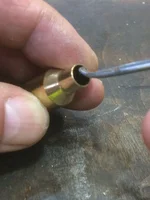
The best method i've seen for cleaning primer pockets is this:


Uses a dremel with a stainless steel brush. Dead quick and come out shiny and spotless.
 
The best method i've seen for cleaning primer pockets is this:


Uses a dremel with a stainless steel brush. Dead quick and come out shiny and spotless.

Not needed if you stainless tumble
Makes sense. My smallest case is a 223, but I haven't needed to tumble them yet, my other calibres are 6.5, 7, 30, & 9.3, and none of these have been an issue.

Do you think the rinse aid helps stopping the pins sticking, by reducing water tension, or something like that ?
Don’t know, I use it as I’m in a very hard water area and the my still seem to stick. The diamond ones are very good so I just use those for anything under .30 and the pins for .30s and the .357.
 
Are the pins better for 308 cases then cos I have not tried them in my tumbler ?
They just don’t get stuck in .308, the diamonds shot works just as well, they take a bit longer to get small rifle / pistol primer pockets clean than the pins, that’s the only disadvantage
 
I've ran my SS tumbler for 6yrs, I've cleaned most calibres for myself and other club members. The pins can get stuck in the smaller necks 223, 6mm etc.

That said, using the method described above using a bucket of water, picking out 4 or 5 at a time then giving them a dip and a shake (neck downwards) I've never had a case with a pin left in it.

You do (with the smaller diameters) get the odd one jammed across the neck but these are easily spotted and removed.

A couple of months ago I switched to 1.5mm, ball bearings. These give a better clean in a shorter time and don't stick in the necks of any cases I've cleaned.

You can get a group or 3 in a small primer pocket but using the method above they always come out.
 
Yup. Camera work today comparing a sample pre-vs-post View attachment 225630 rotary case cleaning clearly shows peening of the case mouth after the rotary action View attachment 225631. That fully explains the 3 thou change in neck internal diameter only.

Ordinarily my case prep sequence is de-prime, ultrasound bath, hot fan dry, anneal, resize, trim, chamfer.

These rotary tumbler test cases were unique: they had already undergone the process in the previous sentence when I dropped them into the rotary tumbler. So not in a typical state prior to cleaning.

Now that I know that the rotary drum wet cleaning with steel pin media does cause neck peening, I realise that it has to be followed by chamfer.

But...what rotary drum wet cleaning with steel pin media also does is remove the annealing high-tide mark. Which makes for a prettier case View attachment 225637. So the sequence I will probably use [compared to my old method] is as follows:

Method #1 -------------------- de-prime, ultrasound bath, hot fan dry, anneal, resize, trim, chamfer

method #2 -------------------- de-prime, anneal, rotary tumble, hot fan dry, resize, trim, chamfer

Personally, I wouldn't be annealing before tumbling, you're just asking for the softer brass to be damaged on the edges ?

I like the idea of using BB's, but I can't see how they can clean the primer pocket properly ?

I do #2 but reverse annealing, and tumbling. No issue with the necks
 
I like the idea of using BB's, but I can't see how they can clean the primer pocket properly ?

I wonder if a hybrid mix of pins and balls is the answer. I.e. enough pins to work the pockets but BBs to address the other surfaces?

Searching Etsy, it seems that tumbler media used by jewellers has a myriad shapes in the mix.
 
All of the above is an awesome reason to stick with an ultrasonic cleaner. The cases are not shiny but clean throughout. I use Hornady cleaner as I have not found a substitute that equals it. One jug makes gallons of solution. I run my cases in quart jars submerged in water in the 2L tank of my US cleaner.

Used steel pins back in the 80's and 90's. I had a massive rotary tumbler and experienced all the problems listed above. I finally decided that i didn't need polished cases and went to the US.

Steel media would be a step backwards for me. If I ever want shiny cases, I have a large vibratory cleaner as well. Haven't fired that up in a few years.... ~Muir
 
Just my two penneth worth but I've tried ultrasonic, wet tumble with/without media, pins, balls etc and finally found what works best.. for me anyway. Disregarding other prep trimming, chamfering etc. After depriming it goes into the ultrasonic with citric acid, fairy liquid and water at 70degrees (max temp on my ultrasonic). Citric acid works better at higher temps. Usually 45mins is enough. Rinse with boiling water (or at least hot) and lay out on a paper towel. Due to the temperature the brass dries itself within a few minutes. Once its cool enough to handle its virtual dry. Then straight into the rotary tumbler with treated corncob for 1-2 hours. Brass is clean, dry, polished and ready to process. Works for me.
 
stick with an ultrasonic cleaner. The cases are not shiny but clean throughout.

...with exception of some primer pockets, I agree. And even those vary widely. Bizarrely some are pristine, others still tarred. [same primers, powders]

Or is the Hornady cleaner that much better than kitchen sink detergent+citric that all primer pockets are clean?


ultrasonic with citric acid, fairy liquid and water at 70degrees...Then straight into the rotary tumbler with treated corncob for 1-2 hours. Brass is clean, dry, polished and ready to process

Does the corncob media rotary cycle clean the primer pockets where the ultrasound bath sometimes fail to clear out all carbon?
 
Change your media to suit your cartridges
There are lots if shapes and sizes available

Use a berry’s media separator
Tumbles the cases in a cage.
Get no sticky ones hiding and the media is smaller than the neck

I also use Bore Tech carbon cleaner
Cup in the tumbler lasts for a good five or six cleans and transforms the time needed and the level of carbon removal
 
...with exception of some primer pockets, I agree. And even those vary widely. Bizarrely some are pristine, others still tarred. [same primers, powders]

Or is the Hornady cleaner that much better than kitchen sink detergent+citric that all primer pockets are clean?


Does the corncob media rotary cycle clean the primer pockets where the ultrasound bath sometimes fail to clear out all carbon?
The Hornady works well and I have a fairly powerful US. I run at 55C and 50 minutes. ~Muir
 
...with exception of some primer pockets, I agree. And even those vary widely. Bizarrely some are pristine, others still tarred. [same primers, powders]

Or is the Hornady cleaner that much better than kitchen sink detergent+citric that all primer pockets are clean?


Does the corncob media rotary cycle clean the primer pockets where the ultrasound bath sometimes fail to clear out all carbon?
I've found the ultrasonics virtually unbeatable at cleaning primer pockets and inside the case. The corn cob tumbling is just for polishing.
 
OK, I plead guilty to being a shiny brass freak :D
I've used dry media tumbling, ultrasonic (2 different units - low and high power) and wet tumbling using stainless pins
Only wet tumbling gets the brass as clean as I like
Sad I know, but there it is.

Cheers

Bruce
 
Back
Top
