Choosing Lead-Free Bullets

Just to add quickly, in terms of Legal muzzle energy for UK deer stalking (1700ft ibs) a quick, TRUED comparison of the 130gr Barnes TSX Vs the 130gr Virtus Merlin- the merlin dips below 1700ft ibs at 186m, the Barnes dips below it at 129m. Even MV wise, it’s at 2,450fps at just 118m. (171m for the Merlin). That’s a difference of nearly 60m, INSIDE of 200m just for muzzle energy requirements. That figure, whether agreed upon or not and noting that arguably you don’t need 1700ft ibs of energy to kill a deer, that is hopefully an illustration of terminal effect at its most basic level, at what I’d consider a very average stalking range.
Do those Virtus Eagle/Merlin petals always break off in the carcass or do they stay attached to the shank? I am assuming the photo on the website of the open petals still attached to the shank came out of gel?
 

Attachments

  • eagle-image001-300x231.webp
    eagle-image001-300x231.webp
    2.8 KB · Views: 3
Well I mean the ranges I gave were to try and get the point across ballisticaly, I know your head is well and truly buried in the sand when it comes to learning stuff! Based on my personal setup (A 6.5-284 custom job with a NF NX8 T3, and Virtus bullets), I’d have no issue about having a crack at a fox out to 1000m. It’s hit or miss there, literally. I know you think shooting steel is irrelevant (it’s not, at all) but it gives a good measure of kit capability and your general shooting capability (wind reading etc). Based on what I’ve physically shot, group size wise with Virtus bullets through another rifle in 6.5CM and having seen the shot to shot consistency in BC and stuff, I’m more than confident to stretch its legs.
Shooting steel targets is fun but as I’m sure you are aware the best measure - especially when trying to determine the capability of a rifle/load/bullet or whatever - is a proper target where all shots are recorded. Coupled of course with enough shots fired to give a decent level of confidence in the results being truly representative.

I’ve been thinking of trying the Virtus bullets on paper at least initially. Do you find your loads are comparable to similar weight Barnes?
 
A few years ago, the choice of projectiles available for those of us who wanted to shoot lead-free ammunition was pretty minimal; Barnes was broadly the only name that the average UK stalker would have been familiar with.

Fast-forward a few years through:
  • Brexit;
  • The election of Joe Biden (and the subsequent scramble by thousands of Americans arm themselves to the teeth in the face of impending doom);
  • The possibility of a ban on lead in the UK and to top it off;
  • The war in Ukraine
and we find ourselves in an unprecedented situation. A huge number of us are searching for alternatives to traditional lead cup & core bullets and surprise, surprise, the shooting industry has responded.... for a price! We now find ourselves spoilt for choice (availability is a separate issue) and for many, it's a job to decide which type of projectile to go for, let alone which brand. However, due to the historic lack of choice and resulting dominance of Barnes, there is still a perception among many that lead-free projectiles are all one and the same. From a terminal performance perspective, that couldn't be further from the truth. These days we can lay our hands on the lead-free equivalent of anything from Varmint bullets to Round-Nose Bonded bullets, with an ever-growing number of options in between. As a side-note, even competitive target shooting is seeing a shift towards copper projectiles due to the advantages in consistency and BC that the manufacturing methods offer.

How can we differentiate between types?

There are a few ways that we could classify these bullets but for ease of comparison of terminal performance, I'd say they fit pretty well into 3 categories (if we exclude , each with their own positives and negatives.

Bi-metal (BM). Non-toxic metal core with a copper jacket; e.g. RWS Geco. These offer rapid expansion which assists in the generation of Hydrostatic Shock, resulting in decreased likelihood of an animal 'running on'. However, they generally result in less penetration compared to NFC and FC and a greater number of small metallic fragments left in the carcass.

Non-fragmenting Copper (NFC). Pure copper projectiles designed to retain as much weight as possible whilst delivering a level of expansion; e.g. Barnes TSX/TTSX. These offer excellent penetration and less carcass damage. However, they tend to create a smaller temporary wound channel and have less ability to generate Hydrostatic Shock (although some are specifically designed to induce Hydrostatic Shock, at the expense of other qualities). In turn, this reduction in Hydrostatic Shock puts greater importance on shot placement and increases the likelihood of animals 'running on'. A great choice for more competent shooters, especially for larger animals but they give less margin for error.

Fragmenting Copper (FC). Pure copper projectile that is designed to break into a number of parts, often in the form of 'petals'; e.g. Virtus Merlin. These give good penetration by the main body of the projectile, a wide wound channel created by the petals, and good ability to generate both Hydraulic Shock and Hydrostatic Shock. Also, they are usually lathe-turned so, precision is greater than BM or NFC. The downside is that carcass damage may well be greater than that from NFC and the petals may deviate enough to pierce unintended parts of the animal (such as the rumen), especially with suboptimal shot placement.

Which one is best?

To my mind, the ability of a projectile to deliver the most humane kill possible, should be the priority. So, the leaderboard is simple right?
  1. Bi-metal
  2. Fragmenting Copper
  3. Non-fragmenting Copper
......Except that all 3 are capable of delivering humane kills in the right hands, and each pair of hands will have different secondary priorities; whether that be high BC, low carcass damage, low cost, or something else.

Let me give an example.

The majority of my shooting is Fallow, Roe, Muntjac and CWD and I find that FC projectiles suit me best. The exceptional precision of the Virtus bullets makes them ideal for head/neck shooting and the fragmenting petals mean that at longer ranges where I am not comfortable taking a head/neck shot, I can be confident of sufficient expansion to ensure minimal 'running on'. Furthermore, the precision means that so far, I am yet to have a petal wander off-course and rupture a gut..... That's not to say that I haven't cocked up any shots but I have not had any issues that I could blame on the bullet.

Now, I rave about the Virtus stuff so I gave 25 of them to my Father-in-Law to try out. He's been stalking for decades and despite being in his mid 70s, he still shoots (and extracts!) more deer per year than most people have hot dinners! After a few months, I asked him how he got on with them and he promptly confessed that he hadn't tried them and that I could have them back. A split-second before I could accuse him of being an ungrateful b*stard, he explained why. He shoots a lot of large game in Africa and swears by NFC, specifically Barnes TSX for that. In the UK, he shoots a lot of Fallow and Red and wants penetration more than expansion or extreme precision as he disagrees with head-shooting and he's 100% confident of his shooting abilities; even at his age, he's still an GB competition shooter so, I can't argue! His priorities and his prior experiences mean that he is utterly confident that he has already found the best bullet for him in the form of Barnes TSX/TTSX. I have accepted that I will probably never win him over.

So, what am I trying to say?

If anyone new to stalking or lead-free ammo was hoping I was going to reveal the best lead-free bullet on the market, I'm sorry, that just ain't going to happen. This is such a complex and emotive topic that this thread would undoubtedly descend into an internet scrap and I'm shite at fighting in real-life and online! What I hope I have done though is explain why there is no such thing as 'the single best lead-free bullet on the market' and outlined a few pros and cons of each of the types available; all based on my experience and where appropriate, the experience of others.

What each of us has to do is decide which one best suits our needs. One of the best ways to do that is to consider several factors in the order that they are most important to you. For me, precision came top because as the theory goes, put your bullet in the right place and everything else is secondary; that's why I use Virtus. It's a personal process though so, nobody can do the thinking for you. Instead, I'll finish up with a list of things to consider. The list is just to get the conversation started so, feel free to pipe up with what is important to you.
  • Availability of factory loads (if you don't load)
  • The distance at which you shoot
  • Precision of the projectile
  • The size and type of animal you shoot
  • Your shooting ability
  • Acceptable carcass damage
  • Intended point of impact on the animal
  • Cost
  • Availability
  • Prior experiences
If you fancy giving Virtus a go, simply twist the arm of your own friendly Son-in-Law. Just make sure you actually use any bullets he gives you as failure to do so may cause emotional damage. If you don't have a vulnerable in-law to bully, I am sure @Virtus Precision UK will have a stand at the British Shooting Show so they can show off new products, like their factory ammo. Check out their Facebook/Instagram for more details.

Hopefully this thread is of use to some of us.
So, here's my opinion...

I've been reloading and shooting Barnes TSX and TTSX bullets in my 257 Roberts for 20 years...well before the "green movement" of ammunition. Here is a recap of my experience with both bullets:

Unbeatable. I have shot 12 deer, numerous coyotes, wild dogs, armadillos, and woodchucks with them. In terms of the deer, the greatest distance that I have had to track one is 13 yards. Yes, I measured. The shortest is 9 yds from point of impact.

Now, I focus on shot placement and am comfortable with "minute of lung" accuracy out to ranges of 400 yards. Now, I freely admit that the longest shot I have taken on a deer (utilizing a log for a rest and in the prone) was 260 yds. That deer went 13 yards. Hit well with a double lung shot, I had no issues at all with a 115 grain bullet at 3K fps. It made one bound, stopped, coughed up its lungs, and fell over. My rifle is sighted in for +3.5 in at 100 yds because it is -3.5 in at 280.

My 257 prefers the Barnes bullets to other manufactures and bullet constructions because of the ogive and the bands. Pressures are consistent and well in the 'green' (no flattened, dimpling, or blackening of primers). I have used other leaded bullets and been less than impressed with them, but that is just me.

Oh, I also reload Barnes bullets for my 9.3x63 (as well as Woodleigh), my 6.5 Swede and my 7x57...my rifles seem to prefer them as I can seat them further out, still not cause chamber issues with contact with the rifling and crimp in between the bands.

Hope this helps
 
So, here's my opinion...

I've been reloading and shooting Barnes TSX and TTSX bullets in my 257 Roberts for 20 years...well before the "green movement" of ammunition. Here is a recap of my experience with both bullets:

Unbeatable. I have shot 12 deer, numerous coyotes, wild dogs, armadillos, and woodchucks with them. In terms of the deer, the greatest distance that I have had to track one is 13 yards. Yes, I measured. The shortest is 9 yds from point of impact.

Now, I focus on shot placement and am comfortable with "minute of lung" accuracy out to ranges of 400 yards. Now, I freely admit that the longest shot I have taken on a deer (utilizing a log for a rest and in the prone) was 260 yds. That deer went 13 yards. Hit well with a double lung shot, I had no issues at all with a 115 grain bullet at 3K fps. It made one bound, stopped, coughed up its lungs, and fell over. My rifle is sighted in for +3.5 in at 100 yds because it is -3.5 in at 280.

My 257 prefers the Barnes bullets to other manufactures and bullet constructions because of the ogive and the bands. Pressures are consistent and well in the 'green' (no flattened, dimpling, or blackening of primers). I have used other leaded bullets and been less than impressed with them, but that is just me.

Oh, I also reload Barnes bullets for my 9.3x63 (as well as Woodleigh), my 6.5 Swede and my 7x57...my rifles seem to prefer them as I can seat them further out, still not cause chamber issues with contact with the rifling and crimp in between the bands.

Hope this helps
Funnily enough Sir we are on the same wavelength 🙌
 
It terrifies me that people like you are allowed to own guns.

This is my first 12hr exposure to social media in years, and I’ve realised how lucky I’ve been not being a part of it.

Keep doing what you’re doing, I hope to meet you in person one day and have a chat about this subject. Until then, I’m outta here.

And as for declaring yourself as a simpleton, that’s probably the only sensible thing you’ve said all day.
Im sorry, but you come on to a deer stalking forum talk about a bullet that you have shot in the area of 3000 of , of which i was genuinely excited about, thinking at last someone with some really good information and the kick in the balls is you have shot gongs!

As deer stalkers we need to know how they perform in the real world on deer not gongs.

The things i want to know are as follows-

Carcass damage - muntjac to red (i shoot all but fallow and sika)

Weight retention - i don’t want shrapnel in my carcasses or the potential of another animal being hit by fragments from my original shot.

All that lovely data your pulling together may be lovely on paper, but those of us as the coal face need practical evidence!

Gongs don't breathe, bleed or run!

I am not going to change from a bullet i have shot for since 2008 until i see some decent evidence.

Please and ta 🙏
 
Last edited:
It terrifies me that people like you are allowed to own guns.
That is a ridiculous statement to make.

I have only switched to copper in the past 12 months, and I was sceptical to begin with, done the rounds and coming back to the Barnes TTSX.
I haven't tried the Vertus yet, not sure I will until some evidence based photo's of real world experience like @Brave Echo Niner kindly posted, if I feel they might be worth a look I am open minded, and I might have an experiment.
But to me TTSX work.

I can understand your passion and development of the bullet etc, punching paper etc, but it's real world after that, what does it do to a deer shot in the engine room, damage, length of time to expire, distance run, hit a rib or not etc
 
My old Ruger 308 hit harder than the whitworth with the same ammo, that was the difference between a 1 in 10 and a 1 in 14 twist. I suspect no lead would behave on a similar way.
 
A few years ago, the choice of projectiles available for those of us who wanted to shoot lead-free ammunition was pretty minimal; Barnes was broadly the only name that the average UK stalker would have been familiar with.

Fast-forward a few years through:
  • Brexit;
  • The election of Joe Biden (and the subsequent scramble by thousands of Americans arm themselves to the teeth in the face of impending doom);
  • The possibility of a ban on lead in the UK and to top it off;
  • The war in Ukraine
and we find ourselves in an unprecedented situation. A huge number of us are searching for alternatives to traditional lead cup & core bullets and surprise, surprise, the shooting industry has responded.... for a price! We now find ourselves spoilt for choice (availability is a separate issue) and for many, it's a job to decide which type of projectile to go for, let alone which brand. However, due to the historic lack of choice and resulting dominance of Barnes, there is still a perception among many that lead-free projectiles are all one and the same. From a terminal performance perspective, that couldn't be further from the truth. These days we can lay our hands on the lead-free equivalent of anything from Varmint bullets to Round-Nose Bonded bullets, with an ever-growing number of options in between. As a side-note, even competitive target shooting is seeing a shift towards copper projectiles due to the advantages in consistency and BC that the manufacturing methods offer.

How can we differentiate between types?

There are a few ways that we could classify these bullets but for ease of comparison of terminal performance, I'd say they fit pretty well into 3 categories (if we exclude , each with their own positives and negatives.

Bi-metal (BM). Non-toxic metal core with a copper jacket; e.g. RWS Geco. These offer rapid expansion which assists in the generation of Hydrostatic Shock, resulting in decreased likelihood of an animal 'running on'. However, they generally result in less penetration compared to NFC and FC and a greater number of small metallic fragments left in the carcass.

Non-fragmenting Copper (NFC). Pure copper projectiles designed to retain as much weight as possible whilst delivering a level of expansion; e.g. Barnes TSX/TTSX. These offer excellent penetration and less carcass damage. However, they tend to create a smaller temporary wound channel and have less ability to generate Hydrostatic Shock (although some are specifically designed to induce Hydrostatic Shock, at the expense of other qualities). In turn, this reduction in Hydrostatic Shock puts greater importance on shot placement and increases the likelihood of animals 'running on'. A great choice for more competent shooters, especially for larger animals but they give less margin for error.

Fragmenting Copper (FC). Pure copper projectile that is designed to break into a number of parts, often in the form of 'petals'; e.g. Virtus Merlin. These give good penetration by the main body of the projectile, a wide wound channel created by the petals, and good ability to generate both Hydraulic Shock and Hydrostatic Shock. Also, they are usually lathe-turned so, precision is greater than BM or NFC. The downside is that carcass damage may well be greater than that from NFC and the petals may deviate enough to pierce unintended parts of the animal (such as the rumen), especially with suboptimal shot placement.

Which one is best?

To my mind, the ability of a projectile to deliver the most humane kill possible, should be the priority. So, the leaderboard is simple right?
  1. Bi-metal
  2. Fragmenting Copper
  3. Non-fragmenting Copper
......Except that all 3 are capable of delivering humane kills in the right hands, and each pair of hands will have different secondary priorities; whether that be high BC, low carcass damage, low cost, or something else.

Let me give an example.

The majority of my shooting is Fallow, Roe, Muntjac and CWD and I find that FC projectiles suit me best. The exceptional precision of the Virtus bullets makes them ideal for head/neck shooting and the fragmenting petals mean that at longer ranges where I am not comfortable taking a head/neck shot, I can be confident of sufficient expansion to ensure minimal 'running on'. Furthermore, the precision means that so far, I am yet to have a petal wander off-course and rupture a gut..... That's not to say that I haven't cocked up any shots but I have not had any issues that I could blame on the bullet.

Now, I rave about the Virtus stuff so I gave 25 of them to my Father-in-Law to try out. He's been stalking for decades and despite being in his mid 70s, he still shoots (and extracts!) more deer per year than most people have hot dinners! After a few months, I asked him how he got on with them and he promptly confessed that he hadn't tried them and that I could have them back. A split-second before I could accuse him of being an ungrateful b*stard, he explained why. He shoots a lot of large game in Africa and swears by NFC, specifically Barnes TSX for that. In the UK, he shoots a lot of Fallow and Red and wants penetration more than expansion or extreme precision as he disagrees with head-shooting and he's 100% confident of his shooting abilities; even at his age, he's still an GB competition shooter so, I can't argue! His priorities and his prior experiences mean that he is utterly confident that he has already found the best bullet for him in the form of Barnes TSX/TTSX. I have accepted that I will probably never win him over.

So, what am I trying to say?

If anyone new to stalking or lead-free ammo was hoping I was going to reveal the best lead-free bullet on the market, I'm sorry, that just ain't going to happen. This is such a complex and emotive topic that this thread would undoubtedly descend into an internet scrap and I'm shite at fighting in real-life and online! What I hope I have done though is explain why there is no such thing as 'the single best lead-free bullet on the market' and outlined a few pros and cons of each of the types available; all based on my experience and where appropriate, the experience of others.

What each of us has to do is decide which one best suits our needs. One of the best ways to do that is to consider several factors in the order that they are most important to you. For me, precision came top because as the theory goes, put your bullet in the right place and everything else is secondary; that's why I use Virtus. It's a personal process though so, nobody can do the thinking for you. Instead, I'll finish up with a list of things to consider. The list is just to get the conversation started so, feel free to pipe up with what is important to you.
  • Availability of factory loads (if you don't load)
  • The distance at which you shoot
  • Precision of the projectile
  • The size and type of animal you shoot
  • Your shooting ability
  • Acceptable carcass damage
  • Intended point of impact on the animal
  • Cost
  • Availability
  • Prior experiences
If you fancy giving Virtus a go, simply twist the arm of your own friendly Son-in-Law. Just make sure you actually use any bullets he gives you as failure to do so may cause emotional damage. If you don't have a vulnerable in-law to bully, I am sure @Virtus Precision UK will have a stand at the British Shooting Show so they can show off new products, like their factory ammo. Check out their Facebook/Instagram for more details.

Hopefully this thread is of use to some of us.
Maybe you know...Do those Virtus Eagle/Merlin petals always break off in the carcass (assuming main shank continues to create exit or do they stay attached to the shank? I am assuming the photo on the website of the open petals still attached to the shank came out of gel?

I have yet to see examples of Eagle or Merlin bullets taken from carcasses.
 
Maybe you know...Do those Virtus Eagle/Merlin petals always break off in the carcass (assuming main shank continues to create exit or do they stay attached to the shank? I am assuming the photo on the website of the open petals still attached to the shank came out of gel?

I have yet to see examples of Eagle or Merlin bullets taken from carcasses.
In my experience, the petals break off every time, as they are designed to do.

Hope that helps.
 
Im sorry, but you come on to a deer stalking forum talk about a bullet that you have shot in the area of 3000 of , of which i was genuinely excited about, thinking at last someone with some really good information and the kick in the balls is you have shot gongs!

As deer stalkers we need to know how they perform in the real world on deer not gongs.

The things i want to know are as follows-

Carcass damage - muntjac to red (i shoot all but fallow and sika)

Weight retention - i don’t want shrapnel in my carcasses or the potential of another animal being hit by fragments from my original shot.

All that lovely data your pulling together may be lovely on paper, but those of us as the coal face need practical evidence!

Gongs don't breathe, bleed or run!

I am not going to change from a bullet i have shot for since 2008 until i see some decent evidence.

Please and ta 🙏
Hi NDS,

I, like you, am interested in results on deer (but hopefully less abrasive towards others coming from a different angle 😉).
For over 20 years I used Swift Sciroccos in my 6.5x55 and Nosler Partitions in my 308. No huge exits from either, like you get with SSTs. Just small holes in, somewhat larger holes on the way out, no blow ups, dead deer every time.
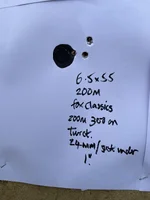
There's little on this thread about Fox Classics from Ed up in Edinburgh, but they are accurate and do an identical job, see attached. I'm 72 deer in with these Fox bullets on roe, Fallow and muntjac, so not thousands, but I'm convinced. Small hole going in, destroyed vitals, a little larger hole on the way out. I've stocked up on these and no doubt will see me out. I'm so pleased I've yet to work up a load in my 308, the Varberger gets pulled out of the cabinet every time.
 

Attachments

  • IMG_3812.webp
    IMG_3812.webp
    89.3 KB · Views: 30
  • IMG_3813.webp
    IMG_3813.webp
    98.5 KB · Views: 29
  • IMG_7621.webp
    IMG_7621.webp
    536.9 KB · Views: 30
  • IMG_7622.webp
    IMG_7622.webp
    282.9 KB · Views: 30
Hi NDS,

I, like you, am interested in results on deer (but hopefully less abrasive towards others coming from a different angle 😉).
For over 20 years I used Swift Sciroccos in my 6.5x55 and Nosler Partitions in my 308. No huge exits from either, like you get with SSTs. Just small holes in, somewhat larger holes on the way out, no blow ups, dead deer every time.
There's little on this thread about Fox Classics from Ed up in Edinburgh, but they are accurate and do an identical job, see attached. I'm 72 deer in with these Fox bullets on roe, Fallow and muntjac, so not thousands, but I'm convinced. Small hole going in, destroyed vitals, a little larger hole on the way out. I've stocked up on these and no doubt will see me out. I'm so pleased I've yet to work up a load in my 308, the Varberger gets pulled out of the cabinet every time.
Fantastic bullet, i shot 200 of the 130gn factory offering from my 270 from Edinbrough Rifles. 👍

Still got 19 left and i am off to re check zero next wee KB with them as i swapped stocks the other day.
 
Last edited:
Fantastic bullet, i shot 200 of the 130gn factory offering from my 270 from Edinbrough Rifles. 👍

Still got 19 left and i am off to re check zero next wee KB with them as i swapped stocks the other day.
130gn Barnes TTSX in .270win problem solved!

I stand by what I have always said, that I would stand up against anything apart from dangerous game with my 270 and 130 grain barnes bullet
If the damage is like the SST you can keep them! 😂😂

i have shot the ttsx for a very very long time, most of the time people have big holes from Barnes because they’re going too quick!

My 130 grain load for my 270 was only doing 2900 ish which is very mediocre.

Interesting that you only write glowing reports about the Barnes TTSX, yet you've shot 200 Fox rounds with great results but no opinion on them until now?
 
Maybe you know...Do those Virtus Eagle/Merlin petals always break off in the carcass (assuming main shank continues to create exit or do they stay attached to the shank? I am assuming the photo on the website of the open petals still attached to the shank came out of gel?

I have yet to see examples of Eagle or Merlin bullets taken from carcasses.
One petal from a Merlin recovered between muscle layers in a Roe next to a complete 150 grain .30 Virtus Merlin.

F99E72CC-0D3B-42C2-B985-15A0DCB6CDD4.webp

Ben
 
One petal from a Merlin recovered between muscle layers in a Roe next to a complete 150 grain .30 Virtus Merlin.

View attachment 294406

Ben
That's raised my curiosity a little bit - do you have any photos of a chest shot animal where presumably there are 4 potential exit wounds? I can imagine them causing huge damage through the shearing of the petals.

What does the petal weigh? I am genuinely surprised they are as big as they are
 
That's raised my curiosity a little bit - do you have any photos of a chest shot animal where presumably there are 4 potential exit wounds? I can imagine them causing huge damage through the shearing of the petals.

What does the petal weigh? I am genuinely surprised they are as big as they are
In my post above where I have shown a chest shot deer with these bullets you can make out multiple exits within the larger ‘exit’

DC48E22B-EA87-46BA-807A-63A08997C4F0.webp
(Entrance in blue and exits in yellow)

I will weigh the fragment when I am home for you.

Ben
 
One petal from a Merlin recovered between muscle layers in a Roe next to a complete 150 grain .30 Virtus Merlin.

View attachment 294406

Ben
That's perfect, thanks. I'd like to see a few more photos like this on their web site, I wasn't sure if each petal would break into small fragments or act more like banana peel. I can see how massively traumatic these bullets are, they do what the maker designed them to do - some will like it and some won't but I am far more interested in proof and facts and I appreciate that you have supplied that.
 
Here is the big question here, whats the possibility of said pictured shrapnel exiting and wounding another animal?

Thats a big lump!

The good thing about a bullet like barnes, fox or the lapua naturalis is 99% weight retention, that bullet goes in its coming out in 1 lump!

Thats why i use them.
 
Back
Top