Can handloading drastically change a rifle's accuracy? What is the expected accuracy from the typical hunting factory load?

A high (or at least not below average) bc bullet is gonna help in 3 regards: 1) flatter trajectory (the least important in my opinion) 2) less wind drift 3) more energy downrange
That's only true for bullets of equal weights but different BCs; don't forget that a lighter/faster bullet will tend to shoot flatter within the distances you're talking about than a heavier/slower one of a similar profile, even if it has an inferior BC.
 
That's only true for bullets of equal weights but different BCs; don't forget that a lighter/faster bullet will tend to shoot flatter within the distances you're talking about than a heavier/slower one of a similar profile, even if it has an inferior BC.
That's true. My rifle seem to prefer 165 grainers which are perfect for me as far as trajectory and terminal performance (i will hunt also fellow deer and boars with it). Change in ballistic between a 150 grainer and a 165 grainer for my applications are not so relevant. If you jump from a 150 grain bullet to a 180 grain one, now we are talking about a big difference of teajectory flatness inside 300 yards
 
Is there a trade off between shooting in an environment where you want a 'through and through' for easier tracking compared (as Bowland mentioned) to a non-exiting bullet that has expended all its energy into the animal?

What does everyone prefer and why?
 
Is there a trade off between shooting in an environment where you want a 'through and through' for easier tracking compared (as Bowland mentioned) to a non-exiting bullet that has expended all its energy into the animal?

What does everyone prefer and why?
I generally prefer to have an exit wound and all the bullets i used for hunting produced one reliably, even with big fellow deer and boars. I have also seen that sometimes, especially with roes, also an expansive bullet lika a softpoint, if it doesn't hit any rib, can have not much expansion with a 308, especially below a certain bullet velocity. In this case the blood trail is small. When i need to stop the animal in its tracks (sunset, the animal is close to very dense woods, etc), i just aim in the middle of the shoulder and they just drop like a sack of potato. Of course this way the margin of error is smaller due to smaller target
 
I generally prefer to have an exit wound and all the bullets i used for hunting produced one reliably, even with big fellow deer and boars. I have also seen that sometimes, especially with roes, also an expansive bullet lika a softpoint, if it doesn't hit any rib, can have not much expansion with a 308, especially below a certain bullet velocity. In this case the blood trail is small. When i need to stop the animal in its tracks (sunset, the animal is close to very dense woods, etc), i just aim in the middle of the shoulder and they just drop like a sack of potato. Of course this way the margin of error is smaller due to smaller target

Nice one, thank you.
 
Some people here said that they experienced the opposite. Same rifle, premium hunting ammo, factory loads grouping very bad, handloads grouping very well

Why the hell on forums you always get opposite opinions and even experiences? 😂🤦
That is true and I suppose everyone has different experiences? I suppose there is a somewhat subjective component to interpreting shooting data. In truth I used to believe I could improve accuracy a great deal using skillful reloading ... Then I began to understand statistics a bit better and realised I was fooling myself. I think large variances in distribution are easy to detect and some rifle load combos definitely don't work but when you get down to 1.5moa and .5 moa it's pretty hard to identify without testing the barrel to the end of its useful life! I'm sure others will disagree but hey ho it is the internet right!
 
That is true and I suppose everyone has different experiences? I suppose there is a somewhat subjective component to interpreting shooting data. In truth I used to believe I could improve accuracy a great deal using skillful reloading ... Then I began to understand statistics a bit better and realised I was fooling myself. I think large variances in distribution are easy to detect and some rifle load combos definitely don't work but when you get down to 1.5moa and .5 moa it's pretty hard to identify without testing the barrel to the end of its useful life! I'm sure others will disagree but hey ho it is the internet right!
Do you mean that the difference between a 0.5 MOA rifle-load combination is not easily differentiable from a 1.5 MOA one? I can distinguish between them very well, in a few shots! I don't get it
 
I’m No expert but in recent years from bitter experience I have found 95% accuracy is dependent on the the basics being in order. Good quality rifle and barrel. Good quality bullets and primer and powder. The fiddling with reloading stuff has minimal effect on accuracy and is hard to detect in normal testing. I get competitive shooters may slight improve their scores and confidence by fine tuning but they start with amazing guns and equipment and then get almost undetectable improvement from messing with the load.
That said some rifles won’t shoot poor quality ammunition and others will. I’ve had bullets group at 5” then tried another bullets at it was 1” but that was poorly made bullets in my view.
I'd agree with most of that however accuracy comes from the basics first. Position behind the rifle, consistent cheek weld and being confident on the trigger. You can have all the Gucci gear in the world, if you can't shoot and don't have the basics down, you won't shoot straight
 
Do you mean that the difference between a 0.5 MOA rifle-load combination is not easily differentiable from a 1.5 MOA one? I can distinguish between them very well, in a few shots! I don't get it
Yes I do get your 0.5moa rifle shoot your group then keep shooting. I’m my experience many so called 0.5moa guns if you shoot a decent sized group will turn out to be 1.25moa or something. If you can genuinely shoot 30 shots inside 0.5 moa then I will be very surprised not impossible but difficult and unusual.
Equally a 1.5moa gun can and will shoot 3 or 5 shot 0.5 moa groups.
It’s just statistics and dispersion
 
Last edited:
  • Like
Reactions: VSS
I have a rifle which is capable of sub-Moa accuracy but not with the projectile i want to use hunting, that's why i am asking.
The thread has been going here and there. From experience, I'd say there's a good possibility that you'd be able to find a bullet that suits your requirements, and find a good load that gives you the accuracy you want.

It might not be the exact bullet you'd like to use (30cal 178gr ELD-X?) but there's lots of options that would be near enough. Key point here is that rifle/shooter combination is already accurate enough with another bullet (what the accuracy is and how it's measured is irrelevant, since shooter will be the judge and is currently happy).

Regarding the statistical validity, I'm no expert but I've let myself be told you must set the question correctly. In the case of load development, the question is to find "node", "window" or whatever you want to call it. And it can be done with low shot count, trick being that group size variance is big between the node and out of node. Difficult or impossible part would be proving that group size is under some (low) figure, or if one node produces better accuracy than another node.
 
I’m No expert but in recent years from bitter experience I have found 95% accuracy is dependent on the the basics being in order. Good quality rifle and barrel. Good quality bullets and primer and powder. The fiddling with reloading stuff has minimal effect on accuracy and is hard to detect in normal testing. I get competitive shooters may slight improve their scores and confidence by fine tuning but they start with amazing guns and equipment and then get almost undetectable improvement from messing with the load.
That said some rifles won’t shoot poor quality ammunition and others will. I’ve had bullets group at 5” then tried another bullets at it was 1” but that was poorly made bullets in my view.
I had this between federal and rws in my 7mm rm. Was genuinely about to chuck the rifle when using feds assuming nothing would shoot (5-6” is ludicrous and I’d never experienced this before). Loads from Lee loader do around an inch so all happy now.
 

Can handloading drastically change a rifle's accuracy?​


Yes. My former Remington 700 (SPS Varmint in .308) grouped about 1½ MOA with a selection of quality factory ammo. My handloads (Lapua 167 Scenar, match primers, Vihtavuori N140) halved that.

What is the expected accuracy from the typical hunting factory load?​


If I bought a new stalking rifle, I'd expect 1 MOA at least (again, with quality factory ammo.)

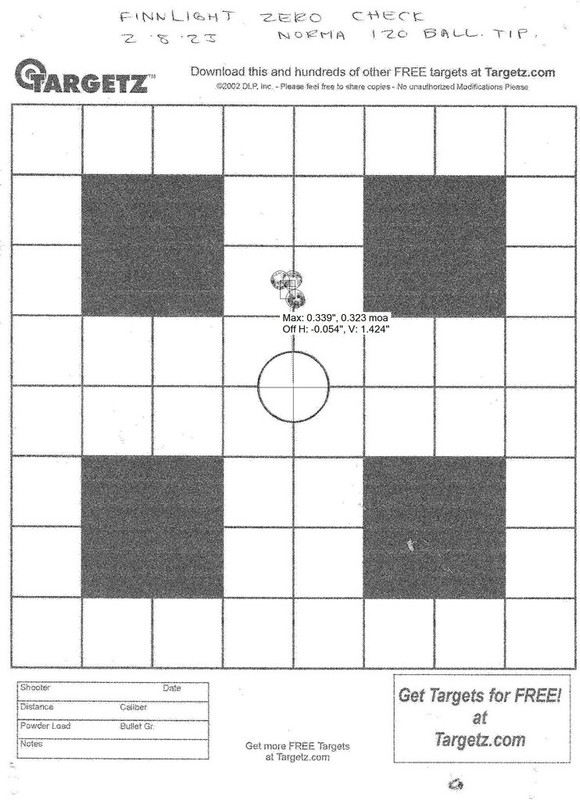
My current stalking outfit (Sako 85 Finnlight in 6.5 x 55mm, Schmidt u. Bender 3 - 12 x 50 Klassik, Norma factory ammo using Nosler 120 Ballistic Tips) produced this group off the bench at 100 yards when I checked its zero last Sunday:

11-Finnlight-zero-020823.jpg


This is not a fluke: It will group under 0.5 MOA all day long.

maximus otter
 
The thread has been going here and there. From experience, I'd say there's a good possibility that you'd be able to find a bullet that suits your requirements, and find a good load that gives you the accuracy you want.

It might not be the exact bullet you'd like to use (30cal 178gr ELD-X?) but there's lots of options that would be near enough. Key point here is that rifle/shooter combination is already accurate enough with another bullet (what the accuracy is and how it's measured is irrelevant, since shooter will be the judge and is currently happy).

Regarding the statistical validity, I'm no expert but I've let myself be told you must set the question correctly. In the case of load development, the question is to find "node", "window" or whatever you want to call it. And it can be done with low shot count, trick being that group size variance is big between the node and out of node. Difficult or impossible part would be proving that group size is under some (low) figure, or if one node produces better accuracy than another node.
That’s a good point however I’m beginning to think the whole node thing might just be imaginary? I know that’s a controversial view but there seems to be increasing evidence that aside from lower powder charges being slightly more accurate than higher charges the actual accuracy of a load is not massively affected by charge weight and the speed vs dispersion is actually fairly linear. Probably too much for the hardcore to swallow but that’s where my research has lead me.
 

Can handloading drastically change a rifle's accuracy?​


Yes. My former Remington 700 (SPS Varmint in .308) grouped about 1½ MOA with a selection of quality factory ammo. My handloads (Lapua 167 Scenar, match primers, Vihtavuori N140) halved that.

What is the expected accuracy from the typical hunting factory load?​


If I bought a new stalking rifle, I'd expect 1 MOA at least (again, with quality factory ammo.)

My current stalking outfit (Sako 85 Finnlight in 6.5 x 55mm, Schmidt u. Bender 3 - 12 x 50 Klassik, Norma factory ammo using Nosler 120 Ballistic Tips) produced this group off the bench at 100 yards when I checked its zero last Sunday:

11-Finnlight-zero-020823.jpg


This is not a fluke: It will group under 0.5 MOA all day long.

maximus otter
Pretty group can it produce ten of those in a row? In which case you have an exceptional rifle!! Enjoy 😉
 
In the good old days of proprietary ammunition, the likes of Messrs Rigby, Westley Richards etc would build, shoot and regulate a rifle around one particular cartridge and the then the rifle would be supplied with a case of several hundred cartridges all from the same lot of ammunition. Many custom rifle makers will still do the same.

Military rifles are all specified to use one very specific load of military ammo.

However go and buy any factory rifle these days and they all have a claim to shoot sub MOA. But what no manufacturer ever tells you is which particular brand, make or load it used to get that MOA accuracy.

These days there is so much choice in ammo. Go to any one ammo manufacturer and chances are they will offer multiple different loads in the same cartridge. And multiply this across several manufacturers. But equally your local gunshop “Bang and Bodget” will probably only have one or two different loads and they will pretty much be what he can get hold off, or what he has bought in bulk for one particular customer.

And in the UK most of us are pretty restricted in the amount of ammo we can hold.

So these days its

1) we have no clue as to what particular load our rifle was built and tested for so we can’t simply buy a brick of that ammo and know it will work.

2) huge choice, but compounded with sketchy availability

3) and limited amounts of ammo we can hold.

At least with handloading you are still able to buy and hold components in sufficient quantities that you can least work up a cartridge that works well in your rifle and to then have enough stock for a reasonable length of time so you have a level of certainty.

And accuracy and bullet performance are all relative.

If you are shooting big grumpy animals in the African or North American bush you are generally sub 100m, if not 50m and bullet terminal performance is key. You are not worried about sun MoA. Just minute of Buffalo will do.

If you are shooting in the F Class world championships at 1,000m you are not worried about bullet expansion, but you are very concerned about aerodynamic performance, variability and above all accuracy. If you have one cartridge that shoots at 10fps lower than the rest, that’s difference podium, or going home early.

And if asking and taking advice you do need to take into account who is offering such advice.
 
And accuracy and bullet performance are all relative.

If you are shooting big grumpy animals in the African or North American bush you are generally sub 100m, if not 50m and bullet terminal performance is key. You are not worried about sun MoA. Just minute of Buffalo will do.

If you are shooting in the F Class world championships at 1,000m you are not worried about bullet expansion, but you are very concerned about aerodynamic performance, variability and above all accuracy. If you have one cartridge that shoots at 10fps lower than the rest, that’s difference podium, or going home early.

That part is quite true, but the idea that there's one magic combination out there which gives noticeably-superior performance in a given rifle seems to have more basis in being willing to be fooled by randomness than in reality.
 
Sadly this sort of 'pub thread' happens when the OP ( @randello88 ) wants to keep asking questions until they are satisfied to hear their own views being echoed by others, to what end, I'm unsure. To achieve some sort of validation perhaps?

First of all, ammunition can only be precise, not 'accurate', as the bullet does not know where it has been aimed. It can only be consistent.

Accuracy is dependent on how well the rifle can be aimed and hit the mark, yet without precision, this is also useless.

The scope is a major factor in both resepects, but we know what happened in the last thread the OP made about scopes. Another 'pub thread' as he didn't like what he heard.

The guys on Rokslide (US hunting forum) didn't give him the time of day for asking the same questions and being unwilling to do research...

The precision of a system boils down to a few things, assuming variables such as shooter error and environmental conditions are nill or minimised:

- Ignition timing of the rifle/catridge combination, lock time of the action

-Ammunition consistency, how well do the powder/primer/case dimentions and bullets work? Do they perform the same across temperatures and environmental conditions? Does shooting at an extreme angle affect this?

- Bullet concentricity, O.D variation (very minute), barrel twist rate requirements for bullet stability

- Rifle bedding, barrel I.D consistency (although some degree of 'choke' is seen to be beneficial)

Barrel tuners have come into vogue now in the competition circuits, some argue that it cuts out a lot of the 'tuning' previously required to find groups when handloading. I have yet to invest in one, but will do soon.

If your reloading is not consistent, your results won't be either. Not all factory ammo is consistent (check lot numbers), but some makes are excellent (Hornady, Federal, Norma and RWS).

precsionvsaccuracy_crashcourse-579x600.webp
 
To some degree yes.

If it's a high quality rifle with a good barrel then you will be able to tune the load to the rifle and make it a good shooter.

However, I'd say if it's a not so good quality rifle that you would only expect 2" from on a good day then your probably at a loss to a degree. You will certainly shrink the group buy not to the size you were hoping for.

Though life's to short for worying, if its shooting 2" at 100m it's still going to kill a fox or deer every day of the week if you keep the range sensible.

I'd argue that having a consistent rifle that holds its zero even if it shoots a 2" group at 100 is better than on that shoot 1/2" but wanders around the target (which I've seen happen)
 
I watched this interview by Ron Spomer with Chris Hodgdon of the H4859 etc powder company. Shooting something with ammo you have loaded yourself is pretty satisfying.

And in the early days Hodgdon had a powder supplier that made powders for them based in Scotland. Do we have powder manufactured in the UK anymore, or for that matter primers, brass and bullets. We have some ammunition assembly - BAE Systems at Radway Green claim ability to make 1 million rounds of ammo a day, but does this include components?

 
Back
Top