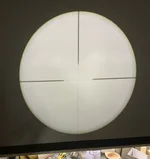
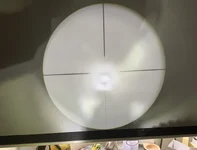
Ensuring scope reticle is perpendicular to action [avoids cant POI error at extended ranges]

Set it by "eyeball" holding the rifle as per your normal stance, then If you look at the rifle & scope from the muzzle end, it is often easier to see any reticle mis-alignment very clearly compared to the barrel & action. This helps on rifles with no flat top surfaces to take as a reference.

The longer the range - the more important the squareness. - At normal stalking ranges it is not critical IMHO.

Ian
 
I've never understood the need for this. You set the scope up and true it vertically but trued to what?
Action, where the scope is probably mounted, barrel or bore? How do you know that the reticule is centred in the scope to start with.
Logically, if you have to true vertically then you need to do it in the left/ right plane too.
A properly zeroed rifle will be " on" at a specific distance and the bullet will deviate from zero at other ranges.
It's not possible to set up your scope absolutely parallel to your rifle bore so don't worry about it.
If it looks right when you throw it up to your shoulder it's good enough, wind and gravity will have a bigger impact than a slightly wonky reticule
 
For a stalking rifle you can level it with your eye and it will be fine but i also like to shoot longer range with my other rifles so I do like all my reticles level.
Its not difficult to do with the right method, I just hang a plumb cord on the wall in a dark room and level the action and shine a torch through the objective end of the scope. It only takes a few minutes.
When your putting on a new scope you will be adjusting it for proper eye relief etc so you may as well level it properly at the same time.
 
Using the word level is the confusion I think...the point is you want the vertical reticule hair to represent and align with the gravitationally produced plane of the trajectory.

So when firing, the cross hairs should be vertically above the bore centre and the notionally extended cross hairs should bisect the bore... so as far as initial scope set up goes, the critical thing is for the windage hair to be aligned with the bore centre, i.e. radiating out from it.

"Level" doesn't need to come into it.

Trying to read a series of bubble levels which are themselves made to a nominal accuracy is counter productive...just align the reticule with the bore centre...

Two torches projecting the bore and the scope reticule are a quick and easy check of this if you are unable to do it by eye...

Alan

fullsizeoutput_1c20.jpeg
fullsizeoutput_1c1f.jpeg
 
Last edited:
All those saying it's close enough by eye. I worked in a gunshop and three of us used to fit scopes for customers. We all had a different result if we aligned them by eye, ie by shouldering the rifle and looking through the scope. We used a smith's bench, to ensure the action was dead level, using good quality spirit levels, then made sure the scope was in the same horizontal plane using more spirit levels. If someone is paying good money for rifle and scope then they deserve it to be properly fitted and adjusted.

I also get that if you're only shooting at stalking ranges then a bit of leeway won't make any real-world difference, especially if you're shooting at or near zero range, but that's not necessarily what's at play here. My rifle and scope combinations are designed to shoot much longer ranges, and even if only for plinking, a bit of cant will make the difference between a hit and a miss a couple of hundred yards further on than stalking ranges. There's no point in owning a scope with long range features and adjustments if you don't get it right out of the box.
 
I use a spirit level app on my phone and a normal domestic 9" real world level I found in my shed. Clamp gun firmly in the bipod with clutch nice and tight and level the receiver, then mount the scope and twiddle about. Perfect every time when checked against a plumb line.

You did not say whether and how you checked or calibrated the levels...

Critically, how does the reticule actually line up with the bore centre? That is all that counts.

It is difficult to get it hugely out, but I have seen one scope at the range which had been set up by an RFD which had the windage hair running between 29 and 59 minutes on a clock face...6˚ out.

Alan
 
We all had a different result if we aligned them by eye, ie by shouldering the rifle and looking through the scope.

But that is not what I mean by aligning by eye...the point is to look from a position where you can see both reticule and bore and ensure that the windage hair of the reticule would extend to bisect the bore...of course you can't do that by shouldering the rifle.

Alan
 
But that is not what I mean by aligning by eye...the point is to look from a position where you can see both reticule and bore and ensure that the windage hair of the reticule would extend to bisect the bore...of course you can't do that by shouldering the rifle.

Alan
No, I'm not denigrating any system where someone has taken care to align the scope properly. We all have our different methods, I was replying to the folk that say they can align it by eye alone, and that in any case it isn't that critical.
 
You did not say whether and how you checked or calibrated the levels...

Critically, how does the reticule actually line up with the bore centre? That is all that counts.

It is difficult to get it hugely out, but I have seen one scope at the range which had been set up by an RFD which had the windage hair running between 29 and 59 minutes on a clock face...6˚ out.

Alan
As an aside, I do find something rather beautiful in a level's capacity to self-prove. The same with a right-angle. There is a purity to any form of calibration that is derived from geometry itself, rather than from a reference.
 
As an aside, I do find something rather beautiful in a level's capacity to self-prove. The same with a right-angle. There is a purity to any form of calibration that is derived from geometry itself, rather than from a reference.

The Romans set out their waterways and viaducts over miles just using the most elegant and simple device, an "A" frame...with a plumb line reading off the cross bar...instant calibration by just ensuring you placed the tips on the same spots at 180˚ and marked the cross bar both times, halfway between was level....lovely! They could even build in a constant fall....

Alan
 
Last edited:
The Romans set out their waterways and viaducts over miles just using the most elegant and simple device, an "A" frame...with a plumb line reading off the cross bar...instant calibration by just ensuring you placed the tips on the same spots at 180˚ and marked the cross bar both times, halfway between was level....lovely! They could even build in constant fall....

Alan
Hilger & Watts eat yer heart out...
 
If you cannot detect a non-perpendicular reticle by simple eyesight on mounting the scope, it will hardly make any difference on shooting by the same person.


If you can't do it by eye, what hope have you of holding your rifle straight in the field?

Both statements above definitely hold some water. If you cannot discern a non-verticle reticle by eye, there is a fair chance you are not aware/diciplined enough to avoid canting your stock in the field.

But eliminating all possible sources of POI error is my intention. Whatever I can prep before I go hunting means whatever vagaries occur in the field [wind, extended distance, etc] are not exacerbated by a built-in error.

Coming to VSS's point specifically: I hunt almost exclusively using quad sticks. Unlike a free-hand hold, it is possible to offer the stock up to the quads and then pull your head back 50cm to assay whether stock is perperndicular in "Vs". I definitely do this on longer shots on live quarry where they are not aware of my presence and time allows for this. Likewise, when benchrest shooting it is definitely possible to be more certain of no stock cant. So I stand by the idea that setting this up right has worth.
 
So I stand by the idea that setting this up right has worth.

I think everybody agrees that setting it up right is necessary...but KISS systems are favourite for me...introducing bubble or iphone levels and plumb lines seems to be adding to the chances of error readings and consequent inaccuracy...

The critical alignment is between reticule and bore centre...not between action, level and plumb line.

Alan
 
Using the word level is the confusion I think...the point is you want the vertical reticule hair to represent and align with the gravitationally produced plane of the trajectory.

So when firing, the cross hairs should be vertically above the bore centre and the notionally extended cross hairs should bisect the bore... so as far as initial scope set up goes, the critical thing is for the windage hair to be aligned with the bore centre, i.e. radiating out from it.

"Level" doesn't need to come into it.

Trying to read a series of bubble levels which are themselves made to a nominal accuracy is counter productive...just align the reticule with the bore centre...

Two torches projecting the bore and the scope reticule are a quick and easy check of this if you are unable to do it by eye...

Agree, and this is a simpler [KISS] method for sure.

But it seems to lack a final step.

The start point is the barrel and scope torch splash are aligned on the wall, with the diameters of each overlaid exactly, but vertically separated.

Surely the final step has to be that you test the "radiating from the bore" part by cranking the windage turret through all possible settings whilst ensuring that the two diameters never diverge?
 
I think this is a marvellous case of over thinking something! You can have it as level as you like but as soon as you put the nut behind the butt and it’s canted by a few degrees it will mean an adjustment in height will also Be an adjustment in windage, not a big deal as you just need to be aware of it if it’s your rifle - the issue I guess is with systems suck as ballistic turrets where you can adjust for point of aim to remain the same out to 500 yards whereas a cant on the scope will mean you may also move a number of inches left or right - but again - it won’t matter if the scope is level of you are holding it at a slight angle (which I bet most do!)

regards,
Gixer
 
Agree, and this is a simpler [KISS] method for sure.

But it seems to lack a final step.

The start point is the barrel and scope torch splash are aligned on the wall, with the diameters of each overlaid exactly, but vertically separated.

Surely the final step has to be that you test the "radiating from the bore" part by cranking the windage turret through all possible settings whilst ensuring that the two diameters never diverge?

As I said in post #14 arguably it should be checked and set finally after zeroing the windage rather than by centring the reticule in the scope.

However the gnats whisker involved would produce a consistent offset of a few thou from the plane of the trajectory. It would have much less effect on POI than not ensuring that the windage hair was vertical when firing...

Even with severe scope mounted cant....providing the reticule was plumb on firing, the trajectory will still follow the alignment of the windage hair...parallel but maybe offset by a millimetre or two all the way out.

If the reticule aligns with zenith and nadir on firing, gravity determines that the trajectory plane can only follow.

Alan
 
Last edited:
I think this is a marvellous case of over thinking something! You can have it as level as you like but as soon as you put the nut behind the butt and it’s canted by a few degrees it will mean an adjustment in height will also Be an adjustment in windage, not a big deal as you just need to be aware of it if it’s your rifle - the issue I guess is with systems suck as ballistic turrets where you can adjust for point of aim to remain the same out to 500 yards whereas a cant on the scope will mean you may also move a number of inches left or right - but again - it won’t matter if the scope is level of you are holding it at a slight angle (which I bet most do!)

regards,
Gixer
Several makes of scope mount have a bubble level built into them, so you can check with left eye to prevent cant. They have limited application for shooting at live quarry, but for range work they are yet another tool to help eliminate the variables. I've got them on my Spuhr and Tier one mounts.
 
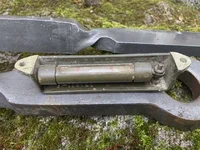
Not sure who made it or where I acquired it from but this one the vial is virtually straight and it is almost impossible to centre the bubble it moves so fast even with the micrometer adjustment!

View attachment 175380
That is truly lovely.

It would be interesting to know the variation between the inner and the outer red graduations. If it isn't marked, I guess one could work it out from the pitch of the screw coupled with a sine chart...although, that is if one has nothing better to do with one's time...:doh::lol:
 
Back
Top