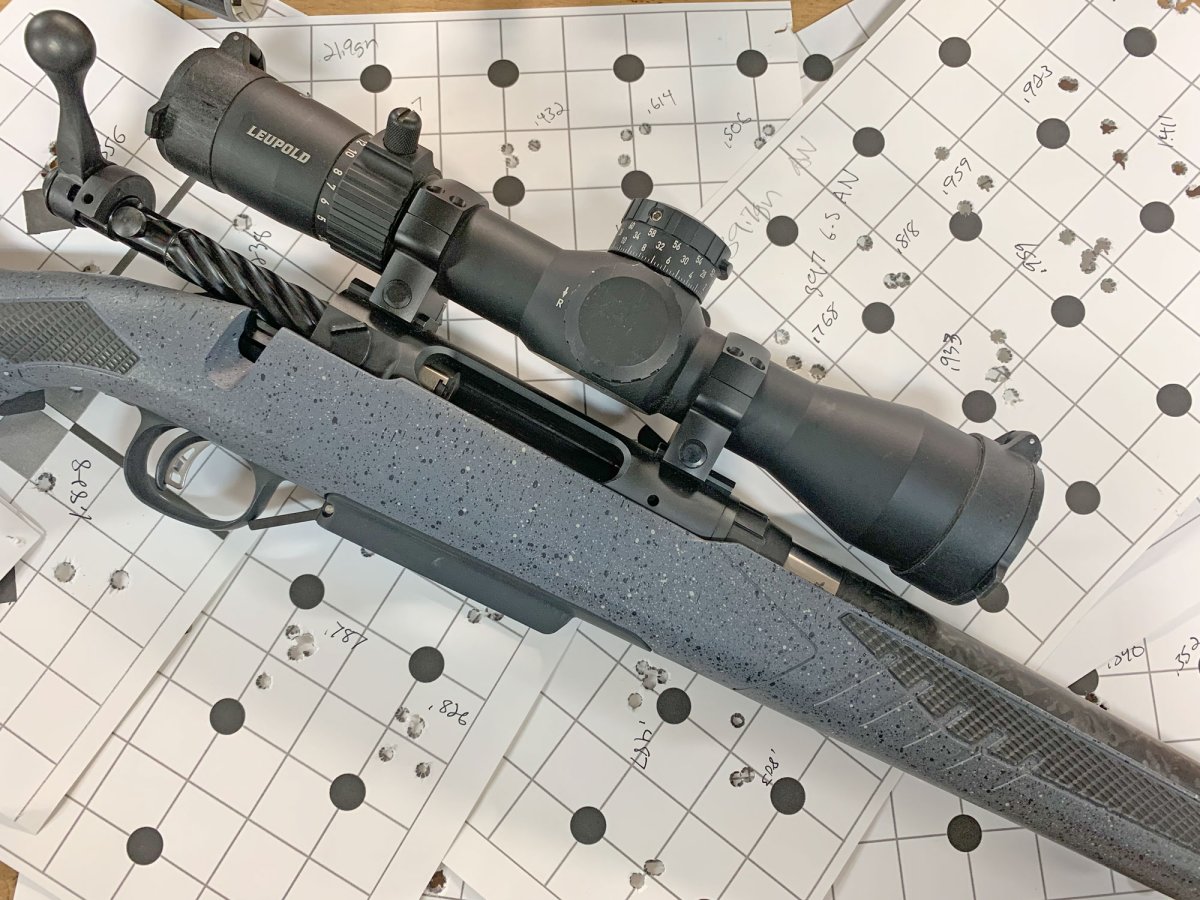
Rifle Nodes - You’re Wasting Your Time

Still load development, still using up components, barrel life.
I think we all accept that tiny sample sizes are irrelevant, but it's highly impractical for us to be firing enough rounds to be truly valid.
People say this but it’s actually untrue. If you do all the tests required of old style load development ladders and bullet depth tests and accuracy tests etc you actually shoot more rounds than doing one or two statically valid tests. In my view the “we can’t afford to shoot 100s of rounds” argument is wrong in truth you can’t afford to do all the old methods which achieve almost nothing.
 
I strongly suspect you'd never give up any ground, and I'll wear out my thumb here. For me, barrel harmonics and OBT still hold water.
 
I strongly suspect you'd never give up any ground, and I'll wear out my thumb here. For me, barrel harmonics and OBT still hold water.
I’m happy to be open minded mate I try to accept any good evidence presented to me and align my opinion and practice to valid evidence. Also I’m fine with the fact many competitive shooters choose to ignore the maths and statistics as it gives me an edge in my view or at least saves me some money!
Straight shooting and do whatever you like mate :)
 
When I used a shoot over chrony my sample sizes were small, now I am using a Garmin I am getting a lot more data, and SD/SE start to become meaningful, it's interesting but creates a rabbit hole of reloading possibilities, then the barrel will be burnt out, will the next barrel perform the same?
 
Ok.... if folk who no longer do small samples and wasting time doing multiple incremental 3 shot loads to find whst they want ....

What DO you do in layman's terms ?
 
Ok.... if folk who no longer do small samples and wasting time doing multiple incremental 3 shot loads to find whst they want ....

What DO you do in layman's terms ?
What i do is a simple ladder test - load up 10 rounds in 0.3 grain increments. Shoot them all to the same point of aim. Stop when you are getting pressure signs. Drop back 1 increment or nearest round number. Load up a half a dozen. Give them a test. Load up a box and go hunting.

I do use a good crimp, and load to book recommended overall length.

My loads might not work well at winning medals at 500m, but work well enough as hunting ammo.
 
Pick a good cartridge good bullet good powder good primer good barrel. Pick a velocity that is appropriate to your application. Shoot two or three test of ten rounds to test for speed and precision pick one and load up thirty and test at 300m. Job done if not change bullet or powder
 
Pick a good cartridge good bullet good powder good primer good barrel. Pick a velocity that is appropriate to your application. Shoot two or three test of ten rounds to test for speed and precision pick one and load up thirty and test at 300m. Job done if not change bullet or powder


Pretty much what i do .
set initial seating dept at 20 thou.
Find the speed you need / want
adjust seating depth back and forth 10-20 thou either way .
If accurate at 100m , zero at 200m , if not i will bin it off and try something else . If good....👍
True drops out to 500 /600m

Case prep and correct full length die set up is key .
 
Built a BR for a regular client a few months ago

8 twist Phoenix on a T3

Test fired using known shooting load (108 hornady)

.3 moa

Client tested

55 g through to 105 g

All in .3 moa area

Good barrel, adequate rifle work, proven end user

Proven and repeatable accuracy

Nodes exist

But easy accuracy if fundamentals are in in place without worrying about them
 
I doubt there are many UK rifle shooters able to afford the cost of shooting the number of rounds suggested by some of these load development methods in 2026. Add to this the challenges around non-lead projectiles in rifles configured for good ol' lead & copper bullets and you'd best renegotiate your overdraft limit!

K
 
Non lead cheap considering the return you get from the carcass

There isn’t a huge difference in price betteen LTS price and decent quality target bullets of traditional manufacture

(Berger)
 
By the time you have worked up statistically significantly data, you've probably worn out the barrel

Chasing precision in a non precise world is the fascinating closed loop of the OCD

Been there!

Loved it

Got no-where useful

Still love it !
 
Check out our Aussie pals Mark and Sam on YouTube who are some of the best ELR shooters around. They have an ultra simple load development process in that they cram as much powder into the case as possible before pressures signs and then do their tweaking on the rifle, in terms of adjusting the stock to get good head position, using a bipod that provides linear recoil, using a hard rear bag etc.
 
Thanks for posting that. I view most reloading stuff as voodoo on the basis of a basic understanding of statistics. My favourite is “it’s a half moa rifle when I do my bit”. Aka you shoot enough wee groups until you get lucky.

Interesting that the node turns out to be voodoo as well. Glad I am lazy and never did all that nonsense anyway
 
10


Renowned ballistician Bryan Litz (chief ballistician at Berger Bullets) approaches load development scientifically, emphasizing statistical significance over chasing mythical one-hole groups. His philosophy centers on finding a consistent, forgiving load with low extreme spreads, rather than trying to perfectly tune every single variable. [1, 2, 3, 4, 5]

Core Philosophies
  • Seating Depth First: Litz suggests a unique approach for Berger Bullets: start with a low-to-medium powder charge and find the best seating depth first, as seating depth tends to be more static. Once the optimal jump/jam is established, work on refining your powder charge. [1]
  • Understanding Group Variability: Shooters often chase "lucky" small groups. Litz's Applied Ballisticsresearch shows that group size has a natural ~ 30% standard deviation. For example, if a rifle averages a 1.0 MOA group, 67% of groups will naturally fall between 0.7 and 1.3 MOA. You should establish baselines using larger sample sizes (like multiple 5-shot groups) to avoid tail-spinning over outliers. [1, 2]
  • Mean Radius: Instead of measuring only Extreme Spread (ES) or relying heavily on small-sample ladder tests, Litz advocates measuring the Mean Radius. This is the average distance of all shots from the center of the group, providing a much more accurate representation of overall precision and system capability. [1, 2]
  • Velocity Matters Most at Distance: For long-range and extreme long-range shooting, achieving low Extreme Spreads (ES) and Standard Deviations (SD) in muzzle velocity is far more critical than splitting hairs on powder charges for slightly smaller paper groups. [1]

Practical Load Development Steps
  1. Gather Baseline Data: Do not rely entirely on ballistics software when starting out. Fire a set of test loads over a chronograph to get a real-world baseline of your muzzle velocity. [1]
  2. Standardize Seating: Choose a powder and bullet, and lock down your seating depth first using the manufacturer's suggested jump (e.g., VLD bullets often prefer being jammed into the lands, whereas tangent ogive bullets prefer a jump). [1]
  3. Find the Velocity Flat Spot: Test your powder charges until you find a velocity plateau where velocity remains stable across slight charge variations, providing a forgiving, robust load. [1]
  4. Accept and Practice: Once you find a reliable and repeatable load, stop testing and focus on marksmanship fundamentals. Litz advises that continually trying to perfectly refine loads often leads to diminishing returns. [1]
 
Chasing ammo and reloading perfection is quite different from chasing skill

Shooting is not unique

It is no different than any other other activity

You do not become a rifleman by not practicing
 
I missed them last time around.
 

This is worth a read, and follows on from work done by Hornady demonstrating that the presence of rifle nodes is an artefact of using a small sample size.
Any thoughts or comments?
Now go back and repeat test across 100 shooters 100 times with not only factory rifles but custom BR rifles, then we have not only a set of tests, but a set of tests from many people with a more controlled environment (BR class rifles).

And who is to say the test agents reloading skills are up to par, so may need to bring in many 3rd party reloaders.

And you wonder why I’ve gone back to shooting the factory ammo that groups well and does what I need on the terminal effectiveness end, albeit, expensive
 
then the barrel will be burnt out, will the next barrel perform the same?
Apparently not, according to Eric Cortina. In one of his videos, he mentions that he had two barrels, made one after the other off the same machinery. The first barrel he fitted was superb, and he swapped over to the second a bit prematurely, thinking it would be the same, but it turned out to be a duffer. He kicked himself as the first barrel was not shot out.
I expect you have seen the video, though :tiphat:
 
Back
Top