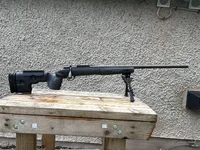
Rifle safety: a salutary tale

Aside from muzzle awareness, which must be universally embraced, everything else is down to personal routine. Having a fail safe system that works for you, with all your own little checks and counter checks. And sticking to it rigidly. It's cutting corners that costs lives. And carelessness.
Think for a moment about an earlier post in a different thread, by @CarlW, referring to his routine in Africa: "The rifle is loaded when I arrive and stays loaded until I leave". I bet that raised a few eyebrows, yet I doubt Carl is any less safe than the rest of us. Probably safer, knowing with absolute certainty, that the rifle is loaded, and treating it as such. No "Oh whoops, I didn't know it was loaded" with him.
 
The “T3: why do folk like them?” thread has been interesting, in that one of the strands has become about whether that particular design is “safe enough”, given the particularly features of the safety catch (e.g. it has to be moved to “Off” to open the bolt). More broadly, though, part of the debate appears to be about how “difficult” (or how much of a “faff”) it might be to make a/the rifle safe, for example when getting into or out of a vehicle, getting into a high seat, or crossing a fence etc.

My personal concern is that some of the issues raised in the thread point to underlying poor safety with a rifle, which is arguably a rather broader and more significant issue for all of us as participants in our various branches of the sport.

I was reminded of this very unpleasantly the weekend before last, when on a driven boar shoot in France. We were dropped off along the drives by vehicle, walked in to our firings pulpits (“miradors”, as they are called; 50-100m apart), and each started to sort ourselves out. A few minutes later, I heard a shot. I thought no more about it: given the possibility of boar breaking out before the drive got under way, we had been given to permission to fire when in position.

But at the end of the day I heard that one of the guns had had a negligent discharge, and promptly been escorted off the estate and sent home; I doubt he will shoot there again.

On talking later to his neighbours and a close friend, I understand that what happened was:
- At the end of the previous drive he had unloaded (or, at least, thought he had; see below), removed the magazine, and put the rifle in the slip.
- On taking his post for the next drive, he removed the rifle from the slip and, whilst doing so, it went off, the bullet hitting the ground less than 2ft in from of his feet.

I do not know the precise make of bolt-action rifle (other than it was not a Blaser), but would suggest that this safety failure very likely involved some/all of the following:
- Not pulling the bolt fully to the rear, to extract the round from the breach. This all too often occurs because we worry about losing the “very expensive round” (sic) if we pull the bolt back hard enough to cause it to eject fully. So the temptation is to pull the bolt back just enough to enable us either to catch the round, or to push it back into the magazine again.
- Pushing the bolt forward without physically checking that the round was not still engaged on the bolt, and hence re-chambering the round. Then removing the magazine, and thinking that the rifle is now unloaded.
- It is clearly possible that he just removed the magazine and forgot to cycle the bolt. Same effect.
- Not firing off the action whilst the rifle is under control and pointed to a safe backstop. Not only would this have eliminated the risk of the round still being chambered, but it would also have un-set any set trigger he might have had.
- Touching the trigger, if set, (or even, heaven forbid, pulling it directly) as he removed the rifle from the slip at the start of the next drive.

My personal view is that the only really safe way to unload a bolt-action rifle is:
- Open the bolt firmly and fully. Check the round extracts and ejects fully.
- If the magazine is detachable, leave the bolt fully open, remove the magazine, and then cycle the bolt several times.
- Check both the breech and magazine well are clear.
- Close the bolt, fire off the action into a safe backstop.
BUT, if the rifle has a floor plate magazine, you need to empty this, either by cycling the action, or opening the floor plate. Then check breech and magazine are empty, and fire off the action.

Note that none of this involves the use of the safety to in any way make the process easier or safer: you have to have the rifle fully in your control the whole time, and understand why you are making each movement.

But please do not kid yourself that, if you push the ejected round back down into the magazine and then close the bolt, even supposedly on an empty chamber, your rifle is unloaded. It just has not been made ready yet. Or, at least, you don’t believe that to be the case…..

The vast majority of bolt action rifles made for civilian use in the last century or so have mechanisms derived from military actions. These have generally been proven by being produced in vast quantities, and then used on operations at an intensity that few, if any, of us can comprehend. A consistent lesson from all this has been that safety catches, however well or badly designed, are never a substitute for good personal drills and safety standards. Literally millions of young (and often tired and frightened) soldiers have mastered the “faff” of these basic handling skills; if we cannot, should we be trusted with a rifle to use at all?

PS:
What would you say to the guy whose rifle went off accidentally? How would you treat him, and what would you want before he was shooting next to you again? Genuinely interested to know.


Again people, you , have not understood what has been said. I have no difficulty in making rifles safe. With the T3, this is the rifle I have been talking about in the other thread. To remove a live round from the chamber for any reason, you have to put the rifle into a state of readiness to fire. Only briefly but you still have to do it. Even withthe muzzle pointing in a safe direction, as I always do, it’s a risk. My complaint is that you have to do five movements to eject the live round and get it back into the mag. Do this enough times a day and it turns into a pain. I’m not talking 2 or 3 times a day, I’m talking multiple times. This operation with a safety like a Remington has is two movements, with the rifle in a safe state all the time.

I hope you get it now, it’s a very simple grumble that you and fail to have understand
 
Last sentence should read

I hope you get it now, it’s a very simple grumble that you and others have failed to understand
 
Last sentence should read

I hope you get it now, it’s a very simple grumble that you and others have failed to understand
Understand it perfectly but I have never found it unsafe I am a sako user and have been for many years and they are the same at least the older ones are the safety must
be in the firing position to work the bolt.
 
the safety must
be in the firing position to work the bolt.
My rifles are like this^^^
It does strike me as something of a design fault.
Does anyone know why this is the case with so many rifles when, for example with shotguns, the safety generally automatically engages as soon as you break the gun to insert cartridges.
 
Understand it perfectly but I have never found it unsafe I am a sako user and have been for many years and they are the same at least the older ones are the safety must
be in the firing position to work the bolt.

Which to me is a bad design. It makes the rifle less safe than it could be.
 
I think many are missing the point.

Neither a Tikka, nor a Remington, nor a Sako, nor a Howa, has as true "safety catch".

That can only be implemented either by de-cocking the bolt (or whatever other mechanism), or by having a mechanism that absolutely prevents the firing pin from striking the primer.

These exist. I could list a few that I know of, but I'm no expert in these matters.

Basically I have been taught, from the beginning, that as soon as you get onto your land the rifle should be loaded. The "safety catch" may be a nice to have, but not trustworthy. Neither the trigger.

Muzzle awareness, sh(it) happens, we can trip, drop our guns, stumble just crossing a fence or stile, never mind the realities of getting up to and down from a high seat, into and out of vehicles, out before dawn, back after last light. No visibility. Passing over a "hot" rifle to a partner whilst doing things even as basic as having a pee or tying up a loose boot lace.

Procedures for making the rifle safe before and after any such manoeuvre. Taught then learned by rote.

Mechanisms can fail, maintenance not so good, is it just one screw, or two pins, or an impeccable impregnable mechanism that absolutely seems impossible to fail holding the trigger in ? Or do we just want a little lever that we usually push forwards or sometimes pull backwards to fire, now that's also confusing.

Anyway it's just a little lever. Might work, might not, same as the trigger. Might be reliable, might be erratic, might have been fiddled with, might go off with a thump or small drop, maybe a screw could have come loose, or it was just a rubbish design from the start.

Having grown up target shooting, ISTM that the only safe rifle is the one with the bolt removed. Or no ammunition inside. But that's absolutely not how it has to be done in the field.
.
 
Same as Paul o and Bear1. With me on bolt action 3 in 3 out, finger up spout remove bolt. Kiplauf 1 in 1 out. Has always worked, slightly different when quarry was different, safety on but always on auto then.
Why do you have to elude to shooting at people in virtually every post on firearms and firearms handling that you make? Does it give you a hard on?
 
In an ideal world so would I. But in reality, say shooting from a high seat, or elsewhere, sometimes you do lose fired cases. It's a bummer if you reload. But if you just use factory stuff it's no big deal. And really you should be concentrating on what you are shooting at, not getting distracted about picking up brass, to the possible detriment of your quarry.

Target shooting, rather different, If I don't return with exactly the same number of rounds, empty or complete, it really annoys me. And seeing an empty space in say an MTM 50 round box makes it very obvious.

But surely a little basic mental discipline and remembering how to count, might just remind you that say you started off with, I don't know, 5 or 10, either in magazines or a wallet. Then shot X number, either retaining empty cases or not. Then at the end of shooting obviously having checked clear and ideally having a second party confirmed that, unload magazine(s) and count again.

Because, of course, a loaded magazine counts as a loaded rifle I think, so all magazines should be unloaded before returning from your permission. Not just treated as a convenient way of carrying your ammo, never mind loading them up in advance.
What is the issue with loading a sepa
In an ideal world so would I. But in reality, say shooting from a high seat, or elsewhere, sometimes you do lose fired cases. It's a bummer if you reload. But if you just use factory stuff it's no big deal. And really you should be concentrating on what you are shooting at, not getting distracted about picking up brass, to the possible detriment of your quarry.

Target shooting, rather different, If I don't return with exactly the same number of rounds, empty or complete, it really annoys me. And seeing an empty space in say an MTM 50 round box makes it very obvious.

But surely a little basic mental discipline and remembering how to count, might just remind you that say you started off with, I don't know, 5 or 10, either in magazines or a wallet. Then shot X number, either retaining empty cases or not. Then at the end of shooting obviously having checked clear and ideally having a second party confirmed that, unload magazine(s) and count again.

Because, of course, a loaded magazine counts as a loaded rifle I think, so all magazines should be unloaded before returning from your permission. Not just treated as a convenient way of carrying your ammo, never mind loading them up in advance.
what’s the issue with loading a separate box magazine in advance? I load up rim fire magazines in advance to avoid having to fumble around in the dark when out on the rabbits band risk dropping a live round. Why is this an issue (it’s not illegal if the magazine is separate to the rifle) and why is a CF any different??
 
Again people, you , have not understood what has been said. I have no difficulty in making rifles safe. With the T3, this is the rifle I have been talking about in the other thread. To remove a live round from the chamber for any reason, you have to put the rifle into a state of readiness to fire. Only briefly but you still have to do it. Even withthe muzzle pointing in a safe direction, as I always do, it’s a risk. My complaint is that you have to do five movements to eject the live round and get it back into the mag. Do this enough times a day and it turns into a pain. I’m not talking 2 or 3 times a day, I’m talking multiple times. This operation with a safety like a Remington has is two movements, with the rifle in a safe state all the time.

I hope you get it now, it’s a very simple grumble that you and fail to have understand
If the muzzle is pointed in a safe direction what is the risk? Minimal of a ricochet if your ND hits a stone maybe but the if the rifle is pointed in a safe direction the risk really is minimal
 
Yo, who said anything about shooting at people.
You have a strange mind.
“Shooting at other quarry, full auto but safety on”

if the other quarry is not humans what other situation are you talking about where you would have access to full auto pray tell!?

loads of your posts mention what appears to be shooting with the military and people firing back so if not humans what were you shooting at?
 
“Shooting at other quarry, full auto but safety on”

if the other quarry is not humans what other situation are you talking about where you would have access to full auto pray tell!?

loads of your posts mention what appears to be shooting with the military and people firing back so if not humans what were you shooting at?

I don't see the word "full" in the op. you added that yourself. just saying.
 
“Shooting at other quarry, full auto but safety on”

if the other quarry is not humans what other situation are you talking about where you would have access to full auto pray tell!?
I don't need to tell you anything and I said auto, not full auto so go and make your lewd remarks elsewhere. Got a few deer to go fettle now after a hard day so could do without wasting time on you.
 
“Shooting at other quarry, full auto but safety on”

if the other quarry is not humans what other situation are you talking about where you would have access to full auto pray tell!?

loads of your posts mention what appears to be shooting with the military and people firing back so if not humans what were you shooting at?
Aliens.:eek:
 
Auto or full auto what’s the difference? On a civilian firearm there is none.

full auto are not legal for civilian use.
semi auto ie, self loading are in 22, and shotguns [with mag limit restrictions, unless sec 1 fac]
I was thinking it was a reference to semi auto, as opposed to full auto.
ruger 10/22 in a self loader, ie, it reloads automatically, as does an auto shotgun, recoil operated. neither are capable of full auto firing, ie continuous fire on a single pull of the trigger.
this thread is predominantly about safety mechanisms and nd,s
 
Back
Top