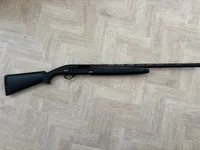
Steel shot gun destruction test

bobo

Well-Known Member
This test was made by a fellow Danish hunter a few years back, I have his permission to bring the results here.


An old Spanish S/S from the 60ies was getting well worn, with some slack in the main closing mechanism it was decided it had to be subject to experimentation.

It’s a 12-gauge 70mm (2 ¾”) camber pressure tested to 850 Bar (12.330 PSI). The gun has 1,1mm choke on secondary barrel (that’s full choke, and generally not recommended for steel shot).


Test is what happen if firing a, 12/89mm (12 gauge 3 ½” chamber) super magnum high performance cartridge 39g steel shot, muzzle speed of 495 M/S (1624 fps), in that gun?????

It’s fired at a sheet paper target, distance 25 meters.


I will let you guess before I post the results, but a movie of the shot can be seen here, the cartridge is a little long, but he manages to press it in.


So, what do you think happened to the gun and how was the pattern on the paper.

There is nothing illegal about making that kind of test here. I do not recommend people to do that kind of testing themselves.

I will bring the results and pictures later ;)
 
i did a similar thing decades ago with a scrap hammergun , dropped two 20 bore cartridges in front of 3'' magnums although i didn't bother patterning , the stock broke where i rested it against a steel test weight but the action and barrels remained intact

sticking its barrels in the mud had the desired effect though :rofl:
 
The pressure is the same in the gun whether against a solid stop or otherwise.
But the gun moving backwards at a rate of knots would have had a damping effect, similar to the suspension on a car, slowing the force of the impact.
Trying to dig a level physics out of my head from 30+ years ago!!
 
The pressure is the same in the gun whether against a solid stop or otherwise.
Agreed, have a backstop to the gun will put force on the stock, so the stock may let go.

Fieldsports Britain a few years ago did a similar testing on shotguns overloading etc. surprising how much it actually takes for one to let go. If you were shooting the gun from the shoulder, your shoulder will take the impact. If you think that double big bore rifles have a recoil impulse of getting on for 80 ft lbs of recoil energy and a normal 12 bore is in the order of 20 ft lbs, wooden stocks can take it, provide you are not putting the butt against a firm immovable object.

What is dangerous is plugging the muzzles - but even then I think they really had to ram clay in hard to get a barrel to explode.
 
I think it’ll be ok, the pattern will be all over the place as the pellets are likely bumping into each other as they try to squeeze out of the choke point.
 
Agreed, have a backstop to the gun will put force on the stock, so the stock may let go.

Fieldsports Britain a few years ago did a similar testing on shotguns overloading etc. surprising how much it actually takes for one to let go. If you were shooting the gun from the shoulder, your shoulder will take the impact. If you think that double big bore rifles have a recoil impulse of getting on for 80 ft lbs of recoil energy and a normal 12 bore is in the order of 20 ft lbs, wooden stocks can take it, provide you are not putting the butt against a firm immovable object.

What is dangerous is plugging the muzzles - but even then I think they really had to ram clay in hard to get a barrel to explode.
I have heard stories of older, thinner barrelled shotguns blowing their barrels after having been partially blocked by snow. One old story said that it was caused by a spider’s web in the barrel!
Not sure how real these stories are tho!!
 
Another vote for it’ll survive. I’m not convinced many steel proofed guns are made any stronger, they’re just proofed at higher pressure.

This is my thinking as well... I can't really see Browning (for example) significantly changing their design of their actions just for the higher proof pressures. Just that older guns were just never submitted for superior steel proofing... (Exception for 3" chambers over 2 1/2" and 2 3/4")
 
But the gun moving backwards at a rate of knots would have had a damping effect, similar to the suspension on a car, slowing the force of the impact.
Trying to dig a level physics out of my head from 30+ years ago!!

Think that's mixing up the recoil force with the actual expansion force from the combustion of the powder.

Would have thought the powder's still going to burn at the same rate, expand at the same rate and thus apply the same amount of pressure on the chamber regardless of whether I have my shoulder to the stock or not.
 
The real test would be to fire 100 shots in a relatively short space of time similar to a clay pigeon shoot or a modest driven day, without harm to the gun, shooter and bystanders. After all the HSE believe that steel is an appropriate substitute for lead, although they don't appear to have done a risk assessment to confirm this.
 
Think that's mixing up the recoil force with the actual expansion force from the combustion of the powder.

Would have thought the powder's still going to burn at the same rate, expand at the same rate and thus apply the same amount of pressure on the chamber regardless of whether I have my shoulder to the stock or not.
You are quite possibly right.
Lots of different things going on in that scenario, including the perpendicular forces applied to the barrel by the shot as it hits the choke.
I’m just waiting to see the state of the gun!
I guess it will be somewhere between having banana skin barrels and a f**ked action at one end of the scale, to being perfectly fine on the other!
 
It’s a 12-gauge 70mm (2 ¾”) camber pressure tested to 850 Bar (12.330 PSI).
That's it's service pressure not proof.
Smelly, you are right, the proof pressure will of course be around 18.000 PSI.


Remember, the gun was not in real good condition, slack in the closing system.
Then think chamber length, the test cartrige was a 12 gauge 89mm long, thats 3½ inch chamber length in imperial, gun is only chamberd for 2 3/4 inch.

I have to go for work now.
Result of test will be shown tomorrow.
 
I think it’ll be ok, the pattern will be all over the place as the pellets are likely bumping into each other as they try to squeeze out of the choke point.

Hmm I think impact will look like a slug shot, or v v tight anyway as the end of the cartridge is blown off

S
 
I think it’ll be ok, the pattern will be all over the place as the pellets are likely bumping into each other as they try to squeeze out of the choke point.
I think it might be broken. I suspect this is one in a series of tests not shown. Guessing this one has been shown because something happened. You've got quite a long way down the silly path by the time you're jamming a 3.5 inch super magnum cartridge into a standard chamber.

As for the pattern, in a normal cartridge all the pellets are in contact with each other anyway as the reach the choke. The extra 3/4 inch of cartridge length may have jammed up and burst it.

Won't be very surprisde if it's superficially undamaged. After 5000 cartridges of that, I'd be very surprised.
 
Of course all these "one time" tests are like the MoT Test. Valid ONLY at that moment on that day.

The referenced 20 bore cartridge in a 12 bore gun has been looked at and revisited often on various videos. Many of them show no ill effect at all. The 20 bore cartridge being swaged down and shot out of the gun or being detonated and then being fired out of the gun. From one that I recall the video creator had to repeat it three times until he got the gun to burst or show any ill effect.

So these tests prove little other than that folk will fall for "click bait". What isn't shown is the pollution caused by the plastic wad and any scoring of the barrel of slight bulging below the choke constriction. Something that one idiot said "would only be cosmetic" in any case. Well try explaining that to a potential buyer when you are trying to sell them your Purdey, Boss or Holland..."It's only cosmetic..."
 
Back
Top