Ensuring scope reticle is perpendicular to action [avoids cant POI error at extended ranges]

What I was saying is the rifle is canted but the scope plumb, so if you mount the rifle and the rifle was off a few degrees but the scope was plumb there should be no effect.
The effect of that would be exactly the same as if the rifle were true and the scope canted, surely? The relationship between the two would still be incorrect, whichever one of the two were held true.
Or maybe not. It's all getting too confusing!
Basically, if it looks wrong it probably is wrong. If it looks right then it probably is right, or so minutely off as makes no difference. Or your eyesight is fcuked.
 
Last edited:
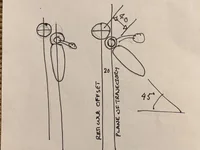
I was offered the chance to shoot an old military rifle at the range sometime ago...originally iron sights it had a telescopic sight mounted. For some reason to do with clearing the action (top loading?) the scope could not be directly above the barrel but had to be set off to one side...as in the left hand sketch....the reticule was vertical when fired and thus the bullet always struck 20mm or so to the right of the line of sight at whatever range...this is what I have been trying to describe by waffling on about the offset.

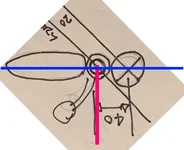
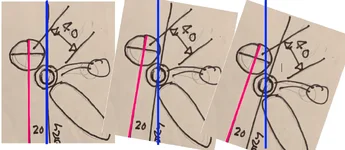
The sketch on the right illustrates my example of the scope being rotated in the rings clockwise 45˚ and the rifle then being rotated anticlockwise 45˚ so the reticule is plumb, giving the constant 20mm offset between the POA and POI at every range...

Alan

fullsizeoutput_1c22.jpeg
 
Last edited:
Went down this hole today, new 22lr Ruger American heavy barrel threaded for a moderator, the guy had a level to ensure the rifle was level in the vise, another level for the scope cap, took 45 minutes to screw up what I fixed by eye in the end so tools help ONLY if you know how to use them.
 
giving the constant 20mm offset between the POA and POI at every range...

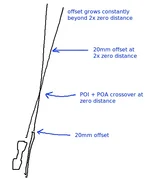
The image below considers your side mounted scope. If your zero distance is short, then the effect of proximal crossing of the POA and POI planes means that a 20mm offset on the rifle is 40mm at twice the distance beyond the zero'd distance.

I realise that would not have a practicle application for hunting or military purposes where rifles are probably zero'd at 200m. So the offset would only exceed 20mm beyond 400m. i.e. it would remain 20mm or less for all practical distances.

But it remains a consideration for those shooting at 500m or more based on a 100m zero. But...
1601008040325.webp


...the side-mounted scope is not the modern day shooter's typical challenge.


In the scenario of your second offset image, your minimal offset statement only holds true where the scope vertical hair is perpendicular to the horizon. So it requires a rotated scope mounting married to an exactly equal cant when the rifle is in the shoulder. That statement is true, but unlikely.

More likely is a small scope deviation from truly perpendicular and an unknowable and possibly variable user-applied rifle cant at the point the shot is taken. Per the OP, I am striving to eliminate the error introduced by the former to lessen the impact of the latter on POI.

A flickbook approach to your second image shows the POA and POI planar divergence. Once again, that divergence is only likely to affect longer shots, agreed, but it cannot be a constant value either.

1601012185363.webp
 
[

View attachment 175556


...the side-mounted scope is not the modern day shooter's typical challenge.


In the scenario of your second offset image, your minimal offset statement only holds true where the scope vertical hair is perpendicular to the horizon. So it requires a rotated scope mounting married to an exactly equal cant when the rifle is in the shoulder. That statement is true, but unlikely.

More likely is a small scope deviation from truly perpendicular and an unknowable and possibly variable user-applied rifle cant at the point the shot is taken. Per the OP, I am striving to eliminate the error introduced by the former to lessen the impact of the latter on POI.

A flickbook approach to your second image shows the POA and POI planar divergence. Once again, that divergence is only likely to affect longer shots, agreed, but it cannot be a constant value either.


View attachment 175557
[/QUOTE]

As above - this is the case with any scope mount! The poi will always intersect an a few points. So the scope being plumb and rifle canted should make any difference really!
 
you could in theory fire a rifle upside down or 90° to one side or the other and as long as the scope is plumb to the target and mounted to the rifle securely wouldn’t matter.

That cannot be right.

Re-cycling Alan's artwork with lines intoduced to show the only plane in which a bullet can be after it has left the barrel [red] plus the only plane in which the reticle crosshairs can move. And the bullet is falling away from the barrel axis as soon as it leaves the muzzle, so POI and POA never converge in this orientation.

1601018588530.png
 
Many older scopes were mounted to the side on the rifle - they were still able to zero them!

as long as the scope is plumb the poi adjustment is still up/down/left/right.

the rifle can be at whatever angle it wants around the 360° - a barrel is round inside so the orientation around 360 degrees doesn’t matter, regardless of if you fire it upside down gravity will still move the bullet the same way! (Down)
 
Side mount, so if the rifle was canted it shouldn’t matter.
 

Attachments

  • 382E13B1-8294-47C2-AD00-16AE1F94C431.webp
    382E13B1-8294-47C2-AD00-16AE1F94C431.webp
    22.8 KB · Views: 6
I have not been able to make myself clear or, you still do not seem to have grasped the point of me saying the offset remains parallel and constant...or notice that I said "zeroed appropriately" to achieve that.

In plan view the line of sight and the trajectory remain parallel (at 20mm in these examples) they never do cross...at the chosen zeroing distance of the elevation, the POI is set 20mm to the right of the POA. That windage offset then remains constant throughout the trajectory.

My example shows that provided the reticule is held vertical the plane of the falling bullet can only do the same...except it will be offset...

Alan
 
Last edited:
Relative to the line of the barrel the scope being offset would have an effect - but as long as it’s in line the can’t of the rifle makes no difference, I suppose the higher the mount the more offset but if you were to zero at a given distance you could hold the rifle at any angle you want and as long as the scope is level the windage and elevation changes would still track as normal. As with any zero, as you move from that distance the track will change but at zero the cant of the rifle will make no difference unless you move it off centre with the scope.
 
The last couple of pages have been about the theoretical issue of whether the scope has to be vertically above the barrel...it can be in any orientation providing the reticule is held plumb at both zeroing and subsequent firing, and the degree of horizontal offset is accounted for.

Back to the OP issue it obviously makes life so much easier to keep everything vertically in line, with the reticule aligned to bore centre. The physical and intuitive guides make it easier to hold vertical when zeroing and firing...but if the horizon or any other cue fools you into holding the reticule out of plumb, introducing cant, it will affect any configuration of barrel and scope...all bets are off.

Alan
 
Last edited:
That cannot be right.

Re-cycling Alan's artwork with lines intoduced to show the only plane in which a bullet can be after it has left the barrel [red] plus the only plane in which the reticle crosshairs can move. And the bullet is falling away from the barrel axis as soon as it leaves the muzzle, so POI and POA never converge in this orientation.

View attachment 175565
In this example, in addition to the bullet falling under the influence of gravity it would also be travelling to the right. You have to remember that the line of sight through the scope and a line taken through the bore are not parallel with one another. When the rifle is held in the normal shooting position the barrel is angled kupwards relative to the line of sight through the scope. This has to be, otherwise the two would never cross to give a zero. Tilt the rifle over, and what would have been an upward flight becomes a sideways flight. So, the red line that you have added to the diagram is not the plane in which the bullet travels, relative to the position of the scope in the diagram.

(edit: see post by @zambezi below.)
 
Last edited:
you could hold the rifle at any angle you want and as long as the scope is level the windage and elevation changes would still track as normal. As with any zero, as you move from that distance the track will change but at zero the cant of the rifle will make no difference unless you move it off centre with the scope.

Perhaps more confusion in wording?

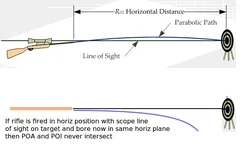
Please explain your point with reference to:

1601023457067.webp
 
  • Like
Reactions: VSS
Perhaps more confusion in wording?

Please explain your point with reference to:

View attachment 175594

if you rotated the rifle in your top pic 90 degrees left or right, the path of the round (parabolic path) would be exactly the same.

turning the rifle 90° does not mean the bullet will beer off to the side instead of dropping is what I’m trying to explain.
 
if you rotated the rifle in your top pic 90 degrees left or right, the path of the round (parabolic path) would be exactly the same.

turning the rifle 90° does not mean the bullet will beer off to the side instead of dropping is what I’m trying to explain.
No it wouldn't, because the barrel would no longer be angled upwards relative to the line of sight through the scope. It would be angled to the right (or left, depending on which way you rotate it) relative to the line of sight through the scope, so there would be no parabolic curve. The bullet would bear off to the right (or left) and fall.
 
Back
Top