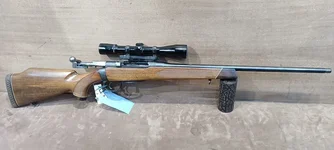
How do I zero a Lee Enfield?

The Zeroing Of Rifles (According to the REME)​


(Taken from the Précis by the Technical Training School REME)
By the term "zeroing" we mean the adjustment of the sights of a weapon so as to give the correct position of the shots on the target in relation to the point of aim.
An Armourer is always concerned with the permanent zeroing of a Rifle, which is effected by the adjustment of, or the fitting of a new blade to the Foresight. In passing it is as well to remember that a temporary adjustment for errors in elevation, can be made by altering the Backsight, e.g. if the mean point of impact (MPI) of a group of shots is below the correct position it can be corrected by raising the Backsight, similarly if an error above the correct position is obtained it can be corrected by lowering the Backlight. If the Rifle is fitted with a Windgauge Backsight, errors of deflection can be adjusted in the same way. It will be seen that in each case the Backsight is moved AWAY from the error.
On the Mk1 leaf sight - 1 click = 1 minute = 1 inch at 100 yds (approx)​
In adjusting the Foresight however, the opposite rule applies. If a Rifle is shooting low the Foresight must be moved down or TOWARDS the error (i.e. a lower blade must be fitted).
To enable Rifles to be zeroed, a moveable blade is fitted into a dovetail base, thereby allowing the blade to be moved from side to side to correct lateral errors.
The Foresight Blades are also made in varying heights so that the vertical errors can be corrected by the replacement of the existing blade by one of a different height.
There are varying sets of blades for the different types of Rifles, but on all those Rifles a blade marked "0" is provided, the tip of which when fitted to the Rifle is exactly one inch above the axis of the bore.

All other blades graduate from this "0" or zero blade either above or below it in constant increments. In the case of British Rifles this increment is .015". If a blade is lower than the zero blade it is referred to as a "minus" blade, and if it is above it becomes a "plus" blade.
All blades are marked so as to be easily recognised, those below the zero having as a prefix the minus sign e.g. —.015". The "plus" sign is not used; therefore a blade with only a figure, e.g. .015", is always a plus blade.
Sight Blades are always fitted from the Left side of the rifle and tapped out from the Right.
(Note: This was the accepted wisdom with regard to the SMLE that didn't have a split block or screw, but I have found no evidence to suggest that there is any practical reason for it other than the fact that it followed the same rule that applied to screws, which all go in from the left, and in theory it should make no difference. RW)
The Mean Sight Radius is the distance from the aperture or "U" of the Backsight to the tip of the Foresight, and this differs on the various Rifles.
Rifle No.1​
19”​
Rifle No. 4​
28.74”​
Rifle No. 5​
23.25”​

It will be appreciated that the Sight Radius governs the amount of adjustment made on the target by the fitting of a different size of blade foresight. The longer the Sight Radius the smaller will be the angle made between a line from the Backsight to the old blade and a line from the Backsight to the new blade.
To assess the difference which will be made by a change of Foresight use the following formula:—
RANGE x DIFFERENCE IN HEIGHT OF BLADES =VARIATION ON TARGET​
SIGHT RADIUS OF WEAPON
To give a simple example, assume that we are going to replace an "0" blade with a —.015" blade on a Rifle No. 4, the Sight Radius of which is 28.74" and our range is 100 yards. By fitting a LOWER blade the resultant MPI will be HIGHER by:—
100 X 36 X 0.015 = 1.87"​
28.74
As we included the figure 36 in our top line, bringing our 100 yards to inches, our answer is in inches. So that by replacing an "0" blade with a —.015" on a Rifle No. 4 we would raise our MPI by 1.87" at 100 yards.

With a Leaf Backsight fitted to a Rifle, the aperture or slide should be set at the lowest graduation, namely 200 yards. It is not however satisfactory to zero a Rifle at this range, and the ranges used are 100 yards or 25 yards. It will be seen therefore, that for the resultant MPI. to be correct, it would have to be somewhere above the point of aim, so that when actually firing at 200 yards, or at other ranges with the correct reading on the sight the shots will group AT the point of aim.
In the case of Rifle No. 4 fitted with an Mk 2 Backsight, the apertures of which are sighted for 300 and 600 yards, the Rifle will be zeroed using the 300 yard aperture with a Bayonet fixed. Therefore the correct position of the MPI at 100 yards or 25 yards would be even higher than with a leaf sight.
The small aperture Battle Sight on some Leaf Backsights manufactured by Savage Rifles is sighted for 400 yds.
Rifle​
No
of
Blades​
Lowest
Blade​
Highest
Blade​
Range​
Variation in MPI with one alteration of Blade​
Correct Position of MPI in relation to Point of Aim​
No. 1​
7​
-.06”​
.03”​
100 yds
25 yds​
2.77”
0.69”​
3” above
¾” above​
No. 3​
9​
-.015”​
.135”​
100 yds
25 yds​
1.70”
0.50”​
3” above
¾” above​
No. 4​
8​
-.03”​
.075”​
100 yds
25 yds​
1.87”
0.475”​
3” above
¾” High​
No. 4
With
MK2
Back
Sight​
8​
-.03”​
.075”​
100 yds
25 yds​
1.87”
0.475”​
6” above
1 ½” above​
No. 5​
8​
-.03”​
.075”​
100 yds
25 yds​
2.33”
0.582”​
3” above
¾” above​

Lateral adjustment will be made to the Foresight with the aid of a "Tools Foresight, Cramp." There are different patterns of these for the various Rifles, namely:—
Rifle​
Cramp​
One turn​
One Width of Blade​
25 yds​
100 yds​
25 yds​
100 yds​
No. 1No. 1 Mk 1
1.6”​
7.4”​
2”​
8”​
No. 1No. 1 Mk 2
2”​
8”​
2”​
8”​
No. 3No. 2
No Data available​
No. 4No. 3
1”​
5”​
1 ½”​
6”​
No. 5No. 4
1 ½”​
6”​
2”​
8”​


1. 2. 3. 4.

On the Cramps Nos. 1 and 2 there is a deflection scale to guide adjustment.
Each division = 4” at 100 yds, otherwise each turn = 0.040”of movement.

One complete turn of the screw cramp X Range in inches.
Sighting Radius.
Example:
Weapon Rifle No. 4
Cramp No. 3. - 25 threads per inch (1/25th)
Range 100 yds. (3600”)
Sight Radius 28.74”
= .040" X 3600" = 5.010"
28.74"
= One complete turn of the screw cramp at 100 yds.

Bet you are sorry you asked now...🤓
 

The Zeroing Of Rifles (According to the REME)​


(Taken from the Précis by the Technical Training School REME)
By the term "zeroing" we mean the adjustment of the sights of a weapon so as to give the correct position of the shots on the target in relation to the point of aim.
An Armourer is always concerned with the permanent zeroing of a Rifle, which is effected by the adjustment of, or the fitting of a new blade to the Foresight. In passing it is as well to remember that a temporary adjustment for errors in elevation, can be made by altering the Backsight, e.g. if the mean point of impact (MPI) of a group of shots is below the correct position it can be corrected by raising the Backsight, similarly if an error above the correct position is obtained it can be corrected by lowering the Backlight. If the Rifle is fitted with a Windgauge Backsight, errors of deflection can be adjusted in the same way. It will be seen that in each case the Backsight is moved AWAY from the error.
On the Mk1 leaf sight - 1 click = 1 minute = 1 inch at 100 yds (approx)​
In adjusting the Foresight however, the opposite rule applies. If a Rifle is shooting low the Foresight must be moved down or TOWARDS the error (i.e. a lower blade must be fitted).
To enable Rifles to be zeroed, a moveable blade is fitted into a dovetail base, thereby allowing the blade to be moved from side to side to correct lateral errors.
The Foresight Blades are also made in varying heights so that the vertical errors can be corrected by the replacement of the existing blade by one of a different height.
There are varying sets of blades for the different types of Rifles, but on all those Rifles a blade marked "0" is provided, the tip of which when fitted to the Rifle is exactly one inch above the axis of the bore.

All other blades graduate from this "0" or zero blade either above or below it in constant increments. In the case of British Rifles this increment is .015". If a blade is lower than the zero blade it is referred to as a "minus" blade, and if it is above it becomes a "plus" blade.
All blades are marked so as to be easily recognised, those below the zero having as a prefix the minus sign e.g. —.015". The "plus" sign is not used; therefore a blade with only a figure, e.g. .015", is always a plus blade.
Sight Blades are always fitted from the Left side of the rifle and tapped out from the Right.
(Note: This was the accepted wisdom with regard to the SMLE that didn't have a split block or screw, but I have found no evidence to suggest that there is any practical reason for it other than the fact that it followed the same rule that applied to screws, which all go in from the left, and in theory it should make no difference. RW)
The Mean Sight Radius is the distance from the aperture or "U" of the Backsight to the tip of the Foresight, and this differs on the various Rifles.
Rifle No.1​
19”​
Rifle No. 4​
28.74”​
Rifle No. 5​
23.25”​

It will be appreciated that the Sight Radius governs the amount of adjustment made on the target by the fitting of a different size of blade foresight. The longer the Sight Radius the smaller will be the angle made between a line from the Backsight to the old blade and a line from the Backsight to the new blade.
To assess the difference which will be made by a change of Foresight use the following formula:—
RANGE x DIFFERENCE IN HEIGHT OF BLADES =VARIATION ON TARGET​
SIGHT RADIUS OF WEAPON
To give a simple example, assume that we are going to replace an "0" blade with a —.015" blade on a Rifle No. 4, the Sight Radius of which is 28.74" and our range is 100 yards. By fitting a LOWER blade the resultant MPI will be HIGHER by:—
100 X 36 X 0.015 = 1.87"​
28.74
As we included the figure 36 in our top line, bringing our 100 yards to inches, our answer is in inches. So that by replacing an "0" blade with a —.015" on a Rifle No. 4 we would raise our MPI by 1.87" at 100 yards.

With a Leaf Backsight fitted to a Rifle, the aperture or slide should be set at the lowest graduation, namely 200 yards. It is not however satisfactory to zero a Rifle at this range, and the ranges used are 100 yards or 25 yards. It will be seen therefore, that for the resultant MPI. to be correct, it would have to be somewhere above the point of aim, so that when actually firing at 200 yards, or at other ranges with the correct reading on the sight the shots will group AT the point of aim.
In the case of Rifle No. 4 fitted with an Mk 2 Backsight, the apertures of which are sighted for 300 and 600 yards, the Rifle will be zeroed using the 300 yard aperture with a Bayonet fixed. Therefore the correct position of the MPI at 100 yards or 25 yards would be even higher than with a leaf sight.
The small aperture Battle Sight on some Leaf Backsights manufactured by Savage Rifles is sighted for 400 yds.
Rifle​
No
of
Blades​
Lowest
Blade​
Highest
Blade​
Range​
Variation in MPI with one alteration of Blade​
Correct Position of MPI in relation to Point of Aim​
No. 1​
7​
-.06”​
.03”​
100 yds
25 yds​
2.77”
0.69”​
3” above
¾” above​
No. 3​
9​
-.015”​
.135”​
100 yds
25 yds​
1.70”
0.50”​
3” above
¾” above​
No. 4​
8​
-.03”​
.075”​
100 yds
25 yds​
1.87”
0.475”​
3” above
¾” High​
No. 4
With
MK2
Back
Sight​
8​
-.03”​
.075”​
100 yds
25 yds​
1.87”
0.475”​
6” above
1 ½” above​
No. 5​
8​
-.03”​
.075”​
100 yds
25 yds​
2.33”
0.582”​
3” above
¾” above​

Lateral adjustment will be made to the Foresight with the aid of a "Tools Foresight, Cramp." There are different patterns of these for the various Rifles, namely:—
Rifle​
Cramp​
One turn​
One Width of Blade​
25 yds​
100 yds​
25 yds​
100 yds​
No. 1No. 1 Mk 1
1.6”​
7.4”​
2”​
8”​
No. 1No. 1 Mk 2
2”​
8”​
2”​
8”​
No. 3No. 2
No Data available​
No. 4No. 3
1”​
5”​
1 ½”​
6”​
No. 5No. 4
1 ½”​
6”​
2”​
8”​


1. 2. 3. 4.

On the Cramps Nos. 1 and 2 there is a deflection scale to guide adjustment.
Each division = 4” at 100 yds, otherwise each turn = 0.040”of movement.

One complete turn of the screw cramp X Range in inches.
Sighting Radius.
Example:
Weapon Rifle No. 4
Cramp No. 3. - 25 threads per inch (1/25th)
Range 100 yds. (3600”)
Sight Radius 28.74”
= .040" X 3600" = 5.010"
28.74"
= One complete turn of the screw cramp at 100 yds.
This is fascinating stuff - and 'zeroing' is indeed the moving of the mean POI to match the POA.

However....
If you're used to rifles that group 1" (on the SD, at least - perhaps nearer 1.5" on the range), then you can almost make an adjustment after a shot or two.

If the rifle the rifle shoots nearer 4" (or worse) groups, you could end up chasing the zero all over the target. I imagine other parts of the manual deal with how many shots to fire, the likely group-size, the 'figure of merit' of the ammunition, etc. etc.
 
Last edited:
It may be that it was originally fitted with a windage adjustable rear sight such as a Parker Hale Model 4 rear sight. These fit in place of the flip up service sight without modification.

They are quite valuable now and may have been sold separately.
 
As for the cost of firing it, if you intend to put a few rounds through it regularly, then roll your own. To keep costs down, get a Lee Loader and a soft faced hammer and see where you go from there.
 
You could put one of these on the rifle

Steel no gunsmith scope mount British Lee Enfield 303 No 4 MK 1 2 & 5​

Then fit a scope, bore sight the rifle at 50yds on a rest or sandbags. I suspect your first shot would be within six inches of your aiming point, then just adjust the scope for point of aim=point of impact.

It's a lot easier to get the bullet in the right place with a telescopic sight. I have used both but I know which I prefer at my time of life. My old eyes aren't what they used to be..!!
 
It isn't really that difficult . A basic formula will tell you exactly how far your sights will need to be moved .
X = RxE divided by D
X is the distance your sight needs to be moved in inches , vertically or horizontally
R is your sight radius in inches
E is the error in your point of impact
D is the distance to your target in inches
For example , your rifle has 20 inches between the front and rear sights and is hitting four inches low at 50 yards
R is 20 inches
E is four inches
D is 1800 inches
20 x 4 = 80
80 divided by 1800 = .0444
You would raise your rear sight , or lower your front sight by this amount . Needless to say , you will need a decent micrometer . This method will save a lot of ammo .

AB
 
As for the cost of firing it, if you intend to put a few rounds through it regularly, then roll your own. To keep costs down, get a Lee Loader and a soft faced hammer and see where you go from there.
Good idea. Although I’m confused why he even bought it if he can’t afford to zero it
 

The Zeroing Of Rifles (According to the REME)​


(Taken from the Précis by the Technical Training School REME)
By the term "zeroing" we mean the adjustment of the sights of a weapon so as to give the correct position of the shots on the target in relation to the point of aim.
An Armourer is always concerned with the permanent zeroing of a Rifle, which is effected by the adjustment of, or the fitting of a new blade to the Foresight. In passing it is as well to remember that a temporary adjustment for errors in elevation, can be made by altering the Backsight, e.g. if the mean point of impact (MPI) of a group of shots is below the correct position it can be corrected by raising the Backsight, similarly if an error above the correct position is obtained it can be corrected by lowering the Backlight. If the Rifle is fitted with a Windgauge Backsight, errors of deflection can be adjusted in the same way. It will be seen that in each case the Backsight is moved AWAY from the error.
On the Mk1 leaf sight - 1 click = 1 minute = 1 inch at 100 yds (approx)​
In adjusting the Foresight however, the opposite rule applies. If a Rifle is shooting low the Foresight must be moved down or TOWARDS the error (i.e. a lower blade must be fitted).
To enable Rifles to be zeroed, a moveable blade is fitted into a dovetail base, thereby allowing the blade to be moved from side to side to correct lateral errors.
The Foresight Blades are also made in varying heights so that the vertical errors can be corrected by the replacement of the existing blade by one of a different height.
There are varying sets of blades for the different types of Rifles, but on all those Rifles a blade marked "0" is provided, the tip of which when fitted to the Rifle is exactly one inch above the axis of the bore.

All other blades graduate from this "0" or zero blade either above or below it in constant increments. In the case of British Rifles this increment is .015". If a blade is lower than the zero blade it is referred to as a "minus" blade, and if it is above it becomes a "plus" blade.
All blades are marked so as to be easily recognised, those below the zero having as a prefix the minus sign e.g. —.015". The "plus" sign is not used; therefore a blade with only a figure, e.g. .015", is always a plus blade.
Sight Blades are always fitted from the Left side of the rifle and tapped out from the Right.
(Note: This was the accepted wisdom with regard to the SMLE that didn't have a split block or screw, but I have found no evidence to suggest that there is any practical reason for it other than the fact that it followed the same rule that applied to screws, which all go in from the left, and in theory it should make no difference. RW)
The Mean Sight Radius is the distance from the aperture or "U" of the Backsight to the tip of the Foresight, and this differs on the various Rifles.
Rifle No.1​
19”​
Rifle No. 4​
28.74”​
Rifle No. 5​
23.25”​

It will be appreciated that the Sight Radius governs the amount of adjustment made on the target by the fitting of a different size of blade foresight. The longer the Sight Radius the smaller will be the angle made between a line from the Backsight to the old blade and a line from the Backsight to the new blade.
To assess the difference which will be made by a change of Foresight use the following formula:—
RANGE x DIFFERENCE IN HEIGHT OF BLADES =VARIATION ON TARGET​
SIGHT RADIUS OF WEAPON
To give a simple example, assume that we are going to replace an "0" blade with a —.015" blade on a Rifle No. 4, the Sight Radius of which is 28.74" and our range is 100 yards. By fitting a LOWER blade the resultant MPI will be HIGHER by:—
100 X 36 X 0.015 = 1.87"​
28.74
As we included the figure 36 in our top line, bringing our 100 yards to inches, our answer is in inches. So that by replacing an "0" blade with a —.015" on a Rifle No. 4 we would raise our MPI by 1.87" at 100 yards.

With a Leaf Backsight fitted to a Rifle, the aperture or slide should be set at the lowest graduation, namely 200 yards. It is not however satisfactory to zero a Rifle at this range, and the ranges used are 100 yards or 25 yards. It will be seen therefore, that for the resultant MPI. to be correct, it would have to be somewhere above the point of aim, so that when actually firing at 200 yards, or at other ranges with the correct reading on the sight the shots will group AT the point of aim.
In the case of Rifle No. 4 fitted with an Mk 2 Backsight, the apertures of which are sighted for 300 and 600 yards, the Rifle will be zeroed using the 300 yard aperture with a Bayonet fixed. Therefore the correct position of the MPI at 100 yards or 25 yards would be even higher than with a leaf sight.
The small aperture Battle Sight on some Leaf Backsights manufactured by Savage Rifles is sighted for 400 yds.
Rifle​
No
of
Blades​
Lowest
Blade​
Highest
Blade​
Range​
Variation in MPI with one alteration of Blade​
Correct Position of MPI in relation to Point of Aim​
No. 1​
7​
-.06”​
.03”​
100 yds
25 yds​
2.77”
0.69”​
3” above
¾” above​
No. 3​
9​
-.015”​
.135”​
100 yds
25 yds​
1.70”
0.50”​
3” above
¾” above​
No. 4​
8​
-.03”​
.075”​
100 yds
25 yds​
1.87”
0.475”​
3” above
¾” High​
No. 4
With
MK2
Back
Sight​
8​
-.03”​
.075”​
100 yds
25 yds​
1.87”
0.475”​
6” above
1 ½” above​
No. 5​
8​
-.03”​
.075”​
100 yds
25 yds​
2.33”
0.582”​
3” above
¾” above​

Lateral adjustment will be made to the Foresight with the aid of a "Tools Foresight, Cramp." There are different patterns of these for the various Rifles, namely:—
Rifle​
Cramp​
One turn​
One Width of Blade​
25 yds​
100 yds​
25 yds​
100 yds​
No. 1No. 1 Mk 1
1.6”​
7.4”​
2”​
8”​
No. 1No. 1 Mk 2
2”​
8”​
2”​
8”​
No. 3No. 2
No Data available​
No. 4No. 3
1”​
5”​
1 ½”​
6”​
No. 5No. 4
1 ½”​
6”​
2”​
8”​


1. 2. 3. 4.

On the Cramps Nos. 1 and 2 there is a deflection scale to guide adjustment.
Each division = 4” at 100 yds, otherwise each turn = 0.040”of movement.

One complete turn of the screw cramp X Range in inches.
Sighting Radius.
Example:
Weapon Rifle No. 4
Cramp No. 3. - 25 threads per inch (1/25th)
Range 100 yds. (3600”)
Sight Radius 28.74”
= .040" X 3600" = 5.010"
28.74"
= One complete turn of the screw cramp at 100 yds.
This (as above)! In addition, Utube is awash with video clips on how to zero Lee Enfields. In particular, you may want to look for 'The Bloke on the Range'. He knows what he is talking about.

Jamsie
 
Go back 20 or 30 years any rifleman knew how to use and adjust iron sights. Most of us learnt with open sights on air rifles, 22s, No 4s, SLRs etc. And scopes were expensive and still not fully accepted - a little unsporting - and most older stalkers had shot many many deer with open sights and out to good ranges. A 6x42 was a powerful scope and standard fit for sniper rifles etc.

Shooting with open sights is a skill. And there is something very satisfying with shooting an open sighted rifle. And rifles didn’t have bipods, nor did you lug around shooting sticks etc. You just shot.

For those not in the know, open sights cover quite a lot of the target. Its where techinique is required. None of this perfectly steady rifle and you put crosshairs on the ticks backside. Instead as you breath the sights move up and down - on a deer, bring the foresight up the backside of the foreleg and squeeze as it gets to the body.
 
Go back 20 or 30 years any rifleman knew how to use and adjust iron sights. Most of us learnt with open sights on air rifles, 22s, No 4s, SLRs etc. And scopes were expensive and still not fully accepted - a little unsporting - and most older stalkers had shot many many deer with open sights and out to good ranges. A 6x42 was a powerful scope and standard fit for sniper rifles etc.

Shooting with open sights is a skill. And there is something very satisfying with shooting an open sighted rifle. And rifles didn’t have bipods, nor did you lug around shooting sticks etc. You just shot.

For those not in the know, open sights cover quite a lot of the target. Its where techinique is required. None of this perfectly steady rifle and you put crosshairs on the ticks backside. Instead as you breath the sights move up and down - on a deer, bring the foresight up the backside of the foreleg and squeeze as it gets to the body.
I go back 48 years @ 12 using them and 46 years using a target .22 on a range also .303 :rolleyes:
 
Why the questions about affording ammunition?

Some people struggle to keep bills paid and put a few pennies aside to take up our sport. The OP may have a young family to feed, and they come first above all else. Judging people without knowing their back ground is something we are all guilty of, including me sometimes.

Ammunition is expensive these days, one only has to look at the ridiculous cost of these gold plated copper bullets they are now flogging. Why are they so expensive, when soft point bullets must be more difficult to make I would think ?
So just because a newbie or someone is not so well off as some are on here, lets cut out the sarky comments about them affording ammunition. It is not required, or the space taken up on the site with pointless video clips :rolleyes:. Someone asked for advice and help, I am glad to see the majority have responded in a helpful manner.
 
Hey so i've just bought a sporterised .303 Lee Enfield. It's a n4 mark 1 dated 1944

It's got a 18.5" barrel

With rounds costing nearly £1 each I cant afford to bugger about.

What's the easiest way to zero it? It has a rear battle site and flip up aperture sight with distances listed to 1300 yards

The front sight is a parker hale style hooded sight (not original)

How would i go about zeroing this? Never used iron sights before in my life!
If you are down this way anytime I have quite a few spare FMJ rounds you can have to use for zeroing.
 
Why the questions about affording ammunition?

Some people struggle to keep bills paid and put a few pennies aside to take up our sport. The OP may have a young family to feed, and they come first above all else. Judging people without knowing their back ground is something we are all guilty of, including me sometimes.

Ammunition is expensive these days, one only has to look at the ridiculous cost of these gold plated copper bullets they are now flogging. Why are they so expensive, when soft point bullets must be more difficult to make I would think ?
So just because a newbie or someone is not so well off as some are on here, lets cut out the sarky comments about them affording ammunition. It is not required, or the space taken up on the site with pointless video clips :rolleyes:. Someone asked for advice and help, I am glad to see the majority have responded in a helpful manner.
Good point, well made. I bet there's a good few Enfields up and down the country in cabinets that hardly get used, except a few times before renewal to show the owner still shoots it. In fact, that's probably the case for many rifles. All waiting for the kids to become independent and allow the owner a bit more time and money to indulge. And with Enfields, if that prevents yet another one being butchered (or deactivated in legal speak) then that can't be bad.
 
Good point, well made. I bet there's a good few Enfields up and down the country in cabinets that hardly get used, except a few times before renewal to show the owner still shoots it. In fact, that's probably the case for many rifles. All waiting for the kids to become independent and allow the owner a bit more time and money to indulge. And with Enfields, if that prevents yet another one being butchered (or deactivated in legal speak) then that can't be bad.
Quite so. I have a MK4 No2 which I have used on a few occassions for stalking and also once in Africa. Great rifles and its part of my small collection that I treasure. I hope the OP gets it sorted and enjoys his Lee Enfield in the field.
 
 
@12gsnapcaps

Just fell over this old thread - I have been ordering some bits for my Enfields, so will be messing around with sights in the near future.

So a couple of questions popped into my head.

Did you ever get your rifle squared away?

Whatever happened to @TH4?

We did not always see eye-to-eye on much, but I do hope he is well.
 
Back
Top