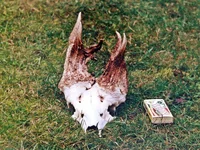
Baillie heads

Is this a better example

DSC000661.jpg


Not sure how a ballie head was given a bronze medal
More like it may of been teetering on the edge of normal-ballieism , so got the benefit of the doubt
Moose
interesting antler configuration , any more like it or is it just a one for the area

Stone,

Am I right in thinking this head ended up on the compost heap before it's significance was realised!?!

Any indication as regards area of the country shot and the year? Would it be fair to say that this represents just about the most recent 'full' ballie head recorded?

Novice
 
Stone,

Am I right in thinking this head ended up on the compost heap before it's significance was realised!?!

Any indication as regards area of the country shot and the year? Would it be fair to say that this represents just about the most recent 'full' ballie head recorded?

Novice

If those are the antlers I think they are, then the Deer was not shot but died of natural causes. The head then got run over which is why it is split in two.

It has since been repaired and mounted, I will get some pics.
 
Yep you are right Novice
But in truth no one new the value of this head and still don't
Don't think this has been recorded or not to my knowledge anyway
Pic is privvy to me and no one else
But a great example none the less
 
On a hunch (it was mention of the head having been subsequently mounted), I've just had a look in my copy of Dominic Griffith's latest book, and it looks to me like the same head has been detailed there. Am I right?!?!

Novice
 
Hi Chris. No, sorry i was talking about the one in stones pic. Do you have a copy of the book, I think they look very similar.

Novice
 
On a hunch (it was mention of the head having been subsequently mounted), I've just had a look in my copy of Dominic Griffith's latest book, and it looks to me like the same head has been detailed there. Am I right?!?!

Novice

Novice,

The head I am talking about is the RTA on page 142 of Dominic's book. the largest ever recorded roe.

I will get you some photos.
 
Thanks eggy, that would be fantastic! How sure are people that it was a victim of an rta, given the state of decomposition? It seems to me that as many animals with these characteristics are found dead as shot, so whatever causes it must be quite aggressive and shorten the animals life significantly, hence my op re repeat heads and cast antlers.

Novice
 
There are all kinds of stories regarding this head.

To be honest no one really knows what happened to it. My favourite story was someone was told they could go shoot a roe buck for the pot, when they shot it and realised what a monster it was they swiftly hid the body and walked away.

As far as I know no one ever found any cast antlers from it.
 
A couple of Baillie heads came of my ground before I took it on. I still see one of them because it's on a mates wall and it's one of the biggest ever shot. It was seen for a few years before being taken and it's believed it cast every year. I will see if he will give me permission to put a picture on here.
 
Novice

The Baillie heads affect not just the antlers but also the skull itself with a large amount of abnormal bone growth, particularly around the eye sockets, for which there is still no explanation (unless someone would care to enlighten us). As such, one would expect the consequent thickening of the antlers to occur year upon year though, as you say, it is unlikely that somone would leave such a buck once seen.

I can't recall if any cast Baillie antlers have turned up, but I'll try to have a dig through the library this evening.

BTW, there's an interesting article by Richard Prior that touches on the Baillie Monsters here: http://www.klaksholm.dk/files/Verdensrekord_i_buk.pdf

willie_gunn
I think if the eye sockets are abnormal then some sort of genetic condition causing hormonal imbalance is likely @Selous ?
 
Wow, holy thread resurrection batman!

It's been nice to read back through this, particularly to see some of the extremely knowledgeable contributors who used to be more involved on the site a decade ago or more. There used to be some great threads started around that period.

Anyway, it would be great to have some more information from Lakey on the image he's posted. From the box of matches, I'm guessing it's a few years old?
 
One of the biggest questions surrounding ballie heads is the gross thickening of the pedicles and eye sockets. Is that due to some imbalance, or is it built up naturally over time to support such massive antlers.( In other words, does the skull thickening lead to the massive antlers, or does the massive antlers lead to the skull thickening ? )
I saw a famous head shot near Cranborne in Dorset a few years ago, that had some thickening of the pedicles and eye sockets, and that had a massive head of conventional antlers (in fact I think it was put forward for the record ??). But I'm not sure that it was classed as a Baillie Monster, despite have some Ballie like traits.

The photo I posted was taken around 10-15 years ago. I borrowed the head to photograph it , and I believe it was shot in Dorset, in the Ringwood forest. It was part of a private collection at the time, which I believe has since been broken up. I have no idea where the head is now.

I found one of the photo's I took, so I thought I would post it here.

Lakey
 
One of the biggest questions surrounding ballie heads is the gross thickening of the pedicles and eye sockets. Is that due to some imbalance, or is it built up naturally over time to support such massive antlers.( In other words, does the skull thickening lead to the massive antlers, or does the massive antlers lead to the skull thickening ? )
I saw a famous head shot near Cranborne in Dorset a few years ago, that had some thickening of the pedicles and eye sockets, and that had a massive head of conventional antlers (in fact I think it was put forward for the record ??). But I'm not sure that it was classed as a Baillie Monster, despite have some Ballie like traits.

The photo I posted was taken around 10-15 years ago. I borrowed the head to photograph it , and I believe it was shot in Dorset, in the Ringwood forest. It was part of a private collection at the time, which I believe has since been broken up. I have no idea where the head is now.

I found one of the photo's I took, so I thought I would post it here.

Lakey
Many thanks for the detailed reply. Out of interest, did this head appear in one of Richard Prior's books? I'm minded he did a section on Baille heads and your image looks quite familiar.
 
Many thanks for the detailed reply. Out of interest, did this head appear in one of Richard Prior's books? I'm minded he did a section on Baille heads and your image looks quite familiar.
The head may well have featured in one of Richards Books, but not this image. That is mine only. They are very interesting heads though. That is for sure.

Lakey
 
J'ai écrit un article sur les bois malformés avec des exemples, avec l'aimable autorisation des photos des propriétaires de leurs collections ainsi que mes propres photos, et je l'ai soumis au magazine BASC Shooting. Il a été rejeté car 1 : il s'agissait uniquement d'un intérêt de niche 2 : il fallait une large couverture. Ils ont proposé de le mettre en ligne ou de me permettre d'essayer le BDS ou le Sporting Rifle. Cet article était basé sur des articles scientifiques évalués par des pairs du monde entier. Avant de le soumettre, j'ai mené une enquête auprès de mes amis harceleurs professionnels qui l'ont trouvé intéressant et instructif.
J'aimerais beaucoup recevoir votre article car nous effectuons actuellement des recherches sur les têtes de BAILLIE pour le musée : « l'odyssée du cerf »

Merci beaucoup
 
Bonjour, je suis biologiste, retraité du Centre National de Recherche Scientifique (CNRS - France), et je mène des recherches évolutives sur les cervidés du monde. Je gère également le « Conservatoire des Cervidés », qui contient plus d'un millier de crânes entiers de toutes les espèces. Avec mon collègue Dr Bernard Andries, nous travaillons actuellement sur un crâne de tête de Baillie, collecté en France. Nous souhaiterions revenir sur cette problématique non résolue des « Têtes de Baillie ». Nous recherchons toute information utile et ou documentation photographique, voire d'éventuels anciens articles parus dans vos revues. Nous avons également remarqué, sur ce forum, la question posée par Morena (1er juin 2012) qui cherchait une revue pour publier son article ! Nous serions également intéressés par cet article. De même, si vous connaissez la localisation d'un ou plusieurs spécimens, nous sommes prêts à faire le déplacement nécessaire pour effectuer les mesures. Merci d'avance pour votre soutien dans ce dossier qui mérite vraiment de refaire surface ! Dr Marc Colyn
 
Back
Top