While on the face of it the comparison seems reasonable, in fact it's not.
No, of course I don't send my best ram lambs to slaughter. That's because I'm a ram breeder. However, the vast majority of livestock farmers rear all of their male lambs (and calves) for eventual slaughter. There is no selection taking place whatsoever. When they need a new stock sire they buy one from a specialist breeder, such as myself.
As a breeder, I have tools available to me that other farmers do not have access to:
I can use ultrasound and CT scanning to assess the meat-to-bone ratio and conformation of the live animals, to ensure that only the best are kept;
I can weigh all my lambs at specific ages to assess growth rates;
I can DNA test all my lambs to ensure that parentage information is accurately recorded;
And I can use genomics to increase the accuracy of my breeding predictions. (We were the first sheep breeding project in the UK to have this capability).
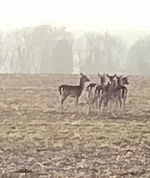
Without these "tools", the only methods available (which are also available to managers of wild deer) are phenotypical selection (very difficult when you're 100+ yards away from the animal you're trying to evaluate) or assessment of the carcass post-mortem (which is pointless unless you know the exact parentage of the animal, and are able to identify the parents).
In addition, I can manipulate the "habitat" in which my sheep live. I can use fencing to stop them straying. I can move them to another field if they're short of grass, I can ensure that the best grazing is reserved for times of year that their nutritional requirements are higher, I can buy in extra feed, etc etc. All of these things help ensure that the genetic potential of the animals is fully expressed. Deer managers cannot do this, which further contributes to the inaccuracy of phenotypical selection. Yes, you can selectively retain the ones that appear to "do" better under the circumstances in which they're existing, but without knowing the genetics it is just a shot in the dark. (For example, a fallow buck in excellent condition in the spring may be considered worthy of retaining based on appearance, whereas in reality his good condition may be as a result of having been unsuccessful during the rut, which means as a breeder he should be culled).
A few things I have picked up on as a livestock breeder, which are overlooked by deer managers are:
Success lies in ruthless selection of females. This is far more important than concentrating on the male side of things;
Where females have access to more than one sire (as is the case with wild deer, or in sheep flocks that run multiple sire mating groups), the male that you have identified as the "best" or most "dominant", and therefore assume is the sire of the majority of the offspring, often isn't;
Appearance (phenotype) and performance (genetics) and often poles apart;
About 20% of sets of twins consist of offspring by two different sires. (Twins are very common in roe, I believe?)
Environmental factors mask genetics, as does overstocking.
Something else of interest, that I read about in a study on the genetics of wild red deer, is that the vast majority of stags do not sire any offspring in their lives, regardless of how smart they look.
Also, as the owner of two herds of enclosed fallow deer, I've observed how much influence nutrition has on antler growth and development. Good genetics is not expressed without good nutrition.
Also, whereas a poor deer is unlikely to grow a good head, a good deer may well grow a poor head.
So, my "take home" messages to deer managers from all of the above are:
A lot of traditional selection based on phenotype is merely ****ing in the wind, because it's often not giving you the result that you think you're going to get;
Traditional selection methods are very slow to produce any kind of meaningful difference;
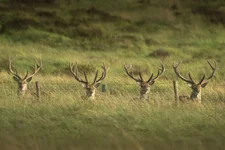
Using antlers as the principal selection criteria isn't particularly helpful;
If you want to improve the quality of the stock on your ground, concentrate on your selection of the females;
Do not assume that the "good" male that you retained will sire "good" offspring, or even any offspring at all;
First and foremost, reduce the population to a level that the habitat can sustain;
Monitor your results. (Carcass weights is the only realistic way to do this with any degree of consistency).