243 fazination???

Strange isn't it considering that the US didn't like the "overly powerful" 7.62mm NATO round that they persuaded NATO to jointly develop and then switched to the smaller, lighter recoiling 5.56mm.

Yes. That's a whole other subject, a political decision made by civilians and non-infantry. The AR-15 was downsized from its original design, the AR-10 in 7.62x51 NATO. The .308 spawned the 6mm-08, .25 Souper, .27-08, 7mm-08, and .358 Winchester, all of them really efficient rounds.
 
The main advantage was always in terms of weight and ammo per man, the thinking behind 5.56mm moving from 7.62mm was always with the ammount of ammo a single man could carry and deliver down range. Sure 7.62mm is a beast but the more rounds you fire the higher the chances of actually hitting something. Might be a bit off topis but there's a pretty blunt reason why .243 was never a choice of calibre for military sniper rifles.
 
The US Marine Corps used the Lee Navy Enfield 6mm effectively in the Spanish American War and in the Boxer Rebellion. The Lee Navy fired a 135-grain 6mm bullet at 2,469 FPS. At Cuzco Wells, a company of 225 Marines attacked an uphill defense position held for 500 Cubans and Spanish troops, and hit them with volley fire at 1,200 yards, closed to 600 yards, and shot individual targets from there.

In the Boxer Rebellion, US Marines used volley fire to knock out Chinese artillery batteries at over 1,000 yards, effectively showering the positions with the equivalent of machinegun fire. John Browning designed a machinegun for the cartridge in 1895.
 
6mm Lee, inservice from 1895 to 1899. Pretty much sums it up. Replaced by a 30 caliber.

SS
 
Bet a 50-70 with 425-450gr lead will drop, actually slap them down faster and with less damage

SS

I can't really say because I do not have a 45-70 however some Sika will run up to 200 yds with their heart lying at the point that they were shot at. All Sika I heart shot with a 170gr 30-30 just ran away, 100yds was normal even for a calf. The 160gr. Leverrevolution dropped em a bit quicker. A Sika hind is only somewhere around 5-6" wide at the heart area, many hunting bullets are a bit hard and don't expand properly or don't leave much energy in the body. 156gr Lapua mega from a 6.5x55 is another example, very slow and made for taking down Moose, distributing the energy over say 2-3ft of penetration, it possibly leaves less energy in a lightweight heart shot sika than a hornet that doesn't exit.
Everything slow and heavy seems to just punch a hole through, yes they will die 100%...but somewhere else. We just cannot afford to let them run in certain places because they would end up on another persons land in many cases we could not retrieve the deer.
The 22-250 seems to drop these lighter deer just like struck by lightning, maybe the temporary cavity upsets spine for a while...I don't know. We have seen the same with a swift and 55gr v-max for example. My 243 with a 80gr SP varmint bullet does not have the magic, never tried anything lighter.
I don't think a 22-250 or a swift is a proper deer cartridge and also see a 243 as marginal but it doesn't change that I have used the 22-250 on Sika for a while and only changed because I didn't want to push my luck.
If you read on German forums, they use the 9.3x62 quite often on Roe deer and also often complain about runners, not a slouch either with a 270gr bullet. My take, wrong bullet, wrong cartridge for roe.
edi
 
Heart shots rarely bring anything down in their tracks. Two years ago they tracked a Bison Bull over a mile on the Armendaris ranch after ti was shot through the heart by a hunter with a 338 W. Destroying the lungs does stop them short.

SS
 
I can't really say because I do not have a 45-70 however some Sika will run up to 200 yds with their heart lying at the point that they were shot at. All Sika I heart shot with a 170gr 30-30 just ran away, 100yds was normal even for a calf. The 160gr. Leverrevolution dropped em a bit quicker. A Sika hind is only somewhere around 5-6" wide at the heart area, many hunting bullets are a bit hard and don't expand properly or don't leave much energy in the body. 156gr Lapua mega from a 6.5x55 is another example, very slow and made for taking down Moose, distributing the energy over say 2-3ft of penetration, it possibly leaves less energy in a lightweight heart shot sika than a hornet that doesn't exit.
Everything slow and heavy seems to just punch a hole through, yes they will die 100%...but somewhere else. We just cannot afford to let them run in certain places because they would end up on another persons land in many cases we could not retrieve the deer.
The 22-250 seems to drop these lighter deer just like struck by lightning, maybe the temporary cavity upsets spine for a while...I don't know. We have seen the same with a swift and 55gr v-max for example. My 243 with a 80gr SP varmint bullet does not have the magic, never tried anything lighter.
I don't think a 22-250 or a swift is a proper deer cartridge and also see a 243 as marginal but it doesn't change that I have used the 22-250 on Sika for a while and only changed because I didn't want to push my luck.
If you read on German forums, they use the 9.3x62 quite often on Roe deer and also often complain about runners, not a slouch either with a 270gr bullet. My take, wrong bullet, wrong cartridge for roe.
edi

Edi,

I'm by no means trying to be a smart-ar$e, but why don't you take them with a high shoulder shot using something like a 165g partition launched at between 2800 and 3000?

I'm just thinking out loud here, because sika has a big fat layer that really slows the bullet down, doesn't do a lot to initiate expansion and create hydrostatic shock, and of course, they already carry more oxygen than their counterparts...if you take a stout or semi stout bullet with a lead core, drive it fast but use bone to initiate expansion, I think the results will speak for themselves.

I appreciate it's by no means a meat-saver of a shot choice of course...
 
There is no such thing as "hydrostatic shock". The proper term would be "hydrodynamic shock", but that does not exist, either.

Since the speed of sound in muscle and fat is around 5,000 FPS, no bullet is going to create a shock wave in any animal. Some fast bullets just blow apart and shed energy as heat and disintegraton. A bullet with enough mass, to expand barely at all and penetrate the entire animal at 1,500 to 2,400 FPS impact speed, will produce a wound 4 to 7 times its diameter, which will kill quickly.
 
Edi,

I'm by no means trying to be a smart-ar$e, but why don't you take them with a high shoulder shot using something like a 165g partition launched at between 2800 and 3000?

I'm just thinking out loud here, because sika has a big fat layer that really slows the bullet down, doesn't do a lot to initiate expansion and create hydrostatic shock, and of course, they already carry more oxygen than their counterparts...if you take a stout or semi stout bullet with a lead core, drive it fast but use bone to initiate expansion, I think the results will speak for themselves.

I appreciate it's by no means a meat-saver of a shot choice of course...

I mostly use a 168 out of a 308 for my deer in the last years and have no surprises. Because of the lighter build of the bullet I tend to go behind the shoulder if possible but just an inch or two below the spine. This normally also drops a rutting stag on the spot. Sometimes the spine is scratched, at least front legs are fine. The light build bullet also works well for the close range neck shots (we have quite high grass).
As mentioned I'd like a 243 for fox/sika that I can use all year round and get to know really well. Main Sika rifle will be a 308.
Regarding bullet type, I prefer a very soft bullet, I don't see the point in trying to hit a certain bone on going in just because I have a too hard bullet. The further away the deer the more one would need to rely on hitting a bone...just the opposite of what one wants. I rely on the bullet opening up, even when a bit out. At close range I pick the point where I want to put the bullet, away from the big bones.
The meat damage from a soft 30 cal bullet. Sika stag early rut 300m dropped on the spot because it scrapped the spine.

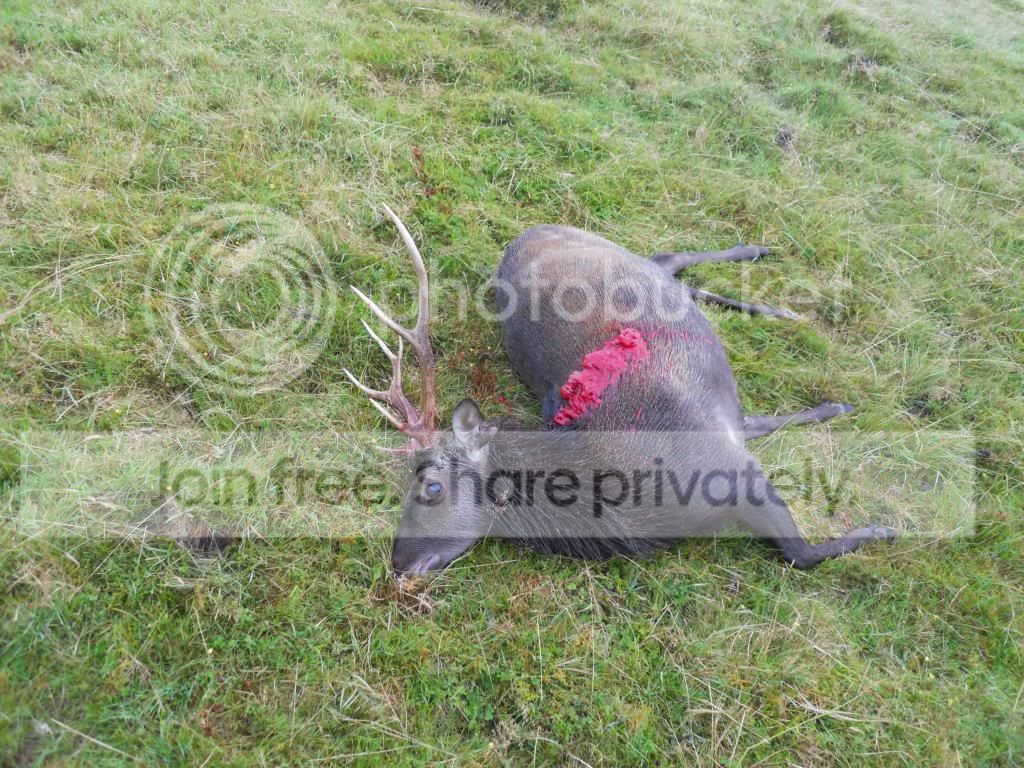
DSCN8883_zpsb371dd90.jpg


DSCN8880_zps6c544ccc.jpg


Marcbo, I understand and that is normally the case however try a 22-250/swift or similar on lighter deer with 50-55gr bullets. I used 52gr Nos CM bullets that dropped a couple hundred fox and a few deer on the spot with heart or heart lung shots. Furthest deer was 180m. As I said before I don't think the light bullet is the right choice long term and can get one in trouble if angles are different etc.


edi
 
Similar shot placement with an 80gr 243 at 260m. Sika hind also dropped on the spot. Meat damage was not too bad.
edi

DSCN6554_zps1c6d30b8.jpg
 
There is no such thing as "hydrostatic shock". The proper term would be "hydrodynamic shock", but that does not exist, either.

Since the speed of sound in muscle and fat is around 5,000 FPS, no bullet is going to create a shock wave in any animal. Some fast bullets just blow apart and shed energy as heat and disintegraton. A bullet with enough mass, to expand barely at all and penetrate the entire animal at 1,500 to 2,400 FPS impact speed, will produce a wound 4 to 7 times its diameter, which will kill quickly.

I could be wrong, but my understanding is that shock is easily created by sending energy, not through fat or muscle, but through the bone such as ribs, which travels swiftly up to the CNS and makes the animal collapse instantly.
 
Just breaking a bone will send you, or an animal into physical shock, which is a medical condition.

I am talking about the mythical notion many hunters have of some shock wave going through the tissue, from back in the Roy Weatherby era.
 
Just breaking a bone will send you, or an animal into physical shock, which is a medical condition.

I am talking about the mythical notion many hunters have of some shock wave going through the tissue, from back in the Roy Weatherby era.

personally I have done quite a bit of reading into the theory of hydrostatic shock..here's the obvious google summary of recent theories for those interested Hydrostatic shock - Wikipedia, the free encyclopedia

FWIW, I genuinely believe HS Shock to be perfectly feasible, especially if linked to the heart beat cycle and at which point in the cycle the bullet strikes.
 
I could show a picture of a rabbit that was shot with a 223 and exploded, a picture of a rabbit that was shot with a 308 165gr sst...also exploded.
I guarantee that their is some sort of pressure on the inside of an animal when a high velocity round hits...no matter what you call it. One can also see it in the slow mo pictures when gelatine is hit. I call it the temporary cavity, if the outside cannot take the stretch...things burst, like the small rabbit.
want to see pictures???
edi
 
There is a pressure area around a bullet, the boundary layer, just as there is around an automobile speeding down the highway. If you shoot a bullet into modeling clay, a block of potters clay, or ballistic gelatin, even at a speed like 1,300 fps, which will not expand a RN jacketed bullet, you will get a hole more than an inch in diameter, for maybe 20 inches. In gelatin, this will close back up. You will only see it with high speed motion pictures or a flash at the right instant.

When a high velocity bullet like a .243 or .223 breaks up, part of it melts and explodes, and it also turns water into vapor, like steam, for an instant, to destructive effect. When a high speed cannot projectile of spent uranium and tungsten carbide hits a army tank, the mechanical energy converts to heat and melts the steel, so you have 20 pounds of molten and fragmented steel flying around the tank cabin at 2,000 fps.
 
The average munt jac dead weight is 8-12 kg and roe 15-22 kg that makes the 243 the prefect round for these deer in mind ,with the caperbility of fallow red and sika to boot case rested .o i love that post from bukaroo8 probably very ture in a lot off cases

Laugh as you will but like I said in the follow-up post: men buy them for women but I didn't say these women killed anything with them. I know it's a good cartridge for the UK but it's a little too little for the area that I live in and the very large deer that populate it.

All that said, there is always an exception. My girl friend grew up on a very rural ranch and had a 6mm Remington for her only rifle. She killed 5 elk with it between 100 and 200 yards. Hard to argue with success.~Muir
 
Last Saturday my kids attended their final training and exam for their hunting license. As part of the training the instructors performed a couple of demonstrations to illustrate the damage that can be done with various cartridges. In one of the demonstrations they shot a one gallon paint can that was filled with water and sealed. The masonary block was used as a base. On top of the block they placed a 1/4" thick steel plate and on top of that a large commemorative coin. The can was placed over the the coin. The instructor using a 223, shot the can with a 62gr HP. The erupted separating into three parts, lid, side wall and bottom. The bottom was blown so hard against the plate that it actucally had the impriint og the coin design pressed into it. I believe that was hydralic effect, aka hydrostatic shock.

SS
 
Last Saturday my kids attended their final training and exam for their hunting license. As part of the training the instructors performed a couple of demonstrations to illustrate the damage that can be done with various cartridges. In one of the demonstrations they shot a one gallon paint can that was filled with water and sealed. The masonary block was used as a base. On top of the block they placed a 1/4" thick steel plate and on top of that a large commemorative coin. The can was placed over the the coin. The instructor using a 223, shot the can with a 62gr HP. The erupted separating into three parts, lid, side wall and bottom. The bottom was blown so hard against the plate that it actucally had the impriint og the coin design pressed into it. I believe that was hydralic effect, aka hydrostatic shock.

SS

I would also call it an hydraulic scenario. With a very stretchy bottle it might have not burst, just like larger animals keep the outer shell in tact vs a rabbit for example. I try to explain the hydrostatic shock to myself a being caused by the huge acceleration speeds that happen and although we might call it a temporary cavity it might actually be permanent damage to the fibres and cells in that area due to inertia of mass after being accelerated so fast.
This evening I shot a fox at around 200yds, was a quick shot as the fox was on the move in high grass. The fox dropped in the high grass and about 5-10 seconds later hurtled through the air , once... and that was that. Maybe an area recovered from the shock before being bled out???
Later I shot two fox that we nicely lined up with on shot. 80gr 243 has enough grunt for that at 200yds. I didn't pick em up and didn't see the shot placement.
edi
 
Back
Top