24 day isolation for household close contacts. You ,I together we can eliminate the virus based on the best NZ medical advice.
What outstanding leadership. It would make Fair Hill proud they have stuck to their guns and through 24 day isolation will eliminate the virus showing the world how its done.
I do sympathise.
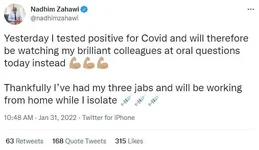
In England, now, basically if you think you might have it, take a diy lateral flow antigen test.
If it's negative, crack on.
If its positive, you've almost certainly got it. No need for any other testing now, don't bother getting a PCR test (which could identify the variant, but we're not really interested about that it seems, at the moment, it will almost certainly be Omicron). This is now the govt. advice, i.e. don't bother going for a PCR test.
Isolate for ten days. Or less if you pass two diy lateral flow tests two days in a row, starting five days after your positive one, or when you first noticed symptoms, whichever came first. Could be out again on day six. But, as I said, you could still be testing positive for a week, before it clears.
If you have been in "close contact" with someone who has it, don't worry. If you have had at least two vaccinations, crack on.
From Feb. 11, provided you are vaxxed, you may leave and return to the UK without any testing or isolation. Destination countries of course may have more stringent requirements.
Stay at home: guidance for households with possible or confirmed coronavirus (COVID-19) infection
1. What has changed
The self-isolation advice for people with coronavirus (COVID-19) has changed. I
t is now possible to end self-isolation after 5 full days if you have 2 negative LFD tests taken on consecutive days. The first LFD test should not be taken before the fifth day after your symptoms started (or the day your test was taken if you did not have symptoms). The self-isolation period remains 10 full days for those without negative results from 2 LFD tests taken a day apart.
4. What is meant by a contact
A contact is a person who has been close to someone who has tested positive for COVID-19. You can be a contact any time from 2 days before the person who tested positive developed their symptoms (or, if they did not have any symptoms, from 2 days before the date their positive test was taken) and up to 10 days after – as this is when they can pass the infection on to others. A risk assessment may be undertaken to determine this, but a contact can be:
anyone who lives in the same household as another person who has COVID-19 symptoms or has tested positive for COVID-19
anyone who has had any of the following types of contact with someone who has tested positive for COVID-19:
face-to-face contact including being coughed on or having a face-to-face conversation within one metre
been within one metre for one minute or longer without face-to-face contact
been within 2 metres of someone for more than 15 minutes (either as a one-off contact, or added up together over one day)
A person may also be a close contact if they have travelled in the same vehicle or plane as a person who has tested positive for COVID-19.
5. What to do if you are a contact of someone who has tested positive for COVID-19
If you are informed by NHS Test and Trace that you are a contact of someone who has had a positive LFD or PCR test result for COVID-19,
you are legally required to stay at home and self-isolate unless you meet one of the following conditions:
you are fully vaccinated. Fully vaccinated means you have had 2 doses of an approved vaccine such as Pfizer BioNTech, AstraZeneca or Spikevax (formerly Moderna); you are also fully vaccinated if you have had one dose of the single-dose Janssen vaccine
you are aged under 18 years old
you have taken part in or are currently part of an approved COVID-19 vaccine trial
you are not able to get vaccinated for medical reasons
If you are not legally required to self-isolate, follow the guidance below for contacts who are not required to self-isolate.
You may also be informed by the NHS Test and Trace app that you are a contact of someone who has had a positive LFD or PCR test result for COVID-19.
In this case you should follow the advice provided within the app.
Changes to international travel rules from 11 February 2022
If you arrive in England after 4am, 11 February, the following rules will apply.
Fully vaccinated – from 11 February
If you qualify as fully vaccinated for travel to England, you:
will not need to take a COVID-19 test before you travel to England or after you arrive
will not need to quarantine when you arrive
The Health Protection (Coronavirus, Restrictions) (Self-Isolation) (England) Regulations 2020
Offences
11.—(1) A person who contravenes a requirement in regulations 2, 7, 8 or 9 without reasonable excuse commits an offence.
(2)
A person who contravenes a requirement to self-isolate under regulation 2 without reasonable excuse and in doing so—
(a)has reason to believe they will come into close contact with another person or group;
(b)does then come into close contact with another person or group;
(c)is reckless as to the consequences of that close contact for the health of that other person or group;
commits an offence.
Of course, if you are not fully vaccinated, all of these things are more onerous. And this is England only, so far.