Help analysing OCW data please.

For me, & this is me just saying what I’ve found has worked for me over the years & I'm by no means a statistician or reloading guru, your increments are way too course.

I find the optimum barrel time for the length of barrel & then use QuickLoad to identify the powder weight that gets me the closest to that time.

I then load five rounds each starting at that powder weight and going up & down two steps at 0.1gn increments.

I’ve not done non lead bullets yet but with traditional cup & core I load one batch at 10 thou off the lands & then a second batch at 20 thou off the lands. So in total I have 50 rounds loaded. It sounds a lot. You,ve just shot 21 rounds - so only 4 less than my first batch at 10 thou jump, & don’t have a clear idea of where you go next.

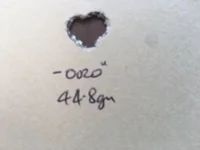
Using this method I worked up the following load for an AI AT in one sitting - I’d shot the rounds with 10 thou jump & had found a good load in that at under 0.5moa so nearly didn’t bother to shoot the other 25 & was going to go home & pull them. However, I decided I should really see how they shot if only to see just how ‘tolerant’ the barrel was. I was pleased I did as the little hole below is 5 rounds of .308W loaded with a Sierra 2155 bullet.

Incidentally for load testing I keep the target simple - rows of 15mm black patches on the back of a large pistol/gallery target which I find make a simple clean aiming mark. I then stick a couple of minutes of elevation on the scope so the bullets don’t hit the aiming mark but instead leave it clear for the next shot to be aimed.
IMG_1888.webp


I’ll be developing a load for my 308 using Sako 162gn Powerhead blade but won’t be bothering with jump initial, I’ll just load to factory length & do a test based on powder weights as above. The fun will come when I do the development for the 6.5x47 as there’s no factory ammo to use as a starting point!
 
That's very good shooting built on a foundation of some very good brass prep and reloading. My personal pick would be 62.0 as it's fast but not too warm a load, but anything below 62.0 will also work very well. Clearly you have a quality rifle and scope.

Well done.

JCS
 
3000fps seems very moderate for a 127gr 6.5SAUM
22” barrel?

Shouldnt be hitting pressure with 62gr H1000 either

Personally I would start with the 61gr load and not be too excited about 20thou jump
You will get better concentricity loading to a length that suits the bands on the shank

Try RS70
 
3000fps seems very moderate for a 127gr 6.5SAUM
22” barrel?

Shouldnt be hitting pressure with 62gr H1000 either

Personally I would start with the 61gr load and not be too excited about 20thou jump
You will get better concentricity loading to a length that suits the bands on the shank

Try RS70
Yes it definitely moderate but 62.5 is getting hot and a full case too.
If the accuracy is there I’m happy with 3000fps from a 22” barrel. Plus I have a ton of H1000😀
Definitely not hung up on the current seating depth just 20thou is when I always start from. So when I come to do seating depth test I can move both directions. Though I won’t go closer than 10 thou off jam.
RS70 would be my next choice 👍🏽
 
That's very good shooting built on a foundation of some very good brass prep and reloading. My personal pick would be 62.0 as it's fast but not too warm a load, but anything below 62.0 will also work very well. Clearly you have a quality rifle and scope.

Well done.

JCS
Thanks 🤙🏽
 
Yes it definitely moderate but 62.5 is getting hot and a full case too.
If the accuracy is there I’m happy with 3000fps from a 22” barrel. Plus I have a ton of H1000😀
Definitely not hung up on the current seating depth just 20thou is when I always start from. So when I come to do seating depth test I can move both directions. Though I won’t go closer than 10 thou off jam.
RS70 would be my next choice 👍🏽
Not closer
Further away
Seat deeper

Monolithics like Barnes respond better to jump
 
When people start talking about nodes and fliers I know that we are in delusion land. As has been pointed out monoliths like a decent jump (40-120thou) and then pick a load you like and go for it. I’m afraid all the testing you have done proves exactly nothing and you would have learnt as much drinking coffee.
 
When people start talking about nodes and fliers I know that we are in delusion land. As has been pointed out monoliths like a decent jump (40-120thou) and then pick a load you like and go for it. I’m afraid all the testing you have done proves exactly nothing and you would have learnt as much drinking coffee.
I appreciate you probably have considerably more experience than I do.
If you feel I’m wasting my time and ammunition, would you be able to provide something constructive as to a better way to go about based on your experience?
 
  • Like
Reactions: JTO
pretty flat in there, apart from the flyer

View attachment 427296
Thought i'd throw this into the mix :)
Just run his data through P-Max and the 62.1gr load gives Node 5 on the OBT chart. This matches the 62 on your chart above. He's not recorded the COL on the target but -using monoliths- seating back further from the lands should tighten the group, in theory.
 
Last edited:
Right- here you go. The following are simulated data using parameters derived from the raw data presented in the first post. So the intercept, slope and residual variance are the same. Each set is created using RANDOMLY DRAWN velocities from distributions with the same variation as the real data.

What should be clear is:
(1) the patterns look identical to the real data - sometimes the velocities cluster at a given charge, sometimes they don't. Apparent fliers just happen.
(2) every single run contains apparent 'flat spots' that you might be tempted to consider as velocity nodes. They are not real - they are statistical artefacts.

What is the conclusion? I'd say it's cause for great optimism: it means that there is absolutely no need to worry at all, or bother with any further testing. If you want speed, pick the fastest safe load. If you want low recoil, pick the lowest velocity that will still give you good terminal performance.

charges.webp
 
or alternatively we could start looking to answer the OP's question and help him with the OCW method of assessment rather than velocities, my bad, i drifted into the Saterlee method at post #6.


the BE Precision method is 3 x 3 shot groups, near max book and just above, always seems to work for me. just pick the smallest raggy hole
 
or alternatively we could start looking to answer the OP's question and help him with the OCW method of assessment rather than velocities, my bad, i drifted into the Saterlee method at post #6.


the BE Precision method is 3 x 3 shot groups, near max book and just above, always seems to work for me. just pick the smallest raggy hole
My last couple of loads were literally a certain amount under max loaded to OAL for the bullet in that cartridge according to the manufacturer. Groups were ok so loaded fifty of each. My longer range rifles I load by percentage for weight increase and look for what I consider good groups I quite often split the difference between two and load that weight. Seems to work ok for me. Is it statistically correct no idea, but it suits me.
 
or alternatively we could start looking to answer the OP's question and help him with the OCW method of assessment rather than velocities, my bad, i drifted into the Saterlee method at post #6.

You could not come up with a set of instructions better designed to chase statistical artefacts if you tried...
 
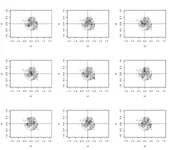
And if we're concentrating on groups... below are nine 3-shot groups (in red), all drawn at random from a single 100-shot group (in grey). The 100 shot group was simulated to represent a 1MOA gun, defined as one where 95% of shots fell within a 1" circle. Points to note:

1. 'Fliers' are to be expected - look at target 6 (far right middle row) for example.
2. Apparent patterns emerge that you might be tempted to ascribe to a systematic relationship with the charge. For instance, you could easily convince yourself that target 4 (far left, middle row) was the 'best', and it looks like a progression from target 1 to target 4, with steadily improving group size.

The take home is that if you did your load development and saw a pattern as represented by the red shots, you'd be tempted to make decisions based on it, when in fact the groups are completely uninformative. Well - other than telling you that the rig overall shoots well.

groups.webp
 
Back
Top