

Absolutely.Reading the above in some detail I conclude folk really need to get out more
I do the stats so people realise they can just bang powder in a case and go shoot

Absolutely.Reading the above in some detail I conclude folk really need to get out more

no, they must start low and work up!Absolutely.
I do the stats so people realise they can just bang powder in a case and go shoot

Absolutely pick a good gun (you have). Pick good powder primers and bullets and pick a desired velocity load that is safe. Make up 10 rounds (with copper a 60-120thou jump is good lead stick to sammi spec) and check if they shoot well (under 1 moa) and show no pressure signs and that’s it…. move on with your life. If they shoot terribly and it’s not a fault of gun or gunner then change bullets or powder or primer in that order.I appreciate you probably have considerably more experience than I do.
If you feel I’m wasting my time and ammunition, would you be able to provide something constructive as to a better way to go about based on your experience?

Thanks very much, Mongo,Right- here you go. The following are simulated data using parameters derived from the raw data presented in the first post. So the intercept, slope and residual variance are the same. Each set is created using RANDOMLY DRAWN velocities from distributions with the same variation as the real data.
What should be clear is:
(1) the patterns look identical to the real data - sometimes the velocities cluster at a given charge, sometimes they don't. Apparent fliers just happen.
(2) every single run contains apparent 'flat spots' that you might be tempted to consider as velocity nodes. They are not real - they are statistical artefacts.
What is the conclusion? I'd say it's cause for great optimism: it means that there is absolutely no need to worry at all, or bother with any further testing. If you want speed, pick the fastest safe load. If you want low recoil, pick the lowest velocity that will still give you good terminal performance.
View attachment 427528
Thank you.or alternatively we could start looking to answer the OP's question and help him with the OCW method of assessment rather than velocities, my bad, i drifted into the Saterlee method at post #6.
the BE Precision method is 3 x 3 shot groups, near max book and just above, always seems to work for me. just pick the smallest raggy hole
Sorry - absolutely.no, they must start low and work up!
Thanks for taking the time.Thought i'd throw this into the mix
Just run his data through P-Max and the 62.1gr load gives Node 5 on the OBT chart. This matches the 62 on your chart above. He's not recorded the COL on the target but -using monoliths- seating back further from the lands should tighten the group, in theory.


Great.PMax is a program (free) created by Geoff Kolbe of BBT (Scotland) that is a very accurate and invaluable tool (to me ) for giving a very accurate prediction of pressure for load development
I’ve used it since inception and it rarely is less than a few fps off reality
As others have said - all the loads are good starters with nothing to take away other than the rifle shoots
Personally I’d pick load two and use that with possibly some seating depth variation
LTS usually perform best .050” off the lands if not further
You may also see a reduction in pressure allowing you to test larger powder charges (should you wish to pursue VO (your choice)
Last point - listen to Mungo - he’s right
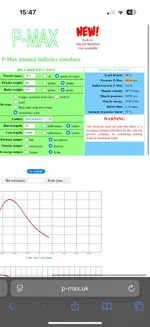
I see you've already found it and it's the only version, you don't need anything more. It isn't 100% accurate but it's certainly good enough to save wasting £100 on a tub of unsuitable powder, or blowing 5gr of unburnt powder out the muzzle every shotThanks for taking the time.
I don’t fully understand what you’ve said?
I’m not familiar with Pmax
 .
.
Great.
I have just found a basic free version. I’m assuming there’s a much more in-depth version of it available?
Velocity predictions are considerably lower with H 1000 then I’m getting currently unless I’ve done something wrong!
View attachment 427558
That’s where I’m going wrong then I’ve always thought it was H2O capacity of a empty fired case to top of neckThat’s the only version and you get best results from measuring accurately H2O weight with seated bullet of choice
Empty case and weigh add has via primer pocket and re weigh that gives you powder weight
I’ve found it to be pretty much non on with in a few fps using RS powders

Normal people don’t read the reloading section… or if they do, they only have themselves blame.I appreciate to some people this is probably the most boring thread on the whole forum.
However, personally, I’m finding it fascinating and potentially learning a lot.
That’s where I’m going wrong then I’ve always thought it was H2O capacity of a empty fired case to top of neck
No, as Ronin says. Empty unprimed case. Seat bullet add a little bit of blue tack and weigh. Use a syringe (Amazon) and fill through flash hole with water. Plug with blue tack and weigh. This will give you the UCC (Usable Case Capacity) which you input to P-Max.That’s where I’m going wrong then I’ve always thought it was H2O capacity of a empty fired case to top of neck

I appreciate to some people this is probably the most boring thread on the whole forum.
However, personally, I’m finding it fascinating and potentially learning a lot.

Descended from that famous IrishwomanAnd if the reloading section happened to be the only one I regularly peruse - what does this say about me…


