
You are using an out of date browser. It may not display this or other websites correctly.
You should upgrade or use an alternative browser.
You should upgrade or use an alternative browser.
If you were to start again...


A carp workman blames his tool. Sorry, I mean tools!
In starting with less than RR grade kit your reloading apprenticeship will be more meaningful and ultimately more rewarding.
I didn't purchase Lee when starting out simply because I prefer the colour green!
K
In starting with less than RR grade kit your reloading apprenticeship will be more meaningful and ultimately more rewarding.
I didn't purchase Lee when starting out simply because I prefer the colour green!
K

Cawdor118
Well-Known Member
On that basis... Which set is blue?A carp workman blames his tool. Sorry, I mean tools!
In starting with less than RR grade kit your reloading apprenticeship will be more meaningful and ultimately more rewarding.
I didn't purchase Lee when starting out simply because I prefer the colour green!
K

Dillon?On that basis... Which set is blue?

Odders
Well-Known Member
Lee Red
Redding Sickly green
Lyman Orange/gunmetal
Dillon Blue
RCBS Proper green
Hornady Red
Forster Red
MEC Black
I still have a real hankering for a Hornady L-N-L progressive for loading handgun ammunition when over the Pond but I can produce 200 rds/hr using an RCBS Junior & a hand primer, plus I'm one o' they odd buggers who actually likes handloading.
Redding Sickly green
Lyman Orange/gunmetal
Dillon Blue
RCBS Proper green
Hornady Red
Forster Red
MEC Black
I still have a real hankering for a Hornady L-N-L progressive for loading handgun ammunition when over the Pond but I can produce 200 rds/hr using an RCBS Junior & a hand primer, plus I'm one o' they odd buggers who actually likes handloading.

LeftHandGuy
Well-Known Member
I use mostly Lee kit and it is mostly fine.
If I was starting again I would buy a Lee Classic Cast press. I have the Classic Cast Breechlock, and it's a great press, but I have come to the conclusion that quick change bushings in a press are unnecessary. On the Lee presses they get you around the crappy Lee lock-rings. A much better solution is a cross bolt lock ring like the Hornady type (I did see Lee are now making their own, but I haven't seen these in the flesh).
Alternatively, I'd look for a Wamadet press (really really regret not buying one from @Colonel on here) or maybe get the RCBS Summit press. For the simplicity of being able to mount it to a smallish lump of wood and have a full press that didn't have to be bolted down. and can be set up anywhere you have a flat surface.
I have no real problem with Lee dies, and they generally represent a decent saving over other brands. Even if you wanted to factor in a Lock-ring upgrade for them. The one exception to this is Hornady bullet seating dies, for some chamberings like 375 H&H they keep the bullet better aligned and avoid bulged case necks (which I did get from the Lee BSD). They are much easier to get a stuck case from than most other brands!
Imperial sizing wax is a great lube, but I basically only use it now if I'm converting one type of brass to another. Hornady one-shot is much faster and promises not to negatively effect powder. For the amount of time I get spend reloading (not enough!) it's worth the modest expense.
Again, if starting again I wouldn't buy a Lyman Pro beam balance scale. Plastic base and badly drawn markings. It works OK, and it agrees with my older Redding No 1 Oil Damped scale (and the Lee beam balance which I also have), but for the money, buy the Redding No 2 and be done with it. I'd buy a powder trickler with a metal base. I have a Lyman one and whilst it works as advertised, it's just too easy to jog the bloody thing. Much too lightweight.
I'm almost tempted to say I'd just buy the set of Lee scoops and abandon scales altogether. You certainly could load quite safely that way, especially if you have the Lee reloading manual and use their conversion charts. I use the dippers that come with the Lee dies to scoop powder into the scale pan anyway, and I'm sure a lot of other people do the same.
Broadly speaking I have found Lyman branded stuff (haven't used their presses or dies to be fair) to be fairly high in price and relatively low in quality.
I firmly believe that no one company makes the best version of everything you will need, and some manufacturers simply don't make a complete range. Lee for example don't make any sort of bullet puller (a crucial piece of kit IMHO), or powder trickler.
I also have a Frankford Arsenal wet stainless tumbler, and whilst its results are excellent, I've come to the conclusion that case cleaning is mostly pointless. It's been well over a year since I've used it, and it'll probably be another year before I bother with it again!
Had I the same money again I'd have bought an RCBS summit press for the convenience of mounting, and a big bag of Hornady lock-rings. And the Redding no2 beam balance scale.
If I was starting again I would buy a Lee Classic Cast press. I have the Classic Cast Breechlock, and it's a great press, but I have come to the conclusion that quick change bushings in a press are unnecessary. On the Lee presses they get you around the crappy Lee lock-rings. A much better solution is a cross bolt lock ring like the Hornady type (I did see Lee are now making their own, but I haven't seen these in the flesh).
Alternatively, I'd look for a Wamadet press (really really regret not buying one from @Colonel on here) or maybe get the RCBS Summit press. For the simplicity of being able to mount it to a smallish lump of wood and have a full press that didn't have to be bolted down. and can be set up anywhere you have a flat surface.
I have no real problem with Lee dies, and they generally represent a decent saving over other brands. Even if you wanted to factor in a Lock-ring upgrade for them. The one exception to this is Hornady bullet seating dies, for some chamberings like 375 H&H they keep the bullet better aligned and avoid bulged case necks (which I did get from the Lee BSD). They are much easier to get a stuck case from than most other brands!
Imperial sizing wax is a great lube, but I basically only use it now if I'm converting one type of brass to another. Hornady one-shot is much faster and promises not to negatively effect powder. For the amount of time I get spend reloading (not enough!) it's worth the modest expense.
Again, if starting again I wouldn't buy a Lyman Pro beam balance scale. Plastic base and badly drawn markings. It works OK, and it agrees with my older Redding No 1 Oil Damped scale (and the Lee beam balance which I also have), but for the money, buy the Redding No 2 and be done with it. I'd buy a powder trickler with a metal base. I have a Lyman one and whilst it works as advertised, it's just too easy to jog the bloody thing. Much too lightweight.
I'm almost tempted to say I'd just buy the set of Lee scoops and abandon scales altogether. You certainly could load quite safely that way, especially if you have the Lee reloading manual and use their conversion charts. I use the dippers that come with the Lee dies to scoop powder into the scale pan anyway, and I'm sure a lot of other people do the same.
Broadly speaking I have found Lyman branded stuff (haven't used their presses or dies to be fair) to be fairly high in price and relatively low in quality.
I firmly believe that no one company makes the best version of everything you will need, and some manufacturers simply don't make a complete range. Lee for example don't make any sort of bullet puller (a crucial piece of kit IMHO), or powder trickler.
I also have a Frankford Arsenal wet stainless tumbler, and whilst its results are excellent, I've come to the conclusion that case cleaning is mostly pointless. It's been well over a year since I've used it, and it'll probably be another year before I bother with it again!
Had I the same money again I'd have bought an RCBS summit press for the convenience of mounting, and a big bag of Hornady lock-rings. And the Redding no2 beam balance scale.
I use mostly Lee kit and it is mostly fine.
...
I firmly believe that no one company makes the best version of everything you will need, and some manufacturers simply don't make a complete range. Lee for example don't make any sort of bullet puller (a crucial piece of kit IMHO), or powder trickler.
I too am a fan of Lee kit.
It's what I started out with, just a hand press kit, a pair of dies, and a full set of scoops. Plus the manual.
It made lots of excellent ammunition, and still can, just as well as ever, having been looked after. Just with basic cleaning and lubrication.. Some might look at it and sneer at the nutcracker, how could that possibly be any good ? However it really is. And AFAIK no other manufacturer is making a hand press nowadays, no point trying to improve on the Lee, or compete on price, and selling such good value things is not good business if you can convince people that your expensive heavy things made of cast iron are required to even get started. Just not true.
But it is mostly just used nowadays at the range, for load development, seating depth adjustments specifically.
An interesting perspective on Lee is at Lee Precision Reloading Equipment | Titan Reloading | Lee Distributor
"Every Lee product must always pass the Lee three question tests:
1. Does it fill a real need or is it better than any other product available?
2. Can it be produced at an affordable price?
3. Would I buy one?
A yes to all three is required before Lee will introduce a product."
So I suspect the reason that they don't offer a bullet puller, is that they have pretty much been perfected already. Either kinetic hammer, or a collet press die like the Hornady. If they could design a better, or more affordable one, or saw it as being worth worthwhile to using their finite resources to develop, rather than other things, I daresay they would have considered it.
But really you don't need either. Put round into press, no die fitted, raise ram until bullet pokes through the top, grasp bullet with e.g. the round bit in the jaws of a pair of pliers, suitably padded (strip of leather, rubber etc.) Lower ram bracing pliers against top of press, out pops bullet, undamaged if you haven't been too brutal holding the pliers. Or just throw it away if mangled. The other pullers can damage bullets too, maybe not so obviously, so I always treat a pulled bullet as second best, reserved for uncritical things, and try to minimise the need to use it.
I subsequently bought the Lee Classic Cast four hole turret press, having previously been using the (heavily used) original three hole pistol design in my club's reloading room, and recognised the many improvements. I like it very much, and the ability to keep one, or two, sets of dies ready and set up in a turret, which only cost about £12 each, is tremendous. No need to buy alternative lockrings for the turret, once set up and nipped down the standard issue aluminium ones with the o-ring do stay in place. Sure there are better lock rings available, but not actually necessary in a turret press
The original single stage Classic Cast is also a great bit of kit, but I think far more than I would ever really use. I don't need something big enough to handle .50 BMG. The latest ones by the way now come with a big die/small die adaptor that incorporates a breech lock thread.
Which is also offered in two different threads as a separate part, to be fitted to other makes of press, or to upgrade the original Classic Cast, in direct competition with the Hornady Lock n Load system.
You don't have to use it, just leave the breech lock bushing in place and use it as a standard screw in die press. The choice is yours.
As to which system is superior I wouldn't know, but it does give options, choice,competition and a way to run a mixed setup all using one standard. Unlike the Hornady arrangement where you must have presses capable of taking one of the big die sizes for the LnL adaptor. Which automatically means that they must be big expensive presses.
Whereas with the Lee setup you can have breech locks in everything from a hand press, to a C frame, to a Challenger, a Classic Cast, a turret, a progressive, other makes with one of the big thread adaptors, doubtless more ideas in future.
TBH I think Lee were copy-catting Hornady, which is unusual for them. But thought more about the possibilities.
There is another dedicated breechlock Classic Cast version which appears to be a value engineered design, doesn't eject the primers through the inside of the ram, won't take large dies, etc. Yet costs the same. Basically a scaled up version of the aluminium Challenger. I wouldn't choose that one.
When I was offered a Challenger breechlock single stage press at a very good price, below trade (cancelled order at local dealer), I thought I'd give it a go, to see whether I could get any better results than from the turret press, not that I doubted it, but some do, who maybe haven't understood how well and predictably the turrets lock up in use. And have found it to be really good.
No, it is not over-built, like a brick sh..house, and other competing products, where massive over-engineering seems to be a selling point, or extreme durability is valued by those who it seems reload by the thousands, or tens of thousands per year but I think it is a very decent little press, nicely judged, and if you do decide that reloading might not be for you will sell on, and you won't lose much in the experience.
And very useful to have around, complementing the big iron turret job. It is screwed to a bit of plywood which is then clamped to my reloading bench (Workmate) when required, otherwise goes back in the cupboard afterwards and is lightweight.
Not that I have used the breechlock system, if I wanted all my dies equipped with them I'd need to spend a lot of money. Besides I still prefer the turret setup, so the dies mostly stay in a set of turrets, ready to go.
However it would be no hardship to only have the Breechlock Challenger, particularly if only loading for a small number of calibres.
Scales, well I am a complete convert to digital. Inexpensive ones that resolve to one milligram, which I have tested carefully and found to be good. Not the overpriced and not necessary as good ones from the big name USA reloading companies. Combined with scoops or Lee Perfect thrower, though frankly I suspect that, once having calibrated the thrower, or the scoops, with the scales (to check that the VMDs published by Lee, or for an undocumented powder), actually weighing individual charges is getting into diminishing returns for many.
It's certainly not how factory ammo is made. Nor how some top bench resters do it. Volumetric only, and the Lee throwers are I think pretty good, not that I have any experience with the more expensive makes.
Also an RCBS trickler (weighty aluminium, further improved by filling the cavity in the base with molten lead).
I can quickly throw charges to within 0.02 grains resolution (i.e. 0.4 grains variation, not necessarily accuracy, though my scales are well inside this window), which I think is comparable with good beam scales and more than good enough. And I now have more confidence in the digital ones, having tested them extensively, and have a simple calibration and drift check routine that rarely throws up any need to adjust during a session, or between sessions. Whereas I have found beam scales to be finnicky, even fragile, slow to use, giving their best in an environment closer to a calibration laboratory than a temporary reloading area, such as my spare room, where things have to be packed away afterwards in a cupboard.
For case trimming the Lee cutter, lockstud, length gauge and shellholder just works, is foolproof, needs no adjustments, and great value, can be automated with e.g. a battery drill or screwdriver. Besides, I do not think that it is an essential step for every reload. Start off trimming with it to the nominal trim-to length, then just keep on eye on the cases thereafter, and don't worry overmuch until they are approaching the maximum, then cut them back again.
If you are batching your reloads, as you should, they won't vary too badly within the batch.
Likewise case cleaning. Lots of ideas, techniques and expensive kit available, but I've come to the conclusion that it doesn't make a lot of difference to results, I managed without a tumbler all the while I was using the hand press, just span up the cases in the lockstud, gave the outsides a rub over, usually with just slightly damp green kitchen scourer, then a worn out bore brush down the inside neck.
Or got them really shiny with a little metal polish, Solvol, Peek etc, on a rag. Still I bought a traditional dry media tumbler later (the ultrasonic and wet steel pin methods hadn't yet appeared back then). A noisy, dusty slow thing, best suited to using in say a garage, which I didn't have then. But it certainly works. Quite expensive too I thought at the time, for a plastic bowl with a cheap looking little motor screwed onto the bottom, spinning an offset weight. Hasn't failed though.
So I would advise to start simply, start by learning the basics, don't think that throwing money at kit will necessarily make for any better results, and I don't think that there are actually any really poor presses on the market nowadays. Certainly there is a spectrum of products, including stuff that could probably outlast the original owner, loading thousands or more rounds per year, or even used commercially, but I'm not sure that is particularly relevant to many of us in the UK.
We don't all need a US muscle car with a big block V8 For many something like e.g. a Ford Focus or Fiesta is a wiser, and better, choice. And the money saved, in these increasingly hard times, put to better use.
Last edited:
You overlooked Corbin - Bronze/BrownLee Red
Redding Sickly green
Lyman Orange/gunmetal
Dillon Blue
RCBS Proper green
Hornady Red
Forster Red
MEC Black
I still have a real hankering for a Hornady L-N-L progressive for loading handgun ammunition when over the Pond but I can produce 200 rds/hr using an RCBS Junior & a hand primer, plus I'm one o' they odd buggers who actually likes handloading.

K

Corbin is very expensive and not at all necessary for reloading IMHO. Great for swaging and when I did this as a living I used Corbin equipment. It was sold by me to Fred Clarke of Empire Arms in the late 1980s. I wonder what happened to it all. There was the press and swaging dies for .455 Webley and .380 Enfield. This isn't mine but it was this model.

Last edited:

8x57
Distinguished Member
No just trying to forget all Corbins, especially the red variety.

Buying reloading gear is like filling a glass of water. At some point you are satisfied with the amount. I have spent a decent percentage of my discretionary funds (shooting budget) on reloading gear and started with the crudest of equipment: hand made sizing dies. Seating bullets using a bench vise.... Anything to make a loaded cartridge. As my needs changed, my equipment changed. I have friends who use only the Lee Classic Loader kits and couldn't be happier. There is no good, no bad. Just useful or not.
I'll still give a like new Hornady Concentricity gauge to any SD member who knocks on my door and asks for it.~Muir
I'll still give a like new Hornady Concentricity gauge to any SD member who knocks on my door and asks for it.~Muir
Cawdor118
Well-Known Member
Buying reloading gear is like filling a glass of water. At some point you are satisfied with the amount. I have spent a decent percentage of my discretionary funds (shooting budget) on reloading gear and started with the crudest of equipment: hand made sizing dies. Seating bullets using a bench vise.... Anything to make a loaded cartridge. As my needs changed, my equipment changed. I have friends who use only the Lee Classic Loader kits and couldn't be happier. There is no good, no bad. Just useful or not.
I'll still give a like new Hornady Concentricity gauge to any SD member who knocks on my door and asks for it.~Muir
Someone might just rock up at your ranch yet!

Its a more user-friendly peice of kit if mounted on a raised and angled base. But I know what you mean.I'll still give a like new Hornady Concentricity gauge to any SD member who knocks on my door and asks for it.~Muir
K

Neddle
Well-Known Member
Buy once, cry onceLee single stage press
Forster dies
Lyman scales and case press tools
LE wilson case trimmer

dropmdead
Well-Known Member
If starting again, I would reconsider my caliber choice first to have an "all rounder" with aftermarket barrel.
With this in mind I would choose the following -
LE Wilson seating die
K&M press
Sizing die cut with the reamer
Rcbs primer seater.
K & M case prep tools
LE Wilson case trimmer
Rcbs chargemaster
And for **** taking, an amp annealer.
I choose the above due to the ease of use and setting up, but more importantly the repeatability time after time.
I'm not far away from this list, but certainly don't have an amp annealer.
With this in mind I would choose the following -
LE Wilson seating die
K&M press
Sizing die cut with the reamer
Rcbs primer seater.
K & M case prep tools
LE Wilson case trimmer
Rcbs chargemaster
And for **** taking, an amp annealer.
I choose the above due to the ease of use and setting up, but more importantly the repeatability time after time.
I'm not far away from this list, but certainly don't have an amp annealer.
LeftHandGuy
Well-Known Member
I too am a fan of Lee kit.
It's what I started out with, just a hand press kit, a pair of dies, and a full set of scoops. Plus the manual.
...
@Sharpie that's a great post, most of which I basically agree with although I would say one of the main things I use a bullet puller (kinetic type) is for when I've overseated a bullet. I don't tap it all the way out, just enough that I can get back to correct OAL. I also don't care about deforming the tip of a softpoint. I have literally nowhere I can shoot over 200 yards, the kinetic bullet puller I use has never deformed a tip any more than some of them come out of the box anyway, and makes no identifiable difference to POI, so I don't consider them to be second rate after banging them out with the green hammer! (no disrespect to anyone who thinks differently on this, just my experience, I'm sure if you're banging steel between 500-1,500 yards the picture is different). Actually the puller I bought second hand, and the previous owner had put a big foam cushion in the end of it, and it's never damaged the bullets. Before I had that I have used pliers and strips of old inner-tube for the same job, and it worked, but ruined the bullet. For my bench at least, it's a "need" not a "want".
I also think you're slightly mistaken about the Classic Cast presses. The basic Classic Cast (which I wish I'd bought instead of the Breechlock version) has the large threads cut directly into the press that would accept 50BMG size dies, but comes with the "standard" size bushing installed. The Breechloack version has the breechlock threads and release button cut into the press. Yes you can just use one breechlock bushing and use the whole assembly like a "normal" press (it feels "mushy" when you do this though). Unfortunately for me I'd bought a whole load of breechlock bushings before I decided they were inferior to just using a better lock ring. I also thought about the turreted route, which would also have been a better option.
I do also have a Breechlock Challenger press that someone at work sold me for peanuts as part of a mixed box of reloading hardware he didn't need. I've used it depriming pistol brass and seating bullets. It's fine and would do all my realoading except maybe the 375H&H (although I haven't tested this to be fair and it might fit). It might even give it to my neighbor to encourage him to take up reloading.
Don't get me wrong, the breechlock system works fine, I just don't think it adds any real advantage, and I would side-step it if starting again.
I think of lot of products in the reloading sphere are over-engineered for no significant benefit to the end user, and you can make very accurate ammo without spending a kings ransom.
I also think you're slightly mistaken about the Classic Cast presses. The basic Classic Cast (which I wish I'd bought instead of the Breechlock version) has the large threads cut directly into the press that would accept 50BMG size dies, but comes with the "standard" size bushing installed. The Breechloack version has the breechlock threads and release button cut into the press. Yes you can just use one breechlock bushing and use the whole assembly like a "normal" press (it feels "mushy" when you do this though). Unfortunately for me I'd bought a whole load of breechlock bushings before I decided they were inferior to just using a better lock ring. I also thought about the turreted route, which would also have been a better option.
As I said, Lee updated the original Classic Cast this year. It is no longer supplied with the plain screw thread adaptor, but instead one that converts from the large die thread, to a breechlock. The press itself is the same.
You can buy the plain threaded adaptor as a spare part, but it doesn't come a standard now. $10. Though I suppose there may be plenty of the original versions in distribution, so worth checking which model you get if considering it.
Explained here:
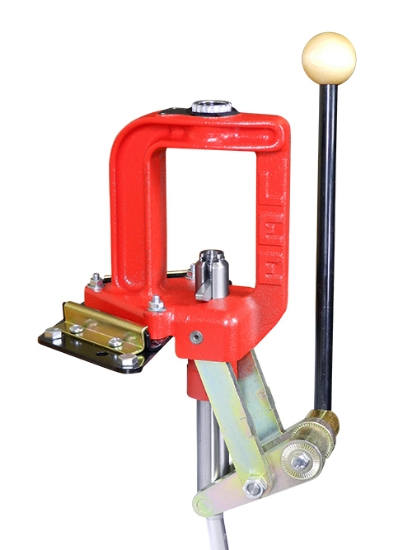
Classic Cast
The largest opening in the industry and the longest stroke -- yet handle is adjustable to provide the least travel of any press. Rigid cast iron construction in a classic @O@ design for maximum strength.
New for 2020! Now includes Breech Lock Bushing update kit.
...
The original Classic Cast designed to work with large series 1 1/4-12 dies. Includes breech lock quick change adapter and breech lock bushing to accept standard 7/8-14 dies.
The original Breechlock Classic Cast is this one:

Lee Precision the Innovative Leader in Reloading Equipment
Lee Precision, the nation's number one manufacturer of reloading equipment for over 50 years presents its full inventory of quality products. Complete with photos, prices, and descriptions. The Lee Precision web site features a company History section, an order form, and a searchable database of...
If you study the photos you'll see it has a different frame and linkage, different spent primer tube, (doesn't send them down the inside of the ram), and to me looks like a value-engineered thing , more like a scaled up Challenger, and lacks the flexibility of the original.
Since they are both listed at identical price, $190, to me it would be a no-brainer to always choose the original.
I think that Lee are really trying to push the breechlock system, perhaps because once you are locked into it there might be good profit from selling more bushings. E.g for hole turrets cost $15, whereas two of the latest breech lock bushings cost $16. Or a pack of four is $25.
LeftHandGuy
Well-Known Member
Ah I didn’t realize they’d added a breechlock bushing to the original Classic Cast. My mistake. Yes the Breechlock only version is the one I have. Annoyingly!
Similar threads

- Replies
- 7
- Views
- 735


- Replies
- 107
- Views
- 11K
- Replies
- 25
- Views
- 3K


