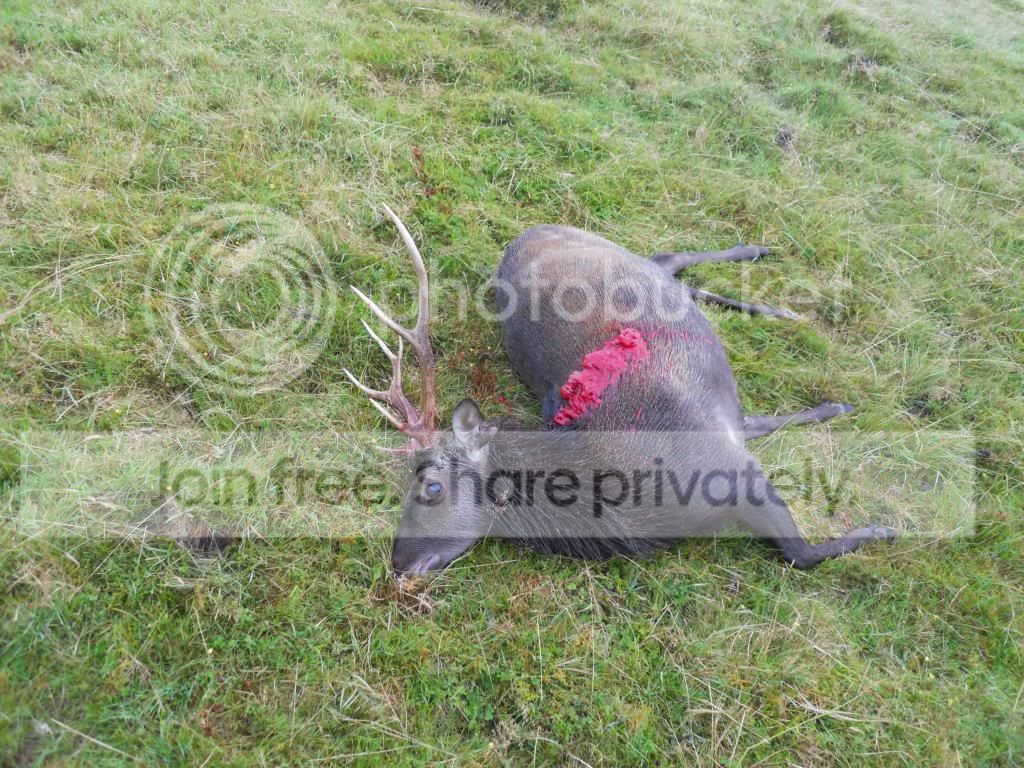
Sika stags final run.....

stalker.308

Well-Known Member
I am not one to trawl Youtube looking for anything deer related, but did stumble upon this, skip ahead to the shot at 3:50 and then the sikas run. I have seen a lot of deer shot and then run, but nothing like the fight in this chap, he is still moving a minute later after a bloody good run. The fight to keep his head up when he is stood still is incredible. I know they are tough beasties and I am sure a lot of the SD will say this is nothing, but it is a fascinating piece of footage of the sheer determination of a sika stag and I am not surprised after seeing that on the problems when they get into forestry.

 
Great example mate of the resilience in these amazing animals..

Ive seen a mate shoot one with a 30-06 perfect placement heart shot it still made near 400m.

On gralloching nothing but a load of soup for a heart.

Totally awesome and my favourite to stalk.
 
Tough animals for sure my longest runner with sika he made 150 + yds into cover which made it a pretty hard retrieve I got him ok but I no longer heart shoot, it's through both shoulders nowadays and so far ( I say so far with my fingers crossed you just never know ) they don't go very far.
 
Tough animals for sure my longest runner with sika he made 150 + yds into cover which made it a pretty hard retrieve I got him ok but I no longer heart shoot, it's through both shoulders nowadays and so far ( I say so far with my fingers crossed you just never know ) they don't go very far.

Where do you aim to hit them for a shoulder shot? Do you aim as for a heart shot but a little higher or do you come a little further forward as well?

I shot a sika hind through both shoulders in the snow last year. Both legs were well broken and I couldn't drag her out by them once I'd found her. The snow was a major factor in my shooting her in the location I did, beside some very thick replanting, as I knew I could track her but couldn't believe that she made 30 yards with no front legs. She died under a 10ish year old sitka and even with the snow I walked past several times before I finally managed to spot her, she'd got right in under the lower branches and was invisible. If it hadn't of been for the snow I'd almost certainly have walked past her and spent the time searching further and further into the replanting and odds are that I'd never have found her.

 
It seems the word shoulder shot is used to indicate a spinal shot at the top of the shoulders which then puts them on the floor but not usually dead. I have no problem with the shot just the terminology, as shoulder shot to me indicates heart and lungs.....
 
Where do you aim to hit them for a shoulder shot? Do you aim as for a heart shot but a little higher or do you come a little further forward as well.?


I have no problem with the shot just the terminology, as shoulder shot to me indicates heart and lungs.....[/QUOTE]

The following description by Timbo61 sums it up perfectly.


I have not shot enough Deer to make an informed opinion, so am still on the fence so to speak. I came accross the following on another forum and reckon it is pretty well put;;;

To get a quick, clean kill you need to disrupt the central nervous system such that functions essential for life are shut down, or you need to cause rapid bleeding such that the central nervous system is denied blood and functions essential for life are shut down.

The quickest way to achieve neural disruption is a brain shot BUT the brain in a deer (or coyote for that matter) is not a large target and is highly mobile. A misjudgement in aim or if the deer moves its head as the shot is taken or while the bullet is in flight and you will most probably inflict a horribly mutilating injury which will allow the animal to escape and will cause a long slow death for the animal. Most people aim in the wrong place for a brain shot with deer ... the aim point is ABOVE the eyes and should only be attempted at short range by a rifleman who is very confident about his ability to place his bullet accurately in the correct location.

A neck shot will allow for a greater range in bullet trajetory and is therefore better as a longer range target. Shock from the bullet will be transferred to the central nervous system through bone and cerebral spinal fluid and will result in instant coma, during which essential functions such as breathing and heart regulation will cease ...... the deer will never recover its conciousness (i.e Dead Right There).

The other target area is the front area of the lungs. This portion of the lungs is richly supplied with blood. If a bullet passes through the front portion of the lungs it not only destroys lung tissue essential for oxygenating blood, it ruptures arteries which, together with the animals efforts to breathe, fill the lungs with blood. The animal both suffocates because the blood stops air from getting into the lungs and bleeds out because the blood is being pumped by the heart into the lungs. Blood pressure rapidly drops, blood is no longer supplied to the brain, the animal looses conciousness and dies rapidly (within 30 yards of where it was hit).

Do not make the mistake of thinking a heart shot will kill an animal quickly. If you make a perfect heart shot and destroy the heart completely, there will be some lung damage but minimal bleeding into the lungs. The brain will still have a supply of oxygen, the muscles will still have a supply of energy, the animal will bolt without leaving a blood trail (no blood pumping remember) and it will be able to cover upwards of 100 yards or more before the central nervous system fails. 100 yards in heavy cover with no blood trail can mean a lost animal ...... dead, but the hunter may never be able to find it.

The hilar zone (the front part of the lungs, the major arteries feeding the lungs and a plexus of nerves supplying the lungs and heart) is in the lower front chest area protected to a large degree by the shoulder joint. A shot into this area can achieve disruption of the locomotor system (break one or both shoulders), rapid bleeding assisted by blood pressure and breathing action, suffocation by blood displacing the air in the lungs and preventing any air from entering the lungs, and some neural disruption to the vital cardio-pulmonary system. This is a very safe target zone which will always result in a rapid death
.

A shot which ruptures an artery such as the femoral will result in death, BUT, arteries are flexible and resistant, to a degree, to pressure (they have to be to handle blood under pressure form the heart). A direct or nearly direct hit on the artery is essential to guarantee arterial bleeding. The artery is a small target with nothing to distinguish its location externally. In the time it takes the animal to bleed out via a femoral arterial bleed it may well have travelled a considerable distance. I refer you to a book by Matt and Bruce Grant* where Matt Grant relays:

Quote


The above mentioned shot I have been using to great effect thus far (crossed fingers) you aim for the scapula follow a line up the front leg to a point midway up the chest, and let go, try to get try to get the animal as square as possible to get maximum damage to the internal organs, there should be no damage to the legs if done correctly, report back if you give this shot a try and let us know your findings....D



 
Imo pinning it through the shoulders is just that and would be used where the animal is reasonably close to a border where no permission to retrieve or fractious relationship with neighbour means under no circumstances do you want it running, or you have no access to a dog..

I guess as said dependant on placement there is a possibility of spinal or heart lung trauma.. But to me the shoulder shot is further forward than heart lung.

When ive done and seen this used the animal is followed up quickly and bled out having had its shoulders smashed its down.

You don't want this turning into a head/neck shot thread but I always choose to neck shoot them and as yet have not had a runner where as with heart lung they usually have a will to make good ground hitting the wood/hedge line or completely disappear in thick cover.
 
Imo pinning it through the shoulders is just that and would be used where the animal is reasonably close to a border where no permission to retrieve or fractious relationship with neighbour means under no circumstances do you want it running, or you have no access to a dog..

I guess as said dependant on placement there is a possibility of spinal or heart lung trauma.. But to me the shoulder shot is further forward than heart lung.

When ive done and seen this used the animal is followed up quickly and bled out having had its shoulders smashed its down.

You don't want this turning into a head/neck shot thread but I always choose to neck shoot them and as yet have not had a runner where as with heart lung they usually have a will to make good ground hitting the wood/hedge line or completely disappear in thick cover.

Agreed but if done correctly it provides a balance between the two with an animal on the ground and that does not go far or so we try our very best to achieve.
 
Diz90

I guess the quote you use regarding the damage to the lungs would work if someone had remembered to tell the deer.

I find some generalisations very hard to take when personal experience is more often in contention with the experts opinion. This link I have attached was to a thread I put on primarily for those interested in tracking with dogs however, it highlights just what resilience a Sika stag has. This is not a one off although a beast with such a wound would not normally travel as far as on this occasion, but as another quick example (And I have literally dozens) last year I shot a large stag with a 150grn SST and when I gralloched it there were no lungs left, literally, as the bullet had exploded in the chest. That stag ran about 150yds. For someone to say that by damaging the frontal area of the lungs means a run of about 30m is just not accurate in the slightest. In fact I would go as far as saying not accurate 90% of the time.

another issue sue I have is when we refer to head shots and how small a target area we have. Wrong. The target area is far greater than the size of the brain as the trauma caused to the brain with any bullet of appropriate construction, with even a shot that is slightly off but still connects with bone in the skull, in my experience causes instant death.

Another opinion I have is relating to shoulder shots or 'pinning deer'. The front shoulders of a deer are not joints as such and are of a completely different construction to say a hip joint which is clearly ball and socket. The shoulder is no more than a bone plate held in place with muscle and tissue. A bullet may well go through the shoulder and not leave it completely inoperable. I don't care what the experts say. I have seen deer shot through both shoulders still managing to make off. I don't know how, but I guess they differ from you and me because they don't know just how serious the injury is and the shock factor instead of causing you and me to collapse screaming, tells the deer to get out of there.

Track On Sika Stag
 
Last edited:
My favourite is high lung just behind the shoulder. Just below or scraping the spine. Animals drop on the spot, bleed out and have very little blood splash.
This stag didn't take a step. I find Sika hinds almost tougher than stags.
edi
DSCN8880_zps6c544ccc.jpg
 
Last edited:
Agreed but if done correctly it provides a balance between the two with an animal on the ground and that does not go far or so we try our very best to achieve.

:tiphat: I would add, that I only neck shoot Sika.... Red and Fallow would all be heart lung where possible
 
Diz90

I guess the quote you use regarding the damage to the lungs would work if someone had remembered to tell the deer.

I find some generalisations very hard to take when personal experience is more often in contention with the experts opinion. This link I have attached was to a thread I put on primarily for those interested in tracking with dogs however, it highlights just what resilience a Sika stag has. This is not a one off although a beast with such a wound would not normally travel as far as on this occasion, but as another quick example (And I have literally dozens) last year I shot a large stag with a 150grn SST and when I gralloched it there were no lungs left, literally, as the bullet had exploded in the chest. That stag ran about 150yds. For someone to say that by damaging the frontal area of the lungs means a run of about 30m is just not accurate in the slightest. In fact I would go as far as saying not accurate 90% of the time.

another issue sue I have is when we refer to head shots and how small a target area we have. Wrong. The target area is far greater than the size of the brain as the trauma caused to the brain with any bullet of appropriate construction, with even a shot that is slightly off but still connects with bone in the skull, in my experience causes instant death.

Another opinion I have is relating to shoulder shots or 'pinning deer'. The front shoulders of a deer are not joints as such and are of a completely different construction to say a hip joint which is clearly ball and socket. The shoulder is no more than a bone plate held in place with muscle and tissue. A bullet may well go through the shoulder and not leave it completely inoperable. I don't care what the experts say. I have seen deer shot through both shoulders still managing to make off. I don't know how, but I guess they differ from you and me because they don't know just how serious the injury is and the shock factor instead of causing you and me to collapse screaming, tells the deer to get out of there.

Track On Sika Stag

As said above I think the generalisations mentioned are not what I have personally experienced
 
Diz90

I guess the quote you use regarding the damage to the lungs would work if someone had remembered to tell the deer.

I find some generalisations very hard to take when personal experience is more often in contention with the experts opinion. This link I have attached was to a thread I put on primarily for those interested in tracking with dogs however, it highlights just what resilience a Sika stag has. This is not a one off although a beast with such a wound would not normally travel as far as on this occasion, but as another quick example (And I have literally dozens) last year I shot a large stag with a 150grn SST and when I gralloched it there were no lungs left, literally, as the bullet had exploded in the chest. That stag ran about 150yds. For someone to say that by damaging the frontal area of the lungs means a run of about 30m is just not accurate in the slightest. In fact I would go as far as saying not accurate 90% of the time.

another issue sue I have is when we refer to head shots and how small a target area we have. Wrong. The target area is far greater than the size of the brain as the trauma caused to the brain with any bullet of appropriate construction, with even a shot that is slightly off but still connects with bone in the skull, in my experience causes instant death.

Another opinion I have is relating to shoulder shots or 'pinning deer'. The front shoulders of a deer are not joints as such and are of a completely different construction to say a hip joint which is clearly ball and socket. The shoulder is no more than a bone plate held in place with muscle and tissue. A bullet may well go through the shoulder and not leave it completely inoperable. I don't care what the experts say. I have seen deer shot through both shoulders still managing to make off. I don't know how, but I guess they differ from you and me because they don't know just how serious the injury is and the shock factor instead of causing you and me to collapse screaming, tells the deer to get out of there.

Track On Sika Stag


That was some read jamross and just goes to show you just never really know what may happen after the shot ( I guess that's why I keep my fingers crossed lol ) The head and neck are deadly and I do use them and as you say the experts do cause quite a lot of contention with their pontification, though I have had success with the aforementioned shot I realise it's not the holy grail of shots, and no matter when I shoot or whatever shot placement I may use I will always keep my fingers crossed....thanks for the input buddy it's much appreciated....D
 
That was some read jamross and just goes to show you just never really know what may happen after the shot ( I guess that's why I keep my fingers crossed lol ) The head and neck are deadly and I do use them and as you say the experts do cause quite a lot of contention with their pontification, though I have had success with the aforementioned shot I realise it's not the holy grail of shots, and no matter when I shoot or whatever shot placement I may use I will always keep my fingers crossed....thanks for the input buddy it's much appreciated....D

:thumb:

Im a great believer in basing what we do on experience and not just what others tell us. Each to their own mate! :D
 
My own personal order of preference for shooting sika is head, neck, shoulders. Like Brian I don't care what others tell me I base this preference on experience, what works for other deer does just not seem to work on Sika, stags or hinds, with any consistency.

John
 
Diz90
The shoulder is no more than a bone plate held in place with muscle and tissue. A bullet may well go through the shoulder and not leave it completely inoperable. I don't care what the experts say. I have seen deer shot through both shoulders still managing to make off.

That is my position as well - it seems like a great idea and sometimes, maybe more times than not, it might work well.

My concern with the shoulder shot is that it may not be a fatal shot, at least not in the short term, and so if you did get a runner you are going to leave an injured deer wandering around. If you had put the bullet through the normal heart/lungs then this will be fatal and while you might never find the deer the one thing you can be sure of is that it is dead.

I've slowly come to the conclusion that the most humane and sensible shot to take on sika in forestry, especially when you can't have a dog as is my case, is a neck shot with them either looking directly towards or away from you. The chances of a non-fatal injury are small, the chances of an injured runner are almost zero and the chances of recovering the meat are very high indeed. I also think the chest shot is very humane but you need to accept that although there is a very high chance of the deer being dead within a short time after the shot there is also a very real chance that you might never find it.

Linford Christie can run 100 yards in 10 seconds. If a deer lives for 30 seconds after the shot, and may have run up to 300 yards, that gives you about 282743 square yards to search, often with visibility such that you can't see your feet, and it you figure on a replanted tree for every 5 square yards then you have 56548 trees to look under!!
 
Another opinion I have is relating to shoulder shots or 'pinning deer'. The front shoulders of a deer are not joints as such and are of a completely different construction to say a hip joint which is clearly ball and socket. The shoulder is no more than a bone plate held in place with muscle and tissue. A bullet may well go through the shoulder and not leave it completely inoperable.

I reckon it is more to do with collateral damage rather than just mechanical incapacitation of the front legs... a shot in that area also has a good chance of pulling bone through, large expansion, damaging the aorta, the lungs and also delivering a shock to the spine.... any damage to the actual front legs and/or paralysis via the spine are going to hinder it whilst the blood pressure drops away and thus you'd hope it would be less likely to run. It's a hedging all bets shot I guess.

Agree about generalisations though. It would be wrong to say "do this shot because it WILL run less". Maybe it would be more accurate for someone to say "do this shot because it is less likely to run... in my experience"

As we know though, there are infinite permutations as to what can happen when a bullet strikes and therefore we will all have observed different results, had different experiences and therefore formed different opinions.

Alex
 
Back
Top