
You are using an out of date browser. It may not display this or other websites correctly.
You should upgrade or use an alternative browser.
You should upgrade or use an alternative browser.
Overview of the Reloading Process - From Spent Case to Loaded Round

Well done sir, the only thing I do before cleaning is I use a universal decap die then tumble clean. Priming is done with a hand tool for far better feel. My inside neck chamfer is done with a 28 degree vld carbide tool ran in the drill. Nice note's too.This is intended as an overview of the reloading process explaining the steps required to turn spent brass cases into new loaded rounds. It is aimed at those people who are unfamiliar with the reloading process but if any old hands want to chip in with alternative suggestions then please do - I have only been reloading a year or so myself and there is always more to learn!
The article assumes we have the load data for the load we want and doesn't go into any detail about deciding what that load should be, the seating depth etc. That can be for another article!
So, we have 50 used cases and I'd like to take them and reload them to the following spec:
Calibre: .30-06
Powder: 58.4 grains of H4350
Bullet: 150 grain Speer Boat Tail Soft Point
Cases: Once fired Lapua brass
Note: This load was safely worked up from minimum in my rifle - this does not mean it would be safe in your rifle! Always work up from minimum loads!
First our fired brass goes into the tumbler with crushed walnut shell as the media with a powdered polishing compound. Typically I'd leave them going in there for up to 24 hours depending on how badly tarnished and fouled they were. The purpose of cleaning the brass is so that any imperfections such as cracks or splits show up better. Dirt on the cases will also reduce the life of your resizing die as it will cause additional wear between the brass and the surface of the die. Oh and shiny brass looks nice.

After the tumbling cycle the brass should come out looking a lot cleaner. At this stage I give them a quick shake in an old towel to take off any dust from the outside and they are ready to be de-capped and re-sized.

We need to resize the case because the pressure caused by firing will have expanded the case out to fit the inside dimensions of the chamber of the rifle. The neck will also have expanded and a bullet will not sit snugly in it any more. If the loaded rounds are going to be used in the same rifle and we don't mind a tight fit in the chamber we can opt to just resize the neck of the case. However, in this instance we are going to resize the full length of the case to make loading and unloading the rifle easier.
A small amount of lubricant is applied to the inside of the neck...

...and also to the outside of the case by rolling on a pad. All that is required is a thin film, just enough to make the case feel slightly greasy. This is to reduce friction between the brass and the die as it's forced back to size.

It is important not to use too much lubricant because it can build up inside the resizing die and become trapped. The result is a hydraulic dent on the shoulder of the case like the .243 case below. This case will pop back out on the next firing so long as the dent is shallow. You would also need to open up the die and clean out the excess lubricant to stop it happening again.

At the same time as resizing the die will also push out the old primer from the case.

The lubricated case is placed in a shell holder on the press and is raised up into the resizer die.

A pin in the die pushes out the old primer at the same time.

And now our case is resized and the old primer has been removed.

The next task is to check the length of the case and trim it back if required. Firing and resizing also has the effect of stretching the brass and over time it will become longer. The trimming tool below is set to the standard length for .30-06 and if the case is over length the cutter will trim excess material off from around the rim of the neck.

This is a fixed length tool however adjustable ones are also available. For a hunting cartridge I find trimming with a fixed length tool a lot less hassle, although the downside will be that you will have a slight variation in case length as some cases will be under-size from the factory. The case is held in a shell holder and can be spun using a cordless drill.

If any material is removed from the neck there will be a sharp edge left and possibly some burrs. The rotating tool below removes any burrs from the outside of the neck.

And the tool below removes the same from the inside of the neck.

A tiny chamfer is left on the inside of the neck which helps with bullet seating.

While we are at it we clean out the soot from the primer pocket so the new primer will seat properly and we also make sure the flash hole is clear. This spinny brush makes the task easy.

Before and after cleaning.

At this stage I tumble the cases again for 30 mins or so to remove the lubricant left over from resizing. I'm using a corn cobb media this time which is slightly softer, more absorbent and gives a good shine.

The downside of tumbling again at this stage is that media can get stuck in the flash hole and will need to be poked out prior to re-priming.

We select our primer based on the cartridge. In this case .30-06 requires a Large Rifle primer. The primers are poured onto a special tray that, when jiggled, flips all the primers up the same way.

They can then be loaded into the press - in this case the RCBS press uses a tube which you use to pick up the primers.

Then the primers are transferred from the tube to the press by pulling out the pin. The whole stack of primers falls into the lower tube ready to be seated.

The primers are fed one by one into a little cup which carries the primer under the shell holder where the case is waiting to be primed.

When the press is brought down the cup pushes the primer up underneath the case inserting it into the primer pocket. (view below with case removed)

And there is our re-primed case.

So now we have 50 shiney primed cases ready to be reloaded.

The hopper of the powder dispenser is filled with our chosen powder, H4350, and the measure is adjusted to throw just below our required charge of 58.4gr. The reason for this is that H4350 powder consists of bulky, cylindrical pellets that don't meter very well in a standard powder dispenser. The result is that the charge varies somewhat.

So to combat this below the powder dispenser is a powder trickler. The main charge is thrown, just under 58.4 grains, and then the trickler is used to trickle more powder very slowly to make up the difference which may only be a few pellets of powder.

This time the main throw of powder comes to 58.2gr, so we only have to trickle in another 0.2gr of powder.

Twist the knob and several pellets drop down into the scale until...

...we are bang on 58.4 grains. There are those who will laugh and question why we are worried about .2 grains of powder and they may have a pointbut some of us like precision and if you can be precise then why not!

Our 58.4 grains of powder is now poured straight into the case.

When all 50 cases are filled we do a quick visual check to make sure they all have powder in them and that the levels look consistent. This is our last chance to pick up on any mistakes!

The selected bullet for this load is a Speer boat tailed soft point of 150 grains. The boat tail is the tapered back to the bullet. There are ballistic arguments for and against this profile of bullet but for my purposes I chose a boat tail because it's dead easy to seat.

The bullet is placed into the neck and the case is raised into the bullet seating die. The die has been set up to push the bullet in just far enough so that when the round is loaded in the rifle, the bullet is 20 thou off the lands of the rifling. I'm not going to go into the reasons for this particular distance here as it probably deserves an article of it's own, suffice to say that 0.020" gives good accuracy for me in this rifle and results in a round that fits in the magazine and feeds well.

We check the length using callipers against a known value. I know that 2.706" = 20 thou off the lands. The red apparatus attached to the callipers is a comparator and is used to measure from a point on the outside of the bullet on the 'ogive'. We do this to avoid inconsistencies of measuring from the tip of the bullet which can occur, especially with soft tipped bullets that can become deformed.

Now we have 50 loaded rounds ready to be boxed and labelled.

The load details go on the label and should also be entered into your reloading records for future reference.

And there we have it.... the entire process from spent case to loaded round!
If you've made it this far, comments or suggestions welcome!
Alex


Foxyboy43
Well-Known Member
An excellent article covering virtually all bases in the magical art of reloading - shooting's answer to catching a trout on your own fly!
If I may I would add the all-important reloading safety first step and that is case inspection and particularly the dreaded but not well known "insipient case separation". ICS is where upon firing a case fails - usually around the case web - roughly about 1/4 of the way up the case. Now you know one of the main reasons why most modern rifles have a small vent hole or even two coming out of the chamber! Often these weakening cases can be detected with the naked eye as a fine brightish line - either in part or all the way round the case BUT this is not always obvious!! If the case separates upon firing at best you will have part of it jammed in the gun's chamber hopefully preventing the cycling of a subsequent live round and if not observed (yes - it can be missed!) it could be pushed up the barrel by the next round or, if stuck fast, drive the head of the live round back into the brass with a resultant pressure spike upon firing thus creating a potential hand-grenade explosion a few inches from your face!! Not recommended chaps! The remedy is both simple and cheap - some advocate bending a paperclip in such a way that when you insert it the full depth of the case the short bent tip will catch any cracks as you run it up the case, more dedicated types use a dentist's hook! My own method is to use the thin metal rod from a wiper blade bent to suit the calibre, cut to 4 or 5 inches length and the short (bent) tip sharpened to a fine point. For comfort and ease of use I have also fashioned a simple handle. The process is simple - insert your new wondertool in the case right to the bottom, ensure the sharp point is against the case inner (I have coloured the pointed side red) and gently run the tool up the full length of the inside of the case. Rotate the case between finger and thumb and repeat this process at least three times so that the inner circumference is well tested for cracks. Any cases where the tool snags should be given the pliers treatment and discarded. You might be surprised how often this will detect potential case failure or indeed catch that tiny little ring that you missed initially! I learned this the hard way many years ago when a new-to-me 6.5x55 came with several hundred home loads. Not quite the bargain I thought it was - my first range day upon my third shot only the bottom third of the case extracted and close examination of the remaining 47 rounds revealed 11 which were defo suspect and upon pulling them at home 8 had ICS issues so I ended up with a very long pulling, testing and discarding session. A hard lesson well learnt!
If anyone wishes I have several fotos of case failures and my wondertool which I can post - just ask.
Stay safe.
B
If I may I would add the all-important reloading safety first step and that is case inspection and particularly the dreaded but not well known "insipient case separation". ICS is where upon firing a case fails - usually around the case web - roughly about 1/4 of the way up the case. Now you know one of the main reasons why most modern rifles have a small vent hole or even two coming out of the chamber! Often these weakening cases can be detected with the naked eye as a fine brightish line - either in part or all the way round the case BUT this is not always obvious!! If the case separates upon firing at best you will have part of it jammed in the gun's chamber hopefully preventing the cycling of a subsequent live round and if not observed (yes - it can be missed!) it could be pushed up the barrel by the next round or, if stuck fast, drive the head of the live round back into the brass with a resultant pressure spike upon firing thus creating a potential hand-grenade explosion a few inches from your face!! Not recommended chaps! The remedy is both simple and cheap - some advocate bending a paperclip in such a way that when you insert it the full depth of the case the short bent tip will catch any cracks as you run it up the case, more dedicated types use a dentist's hook! My own method is to use the thin metal rod from a wiper blade bent to suit the calibre, cut to 4 or 5 inches length and the short (bent) tip sharpened to a fine point. For comfort and ease of use I have also fashioned a simple handle. The process is simple - insert your new wondertool in the case right to the bottom, ensure the sharp point is against the case inner (I have coloured the pointed side red) and gently run the tool up the full length of the inside of the case. Rotate the case between finger and thumb and repeat this process at least three times so that the inner circumference is well tested for cracks. Any cases where the tool snags should be given the pliers treatment and discarded. You might be surprised how often this will detect potential case failure or indeed catch that tiny little ring that you missed initially! I learned this the hard way many years ago when a new-to-me 6.5x55 came with several hundred home loads. Not quite the bargain I thought it was - my first range day upon my third shot only the bottom third of the case extracted and close examination of the remaining 47 rounds revealed 11 which were defo suspect and upon pulling them at home 8 had ICS issues so I ended up with a very long pulling, testing and discarding session. A hard lesson well learnt!
If anyone wishes I have several fotos of case failures and my wondertool which I can post - just ask.
Stay safe.
B
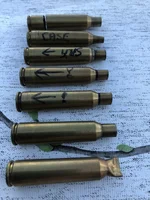

If anyone wishes I have several fotos ofcase failures andmy wondertool which I can post - just ask.
Yes please, always interested to see useful stuff.
Alan


Dengie Boy
Active Member
Very educational read for a newbie. Perhaps one day in the future I might have to try! 

Excellent article, informative and well presented. Here are some comments from a 60-year reloader. First, get a loading manual from one of the manufacturers of components, such as Norma, Hornady, Barnes, Berger, Lee and others. These manuals (worth it to get more than one) cover the reloading process, step-by-step, provide information on powder and bullet choices and give valuable statistical information. The entire process can involve only a few simple tools or an accumulation of multiple tools and pieces of equipment until you realize there is no end to stuff on which you can spend money. For lubrication I started with a jar of anhydrous lanolin and using my fingers would simply apply a thin film to the neck and shoulders of the cartridge case. But first I would dip the case neck into a small container of powdered charcoal. This would lubricate the inside of the neck, then lube the outside and then neck-size and deprime the case. Then I would put the case into a tumbler to clean it. Just my way, not necessarily the best way but it worked for me. As for priming I use a separate hand-priming tool, gives a better feel for seating the primer. As for seating the bullet, once consideration is fitting the bullet into the clip or magazine of your rifle. If seated too far out it may not fit. Also, if the bullet seated too far out it may stick in the rifling. Real bummer to have a bullet stuck in rifling, then open the bolt and pull it back only to realize your bullet is stuck and you have just spilled all the powder into your action...and now you need a cleaning rod to push out the bullet. Not much fun if you're hunting at the time. To measure acceptable seating depth take a sized but unprimed case, seat a bullet measuring the depth based on what will fit into your magazine. This works for hunting. If you're shooting single shots only and spending your time at the range, you can experiment with longer length cartridges. Helpful hints that have worked for me.

Fowler1990
Well-Known Member
Great write up. Many thanks


Moynish Ivy
Well-Known Member
Very well put together. Well done.

Hunterfisher
Well-Known Member
That is basically the methods I use too except I ultrasonic also. Not sure if there is any real noticeable benefits from ultrasonic tho as I have loaded with out ultrasonic and Not noticed anything different in accuracy. More for just making sure insides of my case is nice and clean and primer pocket.
Nice article
Nice article


Similar threads

- Replies
- 14
- Views
- 766
- Replies
- 17
- Views
- 915
- Replies
- 30
- Views
- 1K

