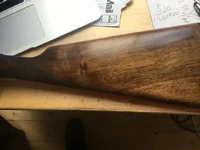
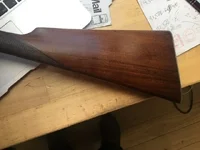
care of Stock on a wooden rifle

Ah, i see what you mean. it’s naturally very dark. The stock is made out of laminated solid black walnut and I darkened it further prior to giving it its first coat of oil when I first got it. I darkened it so that any deep bleed through of glue that may of happened during the pressing and gluing of the laminations would not show in the final finish. I’m quite happy with how it came out.
If I wipe it down with a turps meths and linseed oil cleaning solution that I have mixed up then it lifts all of the dirt etc straight out within a minute or so. I rarely need to do this though ( maybe one a year if I can be bothered) normally I just give the stock a good wipe down with a wet cloth and then buff it dry.
Kindest regards, Olaf
Hi Olaf, tried to ‘start a conversation’ with you, but I’m not allowed?
 
Cold-Pressed Linseed Oil

Cold-Pressed Linseed Oil
£6.99
  • A slightly yellow oil, which is extracted without the use of heat & dries slightly quicker than refined linseed oil.
    • Improves flow.
    • Increases gloss & transparency.
    • Reduces consistency & brushstrokes.
    • Ideal for grinding pigments.
 
I have done several finishes on stocks using nothing more than raw linseed oil with alkanut root to give it a reddish hue. During the initial finishing time is the critical factor. With early oiling's I thin with white spirit or turpentine so that it soaks in rapidly. The leave and leave it alone until it is hard. Then apply more oil and use the heat of your hand to rub it in until its almost dry, add a little more and rub it in again. Wipe off any excess and leave to dry for several days. Repeat. Eventually you will get a skin of dried oil on the surface - after perhaps ten coats.

Get an old plain white cotton shirt - that one you got married in several years ago is ideal - take some fine pumice powder and mix with a slurry of oil. Use this to polish off all the skin o the surface. Then use the cotton shirt to polish the stock. And then once a day for a week, once a week for a month and once a month for a year and then once every six months to a year thereafter a finger tip full of oil and polish this into the surface. And a few days after wards give it a polish with a cotton cloth.

This has worked for me and have used it on shotguns that are used out on the foreshore after ducks and geese. After use just wipe down with a damp cloth to get the mud, salt and blood off. Then dry with a towel. And I just wipe the stock over with a cloth once its dry before putting it away. I do exactly the same with my rifles - all bar one of which are wood and blued steel.
 
80% of 'letting in' done, donor stock was rem700, to fit a steyr prohunter! It's not going to win any prizes but its a fun project. If I mess it up Ive lost nowt as it only stands me £35:cool:
Lovely bit of figure on it.
Not sure if to use raw or boiled linseed oil on it tho:lol:..
 
I bought a wood stocked Sako 85 Hunter last year for deer hunting. Some days out can be pretty wet, and I had similar concerns about the stock. I just removed the barreled action and coated the stock with Tru Oil, both the external surfaces, and the inletting too. Gave it 8 coats in total. While I was at it, I gave the metal work a coat of Renaissance wax, so think it will be good now.
RT you well know the weather conditions we have in our deer country and I have to mention that with wooden stocks it is important to not seal them completely as wood being a 'live' material needs to breathe also.

I vote one for synthetics although I cream over figured wood.
 
Hi David, sorry but I've not read all of the posts on this because I'm a bit busy this morning but here is my answer. In case nobody has told you what to use (the proper method) I thought I'd best point you in the rite direction. Frankly, ignore all commercially available oils, they are ok but not up to the job in my opinion. I've been a bespoke furniture and cabinet maker for over 20 years now and whilst I do use the occasional pre made wood oil (for speed on cheap work) I genuinely stick to the old classics which work way better, they take a little time for the finish to build up but its a much deeper and lustrous finish which is easy to top up.
What you need to use for the 1st 3 wipe downs and then periodic cleanings thereafter is an even mixture of Turpentine (you will usually only find Turpentine substitute but this is fine to use), Methylated spirits, and Raw Linseed Oil, it has to be Raw Linseed oil, NOT Boiled Linseed oil. Just wipe the wood down with that and let it dry off a few times before using your main finishing oil which is a 20% Turpentine and 80% raw linseed oil mix. Apply that pretty much whenever you feel like it, let is 'dry' for a few hrs to a few days, in a warmish place and then buff it off well with a clean rag.
The good old chap who apprenticed me, now long, long gone, taught me that the rule of thumb for using raw linseed oil was "once a day for a week, once a week for a month, once a month for a year, and after that; whenever it needs it Boy"
The good thing with it is that its cheap, you can make it up anywhere if your travelling, it doesn't go all sticky and gooey, like many do, if you don't rub it back within an hour of putting it on, and it really penetrates the wood and hardens it off and builds up to a superb finish. It also doesn't stink and freak out everyone in your house and more importantly does not scare the Deer. All the other oils only go 'skin' deep because of the accelerators in them and cost loads of money. The Raw Linseed oil is the king of finishes an always will be, it just takes a little time to build up, seeing as your stock already has some of the lesser stuff on it, it won't take that long to get going though.
Just remember, oily rags can catch on fire spontaneously so dispose of them whenever your finished or lie them out flat in a well ventilated area.
Happy Hunting, Olaf


@Olaf , thank you for this guidance I have found this really useful, and have now done the three wipe downs and am a day away from completing the 'once a day for a week' with 80% raw linseed and 20% turps on a walnut stock that had already been stained but needed more oil. I have been wiping it down with that mix, leaving it for a few hours, then buffing it off. I can still see the open grain (very small pitting?) on the stock. Could you please advise whether to keep going with the daily routine for a bit longer than the original week? I have avoided any light sanding as you have not mentioned it...
 
@Olaf , thank you for this guidance I have found this really useful, and have now done the three wipe downs and am a day away from completing the 'once a day for a week' with 80% raw linseed and 20% turps on a walnut stock that had already been stained but needed more oil. I have been wiping it down with that mix, leaving it for a few hours, then buffing it off. I can still see the open grain (very small pitting?) on the stock. Could you please advise whether to keep going with the daily routine for a bit longer than the original week? I have avoided any light sanding as you have not mentioned it...
Hi, I’m pleased that you have taken the time to do it properly. Yes, you can do a bit more, play it by eye etc however, it will still build up Over time. Can you Post some pictures?
kindest regards, Olaf
 
@Olaf , thank you for this guidance I have found this really useful, and have now done the three wipe downs and am a day away from completing the 'once a day for a week' with 80% raw linseed and 20% turps on a walnut stock that had already been stained but needed more oil. I have been wiping it down with that mix, leaving it for a few hours, then buffing it off. I can still see the open grain (very small pitting?) on the stock. Could you please advise whether to keep going with the daily routine for a bit longer than the original week? I have avoided any light sanding as you have not mentioned it...

As Olaf has said keep going a bit more. You really want to get those pores blocked. Don't be in a rush to apply more oil though, I would leave it for a few days so the existing oils can harden up. Then keep going with the oil, but allow time to really dry between coats. Once its starts sitting above the surface, use some really fine pumice and oil and polish all that top layer off. You can use Jewellers rouge or other fine polish powder, indeed very fine wet and dry - however these are darker and tend to fill and pores with little black specs. Pumice is almost transparent.

Here is an AyA No 3 20 bore that a laquered stock which I stripped back. New finish is about a year old and has 20 plus oilings and polishings.
05165D17-CF54-48F4-9D88-1048542011E3.webp

And here is a little 410 that is part way through the process. Old finish was black with a cracked at the hand stock. Used washing up liquid, hot water to get the bulk of grime out, then acetone to clean up the hand prior to gluing. Needs more oil and polishing.
 

Attachments

  • 041F8C7B-9983-48FC-A06E-7BF3196BFFB9.webp
    041F8C7B-9983-48FC-A06E-7BF3196BFFB9.webp
    29.8 KB · Views: 26
Last edited:
Thanks for the replies, here is a picture of the stock as of today.

img] [img

I think you will be able to see the grain is still open at the moment?
 
I'm going to leave it for a few days now as @Heym SR20 suggests, then put on a few more coats as suggested by @Olaf . It seems to drink all the raw linseed oil in very quickly, and there is not much to dry off after an hour or two. I have seen suggestions saying 'work a few drops in by hand' but that doesn't seem to cover it, so I am putting a small dab of the 80/20 (raw linseed/turps) onto kitchen towel and then going over the whole of the rifle stock so it appears wet, and is slightly damp to the touch. Hope that is about the right thing to do.

I've had a look online and found some fine pumice powder (I'm guessing that is the right stuff as it mentions it is for french polishing). Havent bought any yet, will see where things get to before that.

Any comments/suggestions welcome :)
 
It the wood is very pourous you can use a mix of spa varnish and linseed oil to speed things up to getting to pores being filed. But next few coats don’t thin with turps. Do rub in by hand - it really fills the pores.
 
Thanks, I'll try rubbing raw linseed oil directly by hand, once I've given it a chance over the next couple of days to harden. I'll post as to how it goes!
 
Thanks, I'll try rubbing raw linseed oil directly by hand, once I've given it a chance over the next couple of days to harden. I'll post as to how it goes!
Don’t bother waiting for a few days, just get on with it. Personally, I would stick to the raw linseed and turpentine mix, not add anything else to it , and I wouldn’t use any abrasive powder.
You can give the stock as much oil as you want to, The wood will let you know when it’s had enough on it for the day because it won’t pull it in anymore. By the looks of your picture, you are not putting enough on. Id pour about 50ml on it and wipe it all over with a lint free cloth and then leave it to soak for an hour or two, then just take a clean and dry lint free cloth and rubber back.
Thanks, I'll try rubbing raw linseed oil directly by hand, once I've given it a chance over the next couple of days to harden. I'll post as to how it goes!
you don’t need to over complicate things, or wait, the stock just needs more oil, you cannot put on too much at this stage as long as you wipe all excess off after a couple of hours. The only reason for not drenching it is that it wastes oil as you will just rub the excess off and waste it. Put plenty on and rub it off and buff it well. Move on to once a week for a month In about 3 days time. All woods are different , some take in more oil and others require little to reach a grain filled state. On some furniture projects I’ve put on 3 or more applications of oil per day as the wood was very thirsty and Id have been there oiling it every day for weeks on end before moving on to the once a week for a month stage.
the first Phase of oiling ( the once a day for a week stage) is to ( for want of a better word ) to ‚ ‘saturate’ the wood. The second phase ( the once a week for a month stage ) is to Create a hard surface ‘film’ to the wood and polish it. The third phase ( the once a month for a year stage ) is to really fill and polish off the final top surface of the wood. The fourth and final phase of ( whenever it needs it) is to maintain and replenish the wood.
i never add anything to the linseed oil and turps mix like wax as it’s not needed and if it ever gets really dirty with grease or gun oil you can lift it off using methylated spirits. Wax would hinder this option. A raw linseed oil finish is relatively time consuming compared with fast drying finishes but it’s also the best and most durable , in my opinion.
you could just use the linseed oil neat and not thin it but it won’t soak in as well and won’t give you as good nor as durable a finish to the wood.
kindest regards, Olaf
 
Last edited:
So... I have put quite a lot more of the 80/20 Raw Linseed & Turps substitute for three days, wiping it on a leaving a relatively thick standing layer of oil. A lot of it was quickly absorbed over the first couple of days. The front of the handle is still drinking a bit, but yesterday afternoon the oil seemed to just sit on the stock without any significant absorption, which I think is a good thing. I buffed it off after about 1-2 hours each time. No glossy finish yet, but I think that is in line with @Olaf 's expectations above. Here are a couple of pictures in bright sunlight.

img] [img

I hadnt seen the light coloured lines until taking the photographs. I am guessing that this is where the raw linseed has filled the grain and is in the process of crystalizing?

img] [img
 
Having said that, I have noticed when I run my fingernail across the grain, there are still indentations, so I am wondering if the end point for the initial 'saturation' is when the surface feels smooth?
 
Back
Top